New Posts (Home)
 ChatBox
 Popular Posts
  Game Zone
 Top PodCasts


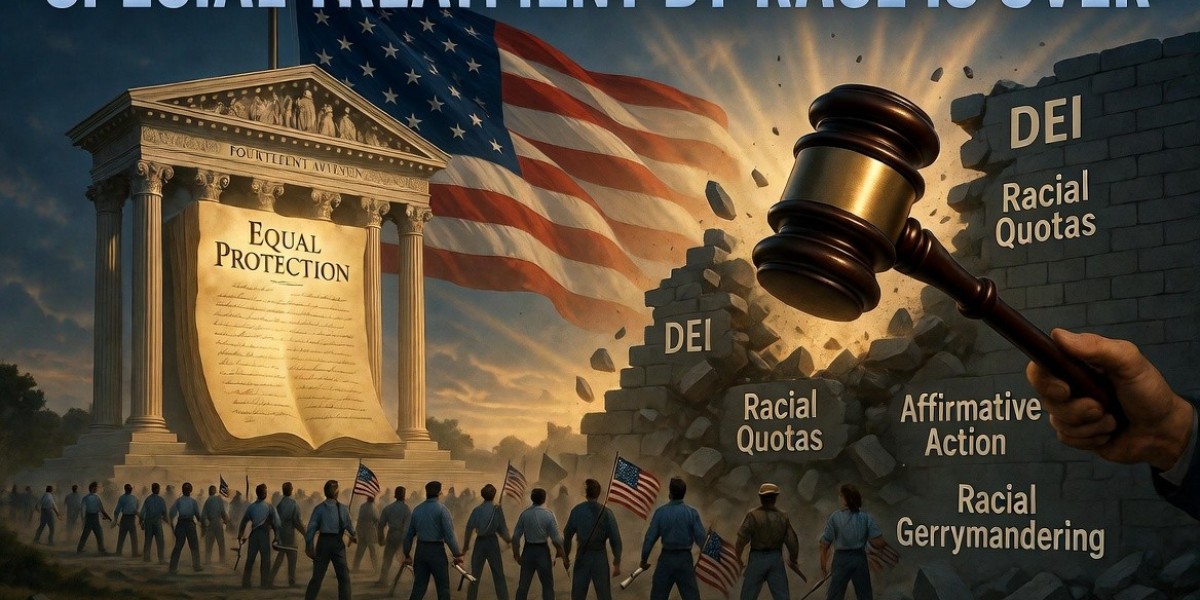
Fellow conservatives, patriots who still believe in the United States Constitution as written, it is time to cheer a long-overdue victory for sanity, merit, and true American justice. The era of government and institutions handing out special treatment based on race has finally met its constitutional end. No more racial quotas, no more preferences that punish Asians and Whites to boost other groups, no more DEI bureaucrats dividing us by skin color while pretending to heal division. Equal protection under the law means exactly that: equal. Not special. Not reverse discrimination dressed up as "equity." The Supreme Court drove a stake through the heart of this anti-American nonsense in 2023, and developments since have made clear it is dying across our universities, workplaces, and government. And now, in a fresh 2026 hammer blow, the Court has slammed the door on racial gerrymandering in voting districts too.
This is not some radical shift. It is a return to the colorblind principles that made this republic great. Liberals and socialists hate it because their entire power grab relies on pitting Americans against each other by race. They fostered grievance, dependency, and lowered standards for decades. But the American people, grounded in our founding documents, have had enough. The Constitution does not tolerate classes of citizens. It demands individuals be judged on character, effort, and achievement, not the color of their skin. As Justice Clarence Thomas has powerfully reminded us, the Constitution is colorblind.

Historic Context: From Noble Intent to Constitutional Abuse
Let us be clear on the history, because the left loves to rewrite it to justify endless special treatment. Affirmative action began in the 1960s with Executive Order 10925 from President Kennedy and expanded under Lyndon Johnson. The idea was to ensure federal contractors did not discriminate and to open doors closed by Jim Crow and earlier injustices.
After the Civil Rights Act of 1964 banned discrimination, some saw proactive steps as needed to remedy past wrongs. The Supreme Court in Regents of the University of California v. Bakke (1978) struck down rigid quotas but allowed race as one "plus" factor for diversity. Later, Grutter v. Bollinger (2003) upheld limited use in higher education, with Justice Sandra Day O'Connor noting such preferences should not last forever, ideally ending within 25 years.
What started as a temporary bridge became a permanent crutch and then a weapon. Universities created massive racial preferences. Asians faced higher standards for the same spots. Black and Hispanic students often received huge boosts, sometimes equivalent to hundreds of SAT points. This was not equality. It was state-sponsored discrimination against some races to favor others. It violated the Equal Protection Clause of the Fourteenth Amendment, which was ratified after the Civil War precisely to protect freed slaves from unequal treatment, not to create new favored classes.
By the 2010s and 2020s, this metastasized into the DEI monster: mandatory diversity statements for hiring, race-based scholarships, segregated graduations, and training that labeled Whiteness as problematic. Liberals cheered it as "social justice." Conservatives saw it for what it was: anti-American identity politics that undermined merit, excellence, and national unity. It conflicted directly with our traditional values of individualism, hard work, and E Pluribus Unum, out of many, one. Not out of many, divided by race.
The damage was real. Mismatched students struggled and dropped out at higher rates. Asian Americans, who faced real discrimination in history yet excelled through family and effort, were penalized. Standards in elite institutions fell. And the narrative of perpetual victimhood kept many from embracing personal responsibility, the bedrock of American family values and success.

The Parallel Battle: Ending Racial Gerrymandering in Voting Districts
This fight against race-based special treatment did not stop at college doors or job applications. Liberals tried the same trick in voting districts, drawing lines to guarantee outcomes by skin color instead of letting voters decide on merit and ideas. The history here traces straight back to the Voting Rights Act of 1965, a good law meant to smash real barriers to Black voting in the Jim Crow South. But by the 1980s, left-wing activists and courts twisted Section 2 of that act into a demand for proportional racial representation. The Thornburg v. Gingles test in 1986 basically told states they had to create "majority-minority" districts wherever possible to let racial groups elect their "preferred" candidates. That opened the floodgates to racial gerrymandering, where mapmakers carved up neighborhoods like a butcher shop, packing voters by race to rig elections.
The Supreme Court finally pushed back hard in Shaw v. Reno in 1993. North Carolina drew a congressional district so bizarre it snaked along an interstate for 160 miles, looking like a snake on the map, all to create a second Black-majority seat after the first one did not satisfy federal demands. Five White voters sued, saying this was nothing but racial segregation in reverse. In a 5-4 ruling, Justice Sandra Day O'Connor wrote for the majority that districts so oddly shaped they could only be explained by race must face strict scrutiny under the Fourteenth Amendment's Equal Protection Clause. Race cannot be the predominant factor in drawing lines unless the state proves a compelling interest and narrow tailoring. No more automatic racial balancing. The Constitution demands districts respect traditional principles like compactness, contiguity, and keeping communities together, not skin color quotas.
Later cases like Miller v. Johnson in 1995 doubled down: If race predominates over politics or other factors, the map is presumptively unconstitutional. Conservatives cheered these rulings as another step toward colorblind justice. But liberals never quit. They kept suing states under the Voting Rights Act, forcing more race-based maps that diluted the votes of everyone else to boost minority blocs. It was special treatment again, pure and simple, turning elections into racial headcounts instead of contests of ideas.
Fast forward to April 29, 2026, and the Supreme Court delivered another decisive win for the Constitution in Louisiana v. Callais. Louisiana drew a new congressional map with a second majority-Black district to comply with a lower court's Voting Rights Act order. Non-African American voters challenged it as a racial gerrymander. In a 6-3 decision written by Justice Samuel Alito, the Court struck the map down. Alito made it crystal clear: Section 2 of the Voting Rights Act did not require that extra district, so no compelling interest justified letting race predominate. The map was an unconstitutional racial gerrymander that violated the Equal Protection Clause. Justice Thomas, in a concurrence joined in part by Justice Gorsuch, went further, blasting decades of jurisprudence that treated racial groups as entitled to proportional seats. He called it a "disastrous misadventure" that divided the country into racial electoral blocs and repugnant to a colorblind Constitution.
Liberals are melting down, of course, screaming that this guts the Voting Rights Act and rolls back civil rights. What a load of socialist garbage. The Court did not kill the act. It simply stopped it from being a blank check for race-based engineering that ignores current conditions and real voter behavior. States like Alabama, South Carolina, and others are already moving to redraw maps without forced racial quotas. This is progress. It means elections will reflect the people's will, not bureaucratic racial bean-counting.
The 2023 Turning Point: Students for Fair Admissions
Thank God for the Supreme Court's ruling in Students for Fair Admissions v. Harvard and the UNC case. In June 2023, the conservative majority, led by Chief Justice Roberts, declared race-based admissions unconstitutional. The programs failed strict scrutiny. They used race negatively against some applicants, relied on stereotypes, and had no logical end point. Diversity as a goal could not justify discriminating by race.
This was a constitutionalist triumph. The Court rejected the left's view that some races need perpetual special help. It affirmed that students must be treated as individuals. Liberals wailed about "devastating impact" on minorities. They predicted doom. But reality, as always, exposes their failed ideology.

Recent Developments: The Preferences Are Waning Fast
By 2026, the shift is undeniable. Law school data shows racial preferences have diminished sharply since the ruling. At highly selective universities, Black freshman enrollment dropped significantly, around 18-27% at top schools, with Hispanic numbers also declining. Asian and White enrollment held or rose modestly.
A "cascade effect" occurred: Underrepresented minorities moved to state flagships and less selective schools, where their numbers often increased. This is not tragedy. It shows students attending schools where they are better matched academically, likely leading to higher graduation rates long-term.
President Trump's 2025 executive orders accelerated the end. He directed federal agencies to root out illegal DEI discrimination, revoked affirmative action mandates for contractors, and pushed merit-based opportunity. Many universities dissolved DEI offices. Diversity statements in faculty hiring plummeted. Affinity graduations got canceled at places like Harvard and Virginia Tech. The American Bar Association even voted to scrap its DEI rule for law schools.
In employment, the DOJ and EEOC warned against race-based hiring and training. States like Florida and Texas issued opinions declaring certain DEI practices unlawful. The backlash against this race-obsessed regime is strong and growing. Companies and schools are pivoting to economic disadvantage or individual experiences, not skin color.
And now with the Callais ruling, redistricting fights are intensifying across the South and beyond. Republican-led states are redrawing maps to end racial packing, while Democrats cry foul. This is exactly the constitutional correction America needed. No more special racial districts that treat voters as members of ethnic blocs instead of individual citizens.
This delights every patriot who knows America works when we reward excellence, not identity. Liberals scream "racism" at colorblind policies because they cannot win on merit. Their socialist schemes require government picking winners by race to maintain control and votes. But the data proves otherwise: merit-based systems lift everyone willing to compete.
Why Equal Means Equal: Constitutional Truths and American Values
The Fourteenth Amendment says "no State shall... deny to any person within its jurisdiction the equal protection of the laws." It does not say equal except for preferred races. Our founders, despite flaws, set a trajectory toward liberty for all. Abraham Lincoln fought to end slavery and preserve the Union under one law. Martin Luther King Jr. dreamed of children judged by content of character, not skin color. The left abandoned that dream for power.
Special treatment breeds resentment, mediocrity, and division. It insults the dignity of every individual by implying some groups cannot succeed without handouts. It conflicts with traditional family values that emphasize personal responsibility passed from parents to children. Asian Americans prove culture and effort matter more than victim narratives. Black Americans succeeding without preferences show the same. We should celebrate that, not undermine it with lowered bars.
DEI and racial preferences are anti-American to the core. They reject the melting pot for a salad bowl of grievances. They mock the Constitution's promise. And they waste resources on bureaucrats instead of real education or job training. Enough. Conservatives must demand full enforcement: no more hidden racial essays that game the system, no more federal funding for discriminatory programs. And no more racial gerrymandering that turns our elections into a skin-color spoils system.

Thought-Provoking Questions for Patriots
Fellow Americans committed to our republic, ask yourselves: If special racial treatment was truly helping minorities thrive, why did gaps in achievement persist for decades despite trillions spent and preferences enforced? Why do liberals panic at the idea of judging people equally, as individuals? What does it say about their view of certain groups? How can families instill pride and excellence when government signals some need perpetual help based on race? Why should voting districts be carved up by race when the Constitution demands equal protection for every citizen? And what action will you take in your community, school board, workplace, or voting booth to defend merit and push back against any lingering race-based schemes?
These questions reveal the bankruptcy of liberal ideology. They should fire you up to act, because restoring colorblind equality strengthens families, schools, elections, and the nation.
Conclusion: A Renewed America on Merit and Unity
The special treatment by race in the USA is over. The Supreme Court, Trump administration actions, shifting enrollment and hiring data, and now the Callais decision on voting districts confirm it. We are returning to the constitutional promise: equal treatment under law, opportunity for all based on effort, not identity. This is victory for traditional American values, for families raising children to compete and achieve, and for a united people under God.
Liberals and their socialist allies will keep fighting, because division is their oxygen. Mock their tears. Reject their guilt trips. Demand every institution comply with the Constitution. Support leaders who prioritize merit. Teach the next generation that America rewards strivers, not victims.
This restoration will make us stronger, more just, and truer to our founding. Equal means equal. No special favors. No racial balancing. Just Americans, pursuing happiness through God-given talents and hard work. The fight continues, but the tide has turned decisively. Stand firm, patriots. Our constitutional republic depends on it.