 New Posts (Home)
 ChatBox
 Popular Posts
  Game Zone
 Top PodCasts


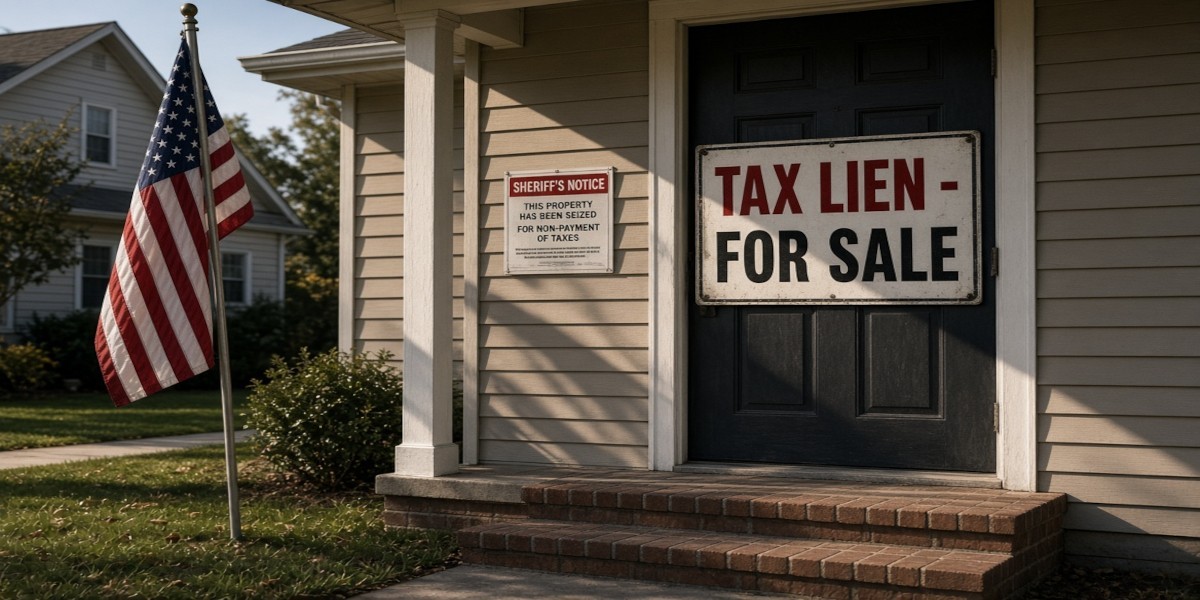
Here’s the straight facts on it, Patriots. Property taxes on private homes are a feudal holdover that turns paid-off family property into perpetual rent to local governments, and under the original understanding of the Constitution they were never meant to hit private citizens the way they do today.
While county property taxes aren't unconstitutional under the Supremacy Clause or the federal direct-tax rules, the whole concept sits in direct conflict with the Constitution's structure and the beliefs the Founders expressed about private property. The Constitution limited direct taxes on ownership for a reason. It treated the bare fact of owning land as something government shouldn't casually reach. James Madison said government exists to protect property as much as persons. John Adams declared that property is as sacred as the laws of God and that once people accept the idea it isn't sacred, anarchy and tyranny begin. George Mason listed the means of acquiring and possessing property among the inherent natural rights. Those men didn't write those words so counties could later claim a permanent annual interest in every paid-off house. The federal text made unapportioned direct taxes on land practically impossible for Congress. The Founders left states with reserved powers, but they never blessed a system that turns freehold ownership into a revocable lease from the local assessor. Counties now collect yearly rent on homes families already bought and paid for. That practice collides with the Founders' view that property rights are natural, not privileges the government can keep taxing forever. It's a standing claim of superior title that the original design rejected.
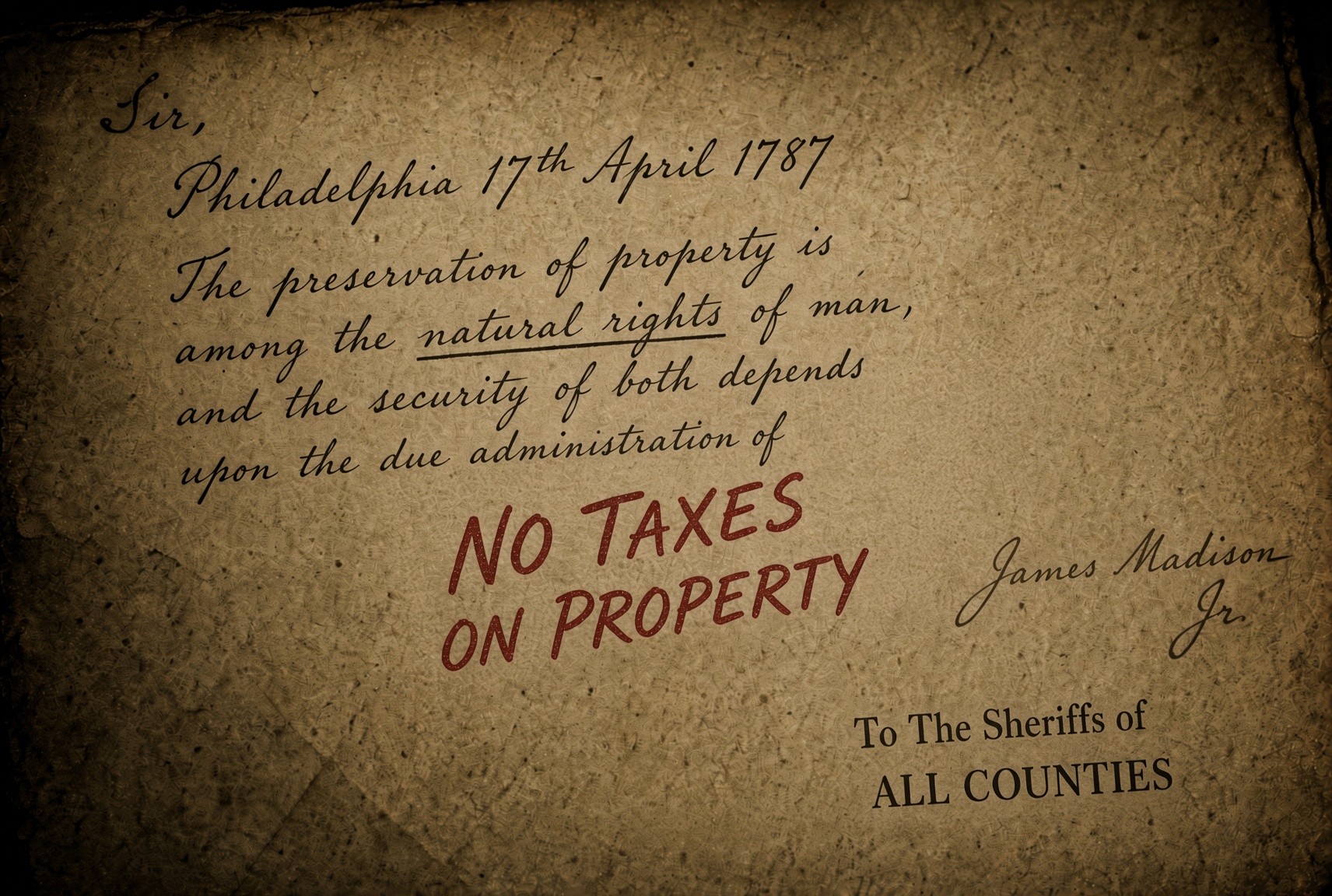
The Founders made their views on private property quite clear in both the Constitution and their private writings
The United States Constitution treats taxes on real property as direct taxes. Article I, Section 2 and Article I, Section 9 require that any direct tax levied by the federal government be apportioned among the states according to population. The Supreme Court confirmed in cases going back to the founding era and reinforced in Pollock v. Farmers' Loan & Trust Co. (1895) that a tax on land or the ownership of real estate is a direct tax. Federal property taxes have almost never been used precisely because apportionment makes them impractical and politically toxic. The Founders made direct taxes hard on purpose. They remembered British abuses and they understood that a tax that falls on the bare fact of ownership, rather than on some voluntary transaction or privilege, is the most dangerous kind of levy. Once a family pays off the mortgage, the house is supposed to be theirs. An annual county tax that can still seize it for nonpayment means the government never really surrendered its claim. That isn't the freehold system the Founders protected. It's a feudal leftover dressed up in modern statutes.
Property tax as we know it didn't originate in American constitutional thinking. It came from European feudal practice. After the Norman Conquest, William the Conqueror claimed ultimate title to all land. Those who held land owed duties, services, or payments to the crown. The early English rates and later colonial property taxes were measures of ability to pay or obligations tied to the land itself. Colonial New England levied rates on land, livestock, mills, and other visible assets. Southern colonies relied more on poll taxes and export duties. The general property tax of the 19th century broadened to cover nearly all wealth because in an agricultural society land and tangible goods roughly tracked ability to pay. Over time the tax narrowed to real estate while the claim of ultimate public ownership never went away. Today a family can pay off a 30-year mortgage, own the house free and clear, and still lose it if they fall behind on the annual tax bill. That isn't ownership. That is a long-term lease from the county, and the lease can be terminated for nonpayment of the rent. Liberals and the local-government machine love this arrangement because it gives them a reliable cash machine that doesn't require voters to approve every spending increase. Conservatives who understand the Constitution and the history of property rights know it is a standing violation of the principle that once you have paid for something, it is yours.

Local governments now use this system to seize homes over debts that are a tiny fraction of the property's value. Pacific Legal Foundation documented that from 2014 to 2021, localities and private investors foreclosed on more than 8,500 homes and extracted hundreds of millions of dollars in equity beyond the taxes owed. In Michigan, the Pung family lost their ranch-style home assessed near $194,000–$200,000 over a disputed tax bill of only about $2,242. Isabella County sold it at auction for $76,008; the buyer flipped it for $195,000. The Supreme Court took up related questions in the case in 2026, but the family still lost the home they didn't want to sell. In another Michigan case, Chelsea Koetter’s home was auctioned for $106,500 over a tax debt of $3,863.40, and the county kept the roughly $102,000 surplus. Tawanda Hall’s family home in Southfield was transferred and sold for more than $300,000 after a tax debt around $22,000. In Massachusetts, Ashley Mills faced the loss of a home worth about $230,000 over unpaid taxes of just $1,636.70. In Ohio, Cuyahoga County began seizing homes over debts as low as $620, with plaintiffs arguing the county took title to properties worth far more without compensating the owners for the equity. These aren't abstract statistics. These are families who worked double shifts, paid off mortgages, and still watched the county auction their life's work because they missed a payment or two after a medical bill or a job loss. The process is designed to be efficient for the government and investors who buy the tax liens. It is designed to be brutal for the homeowner.
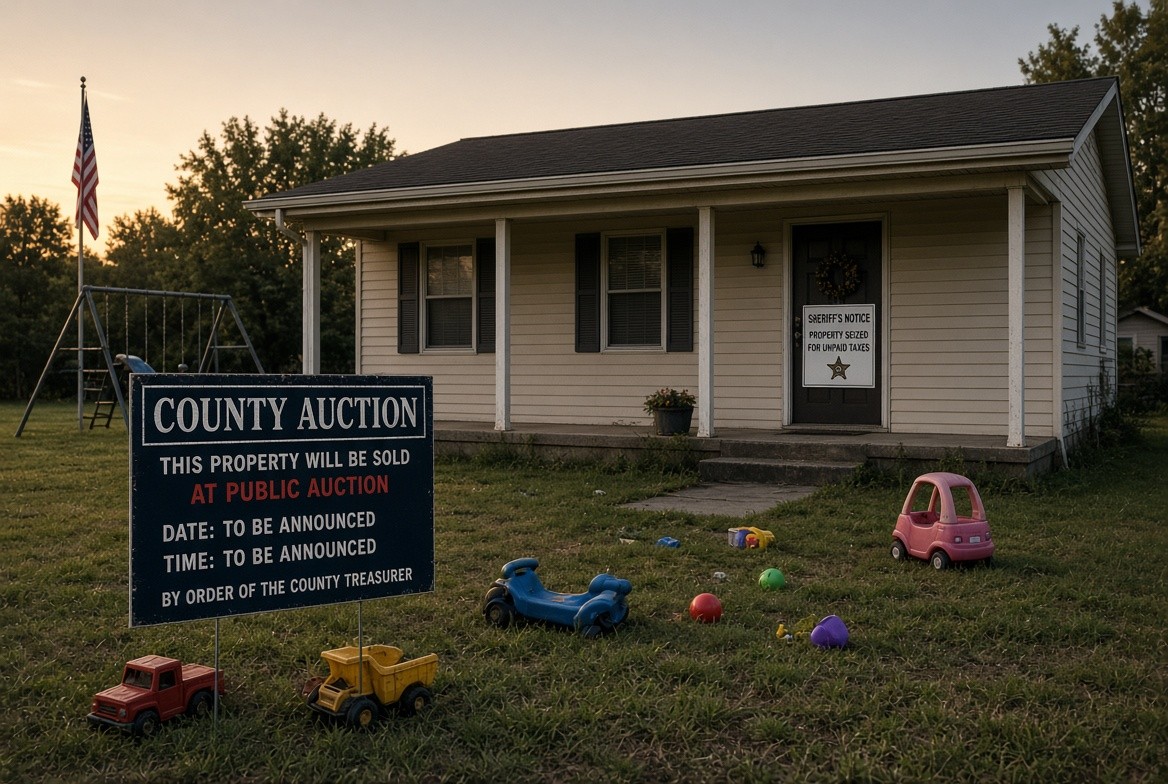
How can a free society condone a county auctioning a house for over $300,000 for a $22,000 tax debt and keeping all the profits while the original owner goes homeless?
Property taxes supply the bulk of local tax revenue in most of the country. Census and ITEP figures show property taxes account for roughly 70 to 75 percent of local tax collections nationwide and an even higher share in many school districts and smaller towns. Residential property generates most of that money simply because there are far more homes than commercial buildings. Lincoln Institute data for the largest city in each state show that commercial properties often face effective tax rates about 80 percent higher than owner-occupied homes, yet the sheer volume of residential assessments still means ordinary families carry the heaviest load. Classification systems in some places already shift more of the burden to commercial and industrial property, but the residential tax remains the reliable base that local politicians refuse to give up. They know commercial rates can be raised, business owners can contest assessments, and businesses can leave. Homeowners are stuck. Once the house is paid for, the only way out is to sell or lose it. That is why the machine keeps the residential tax alive even when commercial rates are already higher.

Rental properties belong in the same category as commercial ones. A rental house or apartment building is a business. It generates income for the owner. The landlord can deduct costs, raise rents, or sell the asset. It isn't a family's primary residence that they paid off through years of labor and sacrifice. Treating owner-occupied homes the same as commercial and rental properties ignores that difference. Counties should tax the productive, income-producing properties at rates that match the services those properties use. They shouldn't keep taxing the paid-off family home as if it were just another commercial holding. The distinction is straightforward. One produces cash flow. The other is the place people live after they've already bought it. Proper taxation of commercial and rental properties would capture the revenue from the enterprises that actually use local infrastructure for profit. That shift, paired with real spending cuts, removes any excuse for continuing the annual levy on private homes.
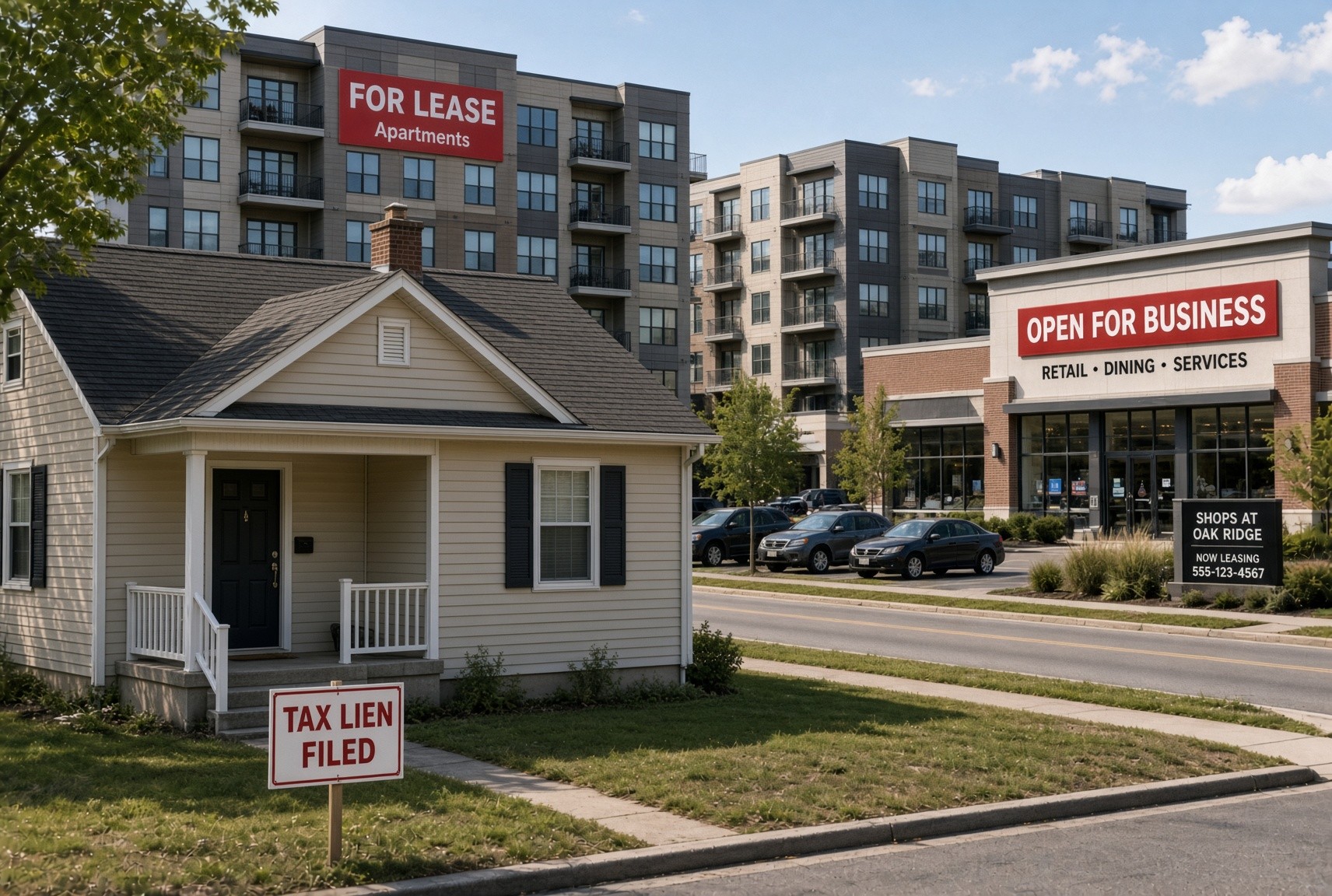
Commercial and rental properties generate income, private residences do not. They can NOT be treated the same.
Local governments don't need this money from private homes if they stop the waste, fraud, and plain corruption that runs through too many of them. Cato and other trackers have catalogued repeated scandals: New York City Housing Authority employees demanding bribes for no-bid contracts, Dallas council members taking cash to steer tax credits and loans, Los Angeles officials trading approvals for gifts, and smaller towns where clerks simply wrote checks to themselves. In Cook County there have been multiple property-tax assessment bribery investigations. Evanston, Illinois, spent millions of restricted motor-fuel-tax dollars without proper state approval. Across the country, tax-increment financing districts and other special mechanisms have been used to divert property-tax growth into favored projects while basic services lag. These aren't isolated mistakes. They are the predictable result of politicians who face weak oversight, strong public-employee unions, and voters who only notice the tax bill once a year. When the same people who set the budget also control the assessors and the collectors, the incentive is to grow the levy, not to cut the fat. Liberals call this investing in communities. Conservatives call it what it is: taking money from people who already paid for their houses so the machine can keep its friends employed and its contractors happy.

Proper taxation of commercial and rental properties, combined with real spending restraint, would eliminate any need to tax the family home. Commercial and rental property generates income. It is used in a business. The owner can pass costs to customers or tenants or deduct them as a business expense. A house occupied by the people who paid for it generates no such cash flow. Taxing it every year is simply a wealth tax on the middle class. In many cities the commercial effective rate is already substantially higher than the residential rate. Raising it further, or eliminating preferential treatment for certain business and rental properties, would shift the burden onto the enterprises that use local infrastructure and services most intensively. At the same time, forcing local governments to cut waste would free up hundreds of millions of dollars that are now lost to bribery, no-bid contracts, inflated pensions, and make-work projects.
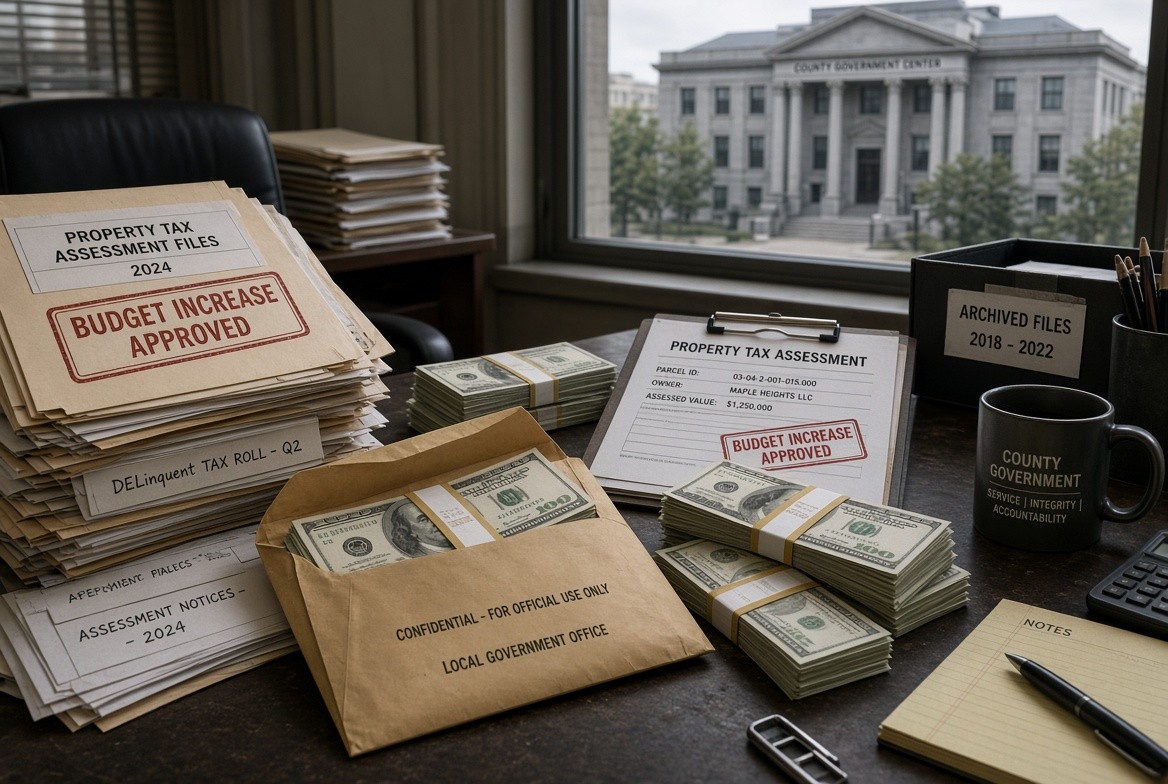
The budgets constantly get raised for pet projects, developer payoffs, extremely exorbitant pay raises for county officials, preferential treatment of certain types of businesses, and all sorts of non-essential waste yet residents are threatened with cuts to core services. It needs to stop.
The numbers are large enough that a combination of higher commercial and rental rates and lower total spending would allow states to phase out or sharply reduce residential property taxes without cutting essential services. The obstacle is political will. The machine that lives on the residential levy will fight any change that threatens its cash flow. That is exactly why the fight has to be forced from outside.
This isn't a technical dispute over assessment methods or exemption formulas. It is a fight over whether a free citizen can own his home outright or whether local government retains a perpetual claim that can be enforced by seizure. The Founders limited direct taxes and protected property rights because they understood the difference. Modern local governments have ignored that limit because it is convenient and because most people have been taught that property tax is just how we pay for schools and roads. Schools and roads can be paid for without turning every paid-off house into collateral for the next budget increase. The current system is a quiet expropriation dressed up as local self-government. It has to be dismantled.
How many more families have to lose homes they already paid for before people admit that an annual tax on the land under a paid-off house conflicts with the Founders' view of private property? If commercial and rental properties already face higher effective rates in most large cities, what concrete spending cuts would be required to let residential rates fall to zero? Why do local officials treat the residential property tax as untouchable while they expand budgets and tolerate documented waste and bribery? What would a true freehold look like if the only taxes that could attach to a house were those the owner voluntarily incurred through use or transactions? How long will conservatives keep voting for local candidates who promise to protect homeowners while the seizure process continues?
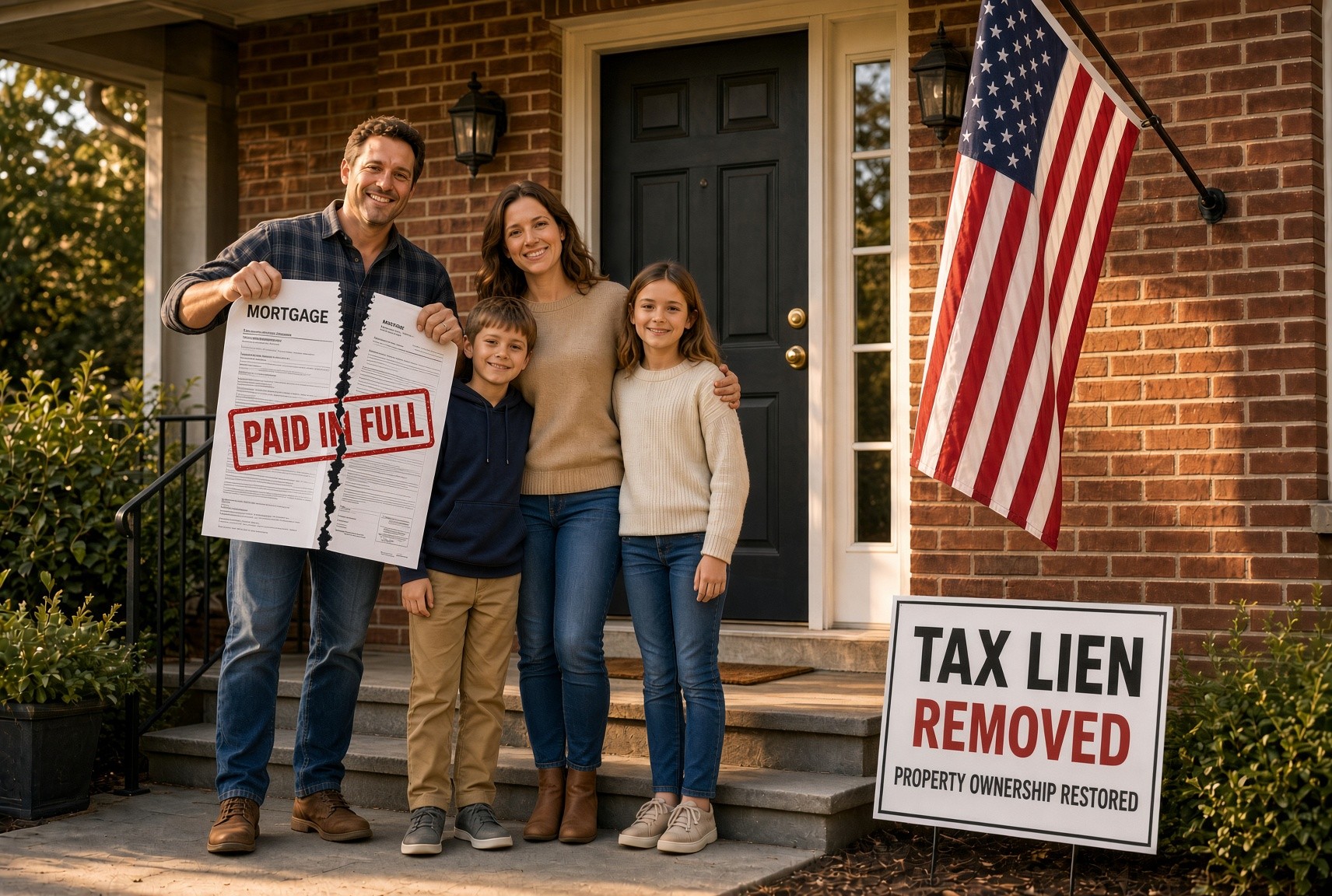
The land is paid for, the house is paid for, nobody owns it except who paid for it and nobody should be able to take it away.
The principle is simple. Once a citizen has paid for his land and house, the government has no legitimate claim to an annual rent on that property. The Constitution limited direct taxes on ownership. The Founders treated property rights as natural and fundamental. History shows the property tax grew out of feudal obligations, not out of American liberty. Local governments have turned the tax into a machine that seizes family equity over small debts and that funds waste and corruption. Taxing commercial and rental property at rates that match its use of public services, and forcing governments to stop the theft and the padding, removes any excuse for continuing the residential levy. Families who broke their backs to pay off homes worth real money shouldn't lose them for pennies on the dollar. That practice isn't revenue collection. It is robbery under color of law. End it.