www.thecollector.com
England’s Greatest Victory? The Battle of Stamford Bridge
In 1066, England’s future hung in the balance. There was a three-way war for possession of one of Europe’s most prosperous kingdoms. The first definitive stage of the conflict saw the last Anglo-Saxon king, Harold Godwinson, face the last true Viking leader, Harald Hardrada, at the Battle of Stamford Bridge in Yorkshire. What happened during that fateful battle, and how did it influence the subsequent face-off with William the Conqueror?
England: An Unsettled Kingdom
Edward the Confessor on the Bayeux Tapestry, c. 1070. Source: Bayeux Museum
It is tempting to think of England as a settled land before the tumult of 1066. However, England had endured centuries of conflict against Viking invaders. In 1013, the Anglo-Saxon House of Wessex was forced to flee England, leaving the Viking Sweyn Forkbeard to establish himself and his successors as the new kings of England. The Wessex dynasty returned in 1042, not through conquest, but because political marriages meant that Edward the Confessor was the closest male relative of Sweyn’s grandson Harthacnut when he died.
Edward’s reign, too, was far from peaceful. He had spent much of his formative years in Normandy and brought with him Norman customs and advisors, which infuriated the Anglo-Scandinavian elite. There was an ongoing power struggle between Edward and his most powerful Anglo-Saxon nobleman, Earl Godwin, which the king effectively lost when he tried and failed to exile the Godwin clan. When Godwin died, his son Harold took over his earldom. His younger brother, Tostig, took the earldom of Northumbria, only to have his own thegns rebel against him in 1065. With an eye on the future, Harold Godwinson positioned himself as Edward’s possible heir, staying loyal to the king, while Tostig was banished.
An Empty Throne: Death of Edward the Confessor
Harald Hardrada, from Lerwick Town Hall, Shetland. Source: Colin Smith via Geograph
In January 1066, Edward the Confessor died childless. The English nobles quickly proclaimed Harold Godwinson as king. William, Duke of Normandy, was hunting when he learned Harold had taken the throne. He erupted into a rage, believing both Edward and Harold had promised him the crown.
But another ruler also had his eyes on England. Harald Hardrada was the fearsome king of Norway, his name meaning “hard ruler.” An ambitious youth who embodied the Viking spirit, which is why he is often called the last true Viking. Hardrada traveled through Eastern Europe as a young man all the way to Constantinople, where he excelled in the Byzantine Emperor’s Varangian Guard. A skilled warlord, he had been trying to conquer Denmark since 1064, but with Edward’s death, he too turned his attention to England. He claimed that as part of Edward’s succession, the crown was promised to pass to Norway upon his death.
Drawing of a coin of Harald Hardrada. Source: University of Edinburgh
In 1066, Harald received a visitor at his court: an English exile claiming to represent Tostig. Tostig promised to support Harald if he chose to invade England. Harald needed little encouragement and began assembling a fleet. He left Norway in September on his flagship, the Serpent, with his banner known as the “Land Ravager,” and traveled around Shetland and Orkney to collect more troops. He also received 2,000 soldiers from the king of Scotland at Dunfermline.
Prelude: Battle of Fulford
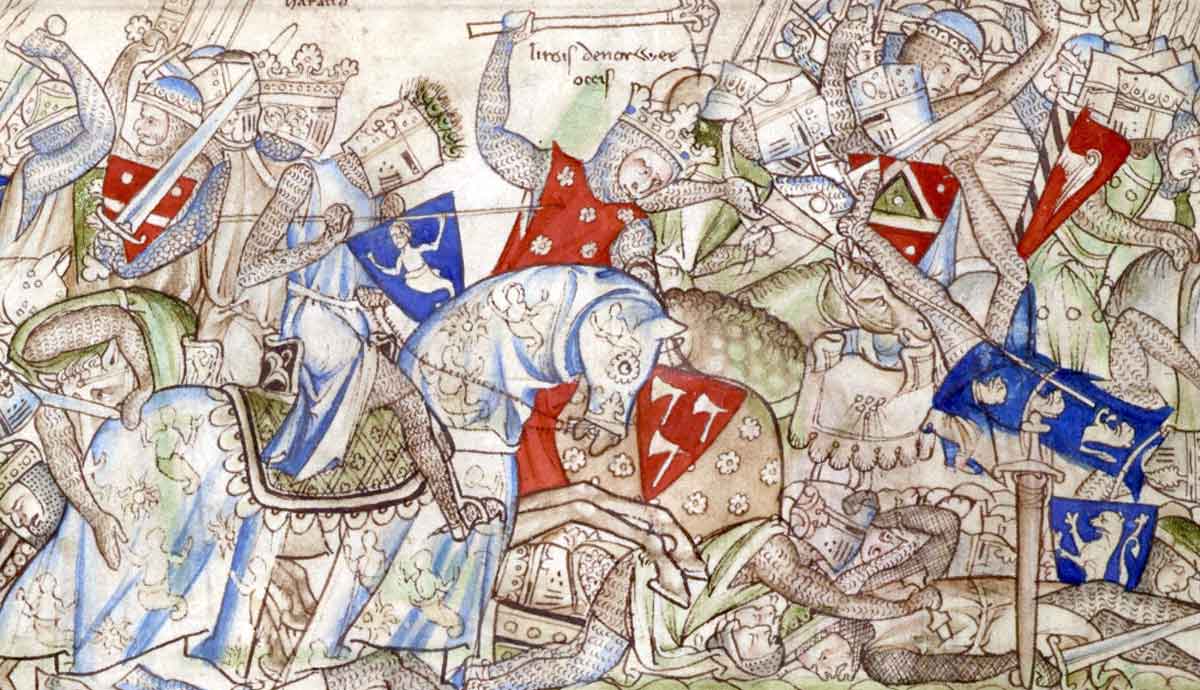
The Battle of Fulford, from The Life of Edward the Confessor, by Matthew Paris, c. 1236. Source: University of Cambridge
Harald and Tostig arrived on the River Tees and began raiding the coast. News of the raids reached the earls Morcar of Northumbria and Edwin of Mercia, who quickly raised the fyrd and met Hardrada and Tostig outside Fulford, a small village, to block their road to York. The smaller English army was defeated on September 20, and Hardrada marched victoriously onto the old Viking capital.
What happened in York is still somewhat perplexing. Somehow, the locals managed to persuade Hardrada that he was fine to leave the city unmolested and unguarded and that they would meet him later, at a location outside the city walls, to agree on who would rule the region in his name. They even managed to persuade him to exchange hostages—an equal number of Norse and English—as security. Hardrada duly took his hostages and supplies and left the city, returning in celebration to his fleet stationed at Riccall. There, they drank and feasted, mocking their English hostages, not realizing that they were being closely watched.
Stamford Bridge: The Site
Memorial stone near the presumed site of the Battle of Stamford Bridge. Source: Wikimedia Commons
Harold Godwinson had been stationed watching the southern coast for William of Normandy, but having heard of Hardrada’s landing, had marched 200 miles in barely five days. He arrived in Tadcaster, near the moored Norwegian fleet, on the same day that Hardrada arrived in York.
The sources name Stamford Bridge as the battlefield, although the original bridge no longer exists. This was where Hardrada and Tostig agreed to meet the men of York. Instead, they found Harold Godwinson and a new English army on the other side of the bridge. Whether through spies or simply by showing up, Godwinson had discovered that York was empty of Hardrada’s troops and marched straight through it to meet his foe.
Start of the Battle: The Hollow Shield
The battlefield at Stamford Bridge. Source: D.S. Pugh via Geograph
A single man rode up Hardrada and Tostig, giving no name. He offered Tostig his earldom back in the name of the king if he turned on Hardrada. Tostig snorted and asked what Godwinson would give the king of Norway for his trouble, to which the man replied, “Seven feet of English ground, as he is taller than other men.” After he left, Hardrada asked Tostig who the man was. It was, of course, Harold Godwinson himself.
According to the Heimskringla, the chronicle of the kings of Norway written around 1230 CE, Godwinson returned to his troops and rallied them:
“Advance! advance!
No helmets glance,
But blue swords play
In our array.
Advance! advance!
No mail-coats glance,
But hearts are here
That ne’er knew fear.”
Hardrada, hearing this, composed his own verse for his soldiers:
“In battle storm, we seek no lee,
With skulking head, and bending knee,
Behind the hollow shield.
With eye and hand we fend the head;
Courage and skill stand in the stead
Of panzer, helm, and shield,
In hild’s bloody field.”
The Battle of Stamford Bridge, from The Life of Edward the Confessor by Matthew Paris, c. 1236. Source: University of Cambridge
The bridge was a natural trap. The Vikings charged across the river against the larger English force but were driven back across. Following them over the bridge, the English were met with a single Norseman swinging a giant axe. The 12th-century historian Henry of Huntingdon writes that he killed 40 Englishmen alone, delaying the English advance and giving the Norse time to regroup. He was finally brought down when someone floated beneath the bridge and thrust a spear between the planks.
The Battle of Stamford Bridge: Victory
The Battle of Stamford Bridge, by Peter Nicolai Arbo, 1870. Source: Fine Art America
The English were now facing the Norse shield wall. They pressed hard against it but were unable to break through. On occasion, the Norse would break ranks and charge after their attackers, but “when they had broken their shield-rampart the Englishmen rode up from all sides and threw arrows and spears on them.” Hardrada was enraged with this and now threw himself into the thickest part of the fray, hewing down men with both hands and nearly driving the English into retreat.
Suddenly, an arrow struck Hardrada in the windpipe. He fell, as did many alongside him, perhaps also struck down with arrow fire. The Norse army retreated under its banner to Tostig. A great hush fell over the battlefield with the Vikings struggling to comprehend the death of their mightiest warrior. At this point, Godwinson again stepped forward and offered Tostig Northumbria and an escape to the other survivors. But, according to the Heimskringla, “the Northmen called out … that they would rather fall, one across the other,” resolving to die with their beloved king.
The Battle of Stamford Bridge, by Wilhelm Wetlese, 1899. Source: Wikimedia Commons
It was at this moment that Viking reinforcements arrived from the fleet. However, their hurried march had exhausted them. First, they dropped their shields, then threw off their mail altogether. The English downed the unguarded men. Others died of exhaustion. As day turned to evening, all the Viking chiefs and Tostig perished, and the army began to dissipate. Tostig’s body was found and given a funeral in York. Others were not treated so ceremoniously. Fifty years later, it was said that the field was still white due to the piles of bones of the dead.
Aftermath: Another Long March
Harold Godwinson in the Bayeux Tapestry, c. 1070. Source: Bayeux Museum
This stunning victory was a product of Harold Godwinson’s speed, cunning, and strategic mind. He had overcome a man feared throughout Europe. However, William of Normandy had landed on the southern coast. Godwinson, exhausted from the battle, was forced to immediately pull his shattered forces back together and begin the 200-mile march southwards. But having proven himself again to be one of Europe’s greatest military leaders, he and his thegns must have ridden tired, but confident, to face the Normans at the Battle of Hastings.








 New Posts (Home)
 ChatBox
 Popular Posts
  Game Zone
 Top PodCasts