www.thegospelcoalition.org
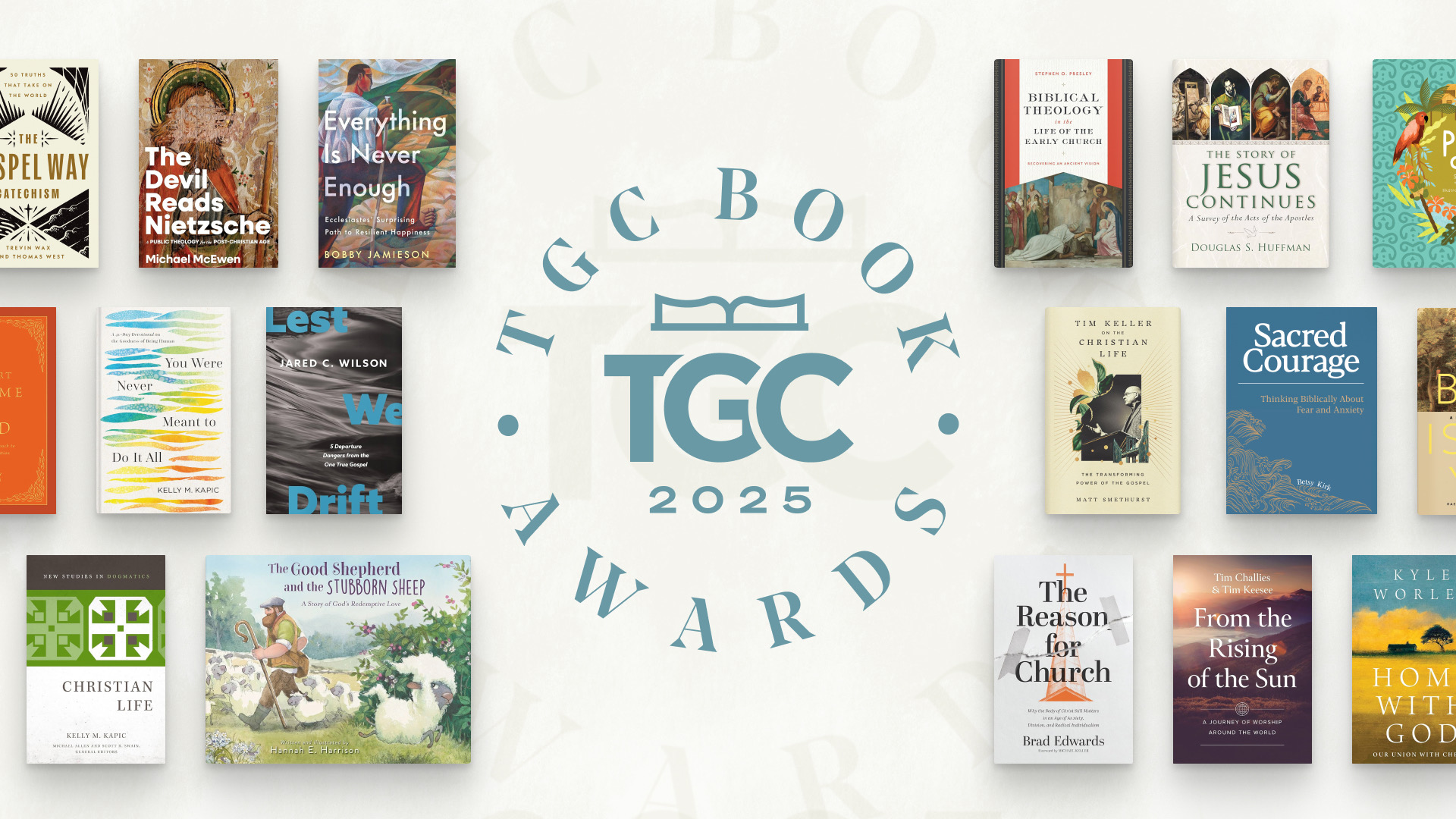
The Gospel Coalition 2025 Book Awards
In a November 1863 sermon on 2 Timothy 4:13, Charles Spurgeon extolled the value of reading for all Christians:
You need to read. Renounce as much as you will all light literature, but study as much as possible sound theological works, especially the Puritanic writers, and expositions of the Bible. We are quite persuaded that the very best way for you to be spending your leisure, is to be either reading or praying.
In the spirit of Spurgeon’s call, The Gospel Coalition’s annual book awards offer help identifying “sound theological works” for your enrichment. We work hard to identify some of the best evangelical books published each year.
This announcement is the culmination of months of hard work by a big team of book lovers. We receive nominations from publishers in 11 categories. Then our editors work together to recommend finalists in each category. Finally, a panel of judges reads each one carefully before casting their votes.
The books are evaluated for the way they
offer gospel-centered argument and application;
include faithful and foundational use of Scripture, both Old Testament and New Testament;
foster spiritual discernment of contemporary trials and trends; and
encourage efforts to unite and renew the church.
The result is a list of 22 books we recommend as helpful resources for the church and for individual believers. We hope you enjoy and are edified by them.
Additionally, at the bottom of this article, you’ll find books that TGC has published this year, which were ineligible for our book awards.
Congratulations to the winners of the 2025 TGC Book Awards.
Andrew Spencer
Books Editor
Popular Theology
Bobby Jamieson, Everything Is Never Enough: Ecclesiastes’ Surprising Path to Resilient Happiness (WaterBrook)
Everyone wants to be happy. You’re scanning these book awards because, in some small way, you think it could make you happy—whether now (by satisfying your curiosity) or later (when the book that caught your interest arrives on your doorstep or under the Christmas tree). Of course, we long for happiness in deeper ways too.
In Everything Is Never Enough, Bobby Jamieson puts the ancient wisdom of Ecclesiastes in conversation with an array of modern authors to guide our happiness quests. We know intuitively that one way to be unhappy is not getting what we most want. Another way, though, is getting all we could possibly want . . . only to discover everything is not enough.
With vivid imagery (think: life as a snow day), searching insight, and elegant prose, Jamieson offers brilliant medicine for our cultural moment. (You can also listen to Collin Hansen’s interview with Jamieson on Gospelbound.)
Award of Distinction
Matthew Bingham, A Heart Aflame for God: A Reformed Approach to Spiritual Formation (Crossway)
There’s a lot of talk these days about spiritual formation—some of it needed, but not all of it helpful. Matthew Bingham enters the conversation, urging us to remember and draw from our Reformation heritage, which brims with resources for growth.
Unpacking the “Reformation triangle”—Bible reading, meditation, prayer—he reminds us that the whole dynamic of experiencing God hinges on what God has revealed. The Bible, then, isn’t just “one tool among many in our spiritual formation toolkit.” It’s God’s “appointed means for communing with his people.”
Therefore, an eclectic, pick-whatever-works-for-you approach to spiritual formation may seem harmless, but it’s not finally reliable. By the power of the Spirit, God’s sufficient Word must remain the center—and driver—of vibrant piety and disciplined lives.
Judges: Joshua Chatman, Juan Sánchez, Matt Smethurst, Laura Spaulding
History and Biography
Matt Smethurst, Tim Keller on the Christian Life: The Transforming Power of the Gospel (Crossway)
At the heart of Tim Keller on the Christian Life lies a simple but profound conviction: The gospel changes everything. Matt Smethurst captures the essence of Keller’s ministry by tracing the key themes that shaped his preaching and writing—Christ in all of Scripture, sin as idolatry, the “three ways to live,” prayer, mercy, work, suffering, and friendship.
In each case, Smethurst weaves Keller’s insights together with pastoral verve and poignant application. In some chapters, especially when drawing primarily from sermons (e.g., friendship), Smethurst’s summary is tighter and more vividly expressed than even what Keller published on the subject, which is just about the highest compliment he could have paid Keller.
More than a study of Keller, however, this book serves as an invitation to the same gospel-centered vision that animated his life and ministry. It reminds us that Keller’s great love wasn’t for his own ideas but for the grace of Jesus Christ that transforms sinners into saints, enemies into friends of God.
Award of Distinction
Alex Fogleman, Making Disciples: Catechesis in History, Theology, and Practice (Eerdmans)
We’re always being catechized, whether we realize it or not. In Making Disciples, Alex Fogleman reminds us that the church has always been in the disciple-making business and that catechesis is one of the oldest and most effective ways to accomplish this goal. As he defines it, catechesis is the “basic but comprehensive instruction in what Christians believe, hope, and love.” Fogleman’s work is both a history of catechesis and a call for renewal today.
More than something for children’s ministry and family worship, catechesis is actually for the entire church at any and every stage of life—especially today when we can’t assume that basic moral frameworks and baseline biblical literacy are present. J. I. Packer wrote, “Where wise catechesis has flourished, the church has flourished.”
While this book will mostly appeal to pastors, ministry leaders, and students of church history, energy and attention spent on catechesis—in the course of one-on-one discipleship, the regular rhythms of a church service, instruction to the youth—will be amply rewarded as we seek to pass the faith on to the next generation.
Judges: Simonetta Carr, Nathan Finn, Ivan Mesa, Andrew Wilson
Cultural Apologetics
Michael McEwen, The Devil Reads Nietzsche: A Public Theology for the Post-Christian Age (B&H Academic)
Understanding the 19th-century German philosopher Friedrich Nietzsche is no small task. Engaging with Nietzsche in a way that introduces Christians to this philosopher thoughtfully is an immensely difficult task. Yet this beautifully argued book manages to do so. Readers learn from Michael McEwen how we can engage with the fundamental assumptions of skeptics and atheists in our post-faith age by evaluating the inadequacies of Nietzsche’s own wrestlings.
We need an apologetic that recognizes how even many who have never heard of Nietzsche still parrot his assumptions about power, morality, the spiritual world, and the death of truth, with devastating implications for bodies, minds, and souls. In kindness, wisdom, and firm conviction that this world needs Christ and the church, McEwen offers just this sort of apologetic, combining practical applications and answers for today with deeply learned examination of the consequential philosopher—and his failures.
Nietzsche lurks behind the ressentiment that fuels so many of our disputes by inverting how Christians value the weak. He’s worth the attention McEwen helps us give him. Nietzsche’s ideas have been too consequential to ignore or dismiss.
Award of Distinction
Trevin Wax and Thomas West, The Gospel Way Catechism: 50 Truths That Take On the World (Harvest House)
The Gospel Way Catechism is a welcome antidote to how younger generations are being shaped by the world today. The book faithfully contextualizes the Christian faith in a way that speaks to and contrasts with the dominant cultural narratives of our time. The authors took Tim Keller seriously when he said, “We need a counter-catechism that explains, refutes, and re-narrates the world’s catechisms to Christians.”
The Gospel Way Catechism does this not only by clearly explaining what Christians have long believed but also by comparing and contrasting our confession with the secular creeds of our age. Like Keller, the authors show how the gospel fulfills and subverts the stories we live by.
Each question the book offers and answers is composed through a gospel-centered lens that meets today’s objections, uses Scripture faithfully, and employs spiritual wisdom to name and respond to current social trends and ideas. Wax and West blaze a trail we need many more to follow.
Judges: Collin Hansen, Timothy Paul Jones, Eric Parker, Nadya Williams
Ministry
Jared C. Wilson, Lest We Drift: Five Departure Dangers from the One True Gospel (Zondervan Reflective)
Some books on ministry provide the timeless encouragement church leaders need to persevere; others issue warnings against complacency or illuminate cultural blind spots. Lest We Drift does both. Wilson warns that the Christian life isn’t static—believers either hold on to Christ as faith’s anchor or drift away from him into victimhood, spiritual dryness, superficiality, pragmatism, or legalism. To avoid these dangers, church leaders must grow in awareness of how drift occurs and actively resist it.
With cultural forces battering today’s church, it’s tempting to hold a funeral for the gospel-centered movement and succumb to trying to “win” socially or politically. Instead, Wilson calls church leaders to rehearse the gospel message and build on its firm foundation for ministry.
Using practical examples and biblical exposition, he inspires pastors to bolster their relationship with Christ through self-examination, community accountability, and ordinary spiritual disciplines. Wilson urges leaders to stay anchored in Christ, reminding us that faith in Jesus is both a daily commitment and a divine safeguard against spiritual shipwreck. His book is a timely message not just for a culture adrift but for the church, whose mission is at risk if we drift too.
Award of Distinction
Dave Harvey, The Clay Pot Conspiracy: God’s Plan to Use Weakness in Leaders (New Growth Press)
In a world that celebrates quick fixes and microwave success stories, believers need to confess this truth: Weakness and dependence on Christ are the way to true flourishing. Going forward in the Christian life means first going down into humility, suffering, and even death before we ever rise with glory, resilience, and strength.
Dave Harvey not only affirms this reality but, with wisdom, honesty, and even humor, shares personally how God has used suffering and grief to strengthen his faith. His pastoral exposition of 2 Corinthians in The Clay Pot Conspiracy invites ministers who have suffered loss, ministry failure, church hurt, or disappointed dreams to see their experiences as a source of strength.
Each chapter includes group discussion questions aimed at helping ministry teams support one another, grow through trials together, and finish their ministry race with strength.
Judges: Paul Gilbert, Jared Kennedy, Julie Lowe, Ronnie Martin, Jeremy Writebol
Christian Living
Betsy Kirk, Sacred Courage: Thinking Biblically About Fear and Anxiety (William Carey)
Everyone is afraid of something. Most of us are a constant jumble of fears both small and great—from snakes and spiders to cancer and divorce. We’re fearful for ourselves, for our loved ones, and even for our society as a whole.
Betsy Kirk’s Sacred Courage can help all of us. She shares wisdom gleaned from her own battles with fear as she guides us through Scripture to help us understand the nature of our anxieties. Looking back to saints of old and forward to the hope of eternal life in Christ, Kirk helps us put our fears in perspective so we can meet our day-to-day challenges with Christian courage.
Ultimately, this book draws readers into communion with the Lord, who says to us again and again, “Do not be afraid.” Sacred Courage is a practical and comforting guide both for personal growth and for supporting others who wrestle with fear.
Award of Distinction
Ian Harber, Walking Through Deconstruction: How to Be a Companion in a Crisis of Faith (IVP)
The world is constantly challenging Christians to question their faith and abandon orthodoxy. Thus, it’s no surprise that the word “deconstruction” has entered our everyday vocabulary. From famous Christians to members of our own families, most of us have encountered someone who is deconstructing. But what does that actually mean?
In Walking Through Deconstruction, Ian Harber clearly defines and explains the process of deconstruction and reconstruction as he tells the story of his own crisis of faith and path back to Christ and the church. With thoughtful use of Scripture and insightful cultural analysis, Harber engages those navigating deconstruction with grace and truth. He also equips people who love them to create environments that encourage reconstruction.
Whether you’re a church leader, a concerned family member or friend, or a person experiencing a crisis of faith, this book is a timely and practical guide.
Judges: Kristie Anderson, Matt Boga, Winfree Brisley, Megan Hill
First-Time Author
Brad Edwards, The Reason for Church: Why the Body of Christ Still Matters in an Age of Anxiety, Division, and Radical Individualism (Zondervan Reflective)
There’s no shortage of reasons why people stop going to church. But in an age of dechurching, what are the reasons for church? Brad Edwards’s The Reason for Church offers a compelling and timely overview of why church-skeptical people shouldn’t forsake the weekly gathering. Edwards reminds readers that the church isn’t only essential but also a beautiful and good gift from God.
This book helps church leaders better recognize the contemporary dynamics undermining local-church commitment. Edwards skillfully diagnoses the problem, weaving technological critique and cultural analysis into his overall assessment. But he also helps readers think through how to respond in ways that apply the gospel to cultural idols and foreground the beauty of Christ’s Bride.
As a pastor himself, Edwards writes in an engaging and personal way. He doesn’t wag fingers at church-skeptics but rather shows them why the reasons for church are ultimately more convincing than the reasons against it.
Award of Distinction
Kyle Worley, Home with God: Our Union With Christ by Kyle Worley (B&H)
In Home with God, Kyle Worley explores the meaning of the often overlooked doctrine of union with Christ. With clear exegesis and pastoral warmth, Worley traces this doctrine through redemptive history to show that the heart of the gospel is an invitation to dwell with God.
The book not only expounds this truth from Scripture but also demonstrates its practical effect on daily life. Readers will be refreshed and encouraged as they learn—or are reminded—that the Christian life is about living with and in God. Home with God is a biblically rich book that deepens our understanding of the glorious reality of being in Christ and stirs our longing for his return.
Judges: Megan Dickerson, Audrey Finken, Brett McCracken, Walter Shaw
Children’s
Hannah E. Harrison, The Good Shepherd and the Stubborn Sheep (Zonderkidz)
“Hello, I’m George.” The Good Shepherd and the Stubborn Sheep introduces readers to a little sheep with wild hair who decides to run away from his shepherd rather than submit to a haircut. When poor George ends up lost and in danger, smelling (and looking) like moldy cheese, his brave and gentle shepherd finds and saves him anyway.
Through charming illustrations and witty narration, readers experience the absurdities and perils in a sheep’s life. Sheep are pretty clueless, but so are we. Based on Isaiah 53:6 (“We all like sheep have gone astray . . .”), this feels like a humbling (but fair) indictment. “It’s embarrassing, to say the least,” George tells us when he gets stuck on his back with his feet in the air. “That’s why we need a Shepherd.”
Many children’s picture books seem designed with only half their audience in mind, but this one will delight parents as well as children. The Good Shepherd and the Stubborn Sheep reminds us that sometimes we can learn deep, even hard, truths with laughter.
Award of Distinction
Steve Richardson with Maxine McDonald, illustrated by Sarah Nunnally, Perfect Peace Child (Mission Kids)
An island shaped like a dinosaur. Crocodiles. Canoes. And cannibals. In the 1970s, missionary Don Richardson told a true story about murder and betrayal in the jungles of New Guinea in his best-selling book Peace Child. Now his son retells the adventure as a picture book for older children.
Steve Richardson writes from his childhood perspective as he traveled with his parents along the Kronkel River to share the gospel with the Sawi people. The Sawi in the story are masters of jungle survival but have no interest in Christ. They admire only one character in the gospel story: Judas, for his clever treachery. The Richardsons cannot seem to find a way to compellingly communicate the goodness of the peace that comes from following Jesus, until one day they witness a Sawi ritual that changes everything.
Children today won’t have to travel halfway around the world like the Richardsons did to encounter cultural differences . . . or to meet with indifference to the gospel. Perfect Peace Child reminds readers that the gospel is both unchanging and still applicable to human lives and cultures everywhere, across the world or across the street.
Judges: Ginger Blomberg, Joe Carter, Betsy Childs Howard, Shar Walker
Theological Studies
Stephen O. Presley, Biblical Theology in the Life of the Early Church: Recovering an Ancient Vision (Baker Academic)
In this enjoyable work, Stephen Presley bridges the worlds of patristic interpretation and contemporary biblical theology with depth, clarity, and grace. Rejecting the modern tendency to treat hermeneutics as a mere set of procedures, Presley reminds readers that interpretation isn’t mechanical but theological, spiritual, and ecclesial.
When we look closer, it’s clear that in the early church, Scripture, the rule of faith, and liturgy worked together toward a common purpose: communion with the triune God. Commitment to Trinitarian theology and spiritual reading in the early church was never an artificial imposition on the text but a faithful expression of reading within the life of God’s people.
Presley’s engagement with both ancient and modern sources—from Origen and Augustine to Hans Boersma and Charles Taylor—is impressively wide-ranging, yet the prose remains accessible and compelling throughout. By bringing patristic interpretation into conversation with the modern biblical-theology movement, Presley provides a needed bridge across contemporary hermeneutical divides.
Scholarly yet deeply pastoral, this book distills the early church’s interpretive wisdom and calls readers to recover a way of reading Scripture that’s both theologically rich and spiritually transformative.
Award of Distinction
Kelly M. Kapic, The Christian Life (Zondervan Academic)
Kelly Kapic’s Christian Life is a masterful work of dogmatic theology that illuminates the beauty and coherence of life in and with Christ. With theological fluency and remarkable clarity, Kapic weaves historical and contemporary sources to present a fully Christ-centered vision of Christian life.
At the heart of this vision is the hypostatic union: Jesus Christ isn’t only the God we worship but also the perfect human in whom we worship God. Kapic also emphasizes the necessity of God’s Trinitarian life for our salvation, showing how Father, Son, and Spirit together shape and sustain the believer’s life within the communion of the church.
The book addresses the real pressures, sins, and confusions that complicate human life, helping readers navigate the challenges posed by the world, the flesh, and the Devil. Situating Christian life within the dynamic of God’s saving mission, Kapic demonstrates how life begins in the Father’s love, is given in the Son’s incarnation, and is experienced in the Spirit’s abiding. Christian life, he shows, is a manifold participation in this love, with Jesus Christ as both mediator and model of properly human life.
Beautifully integrating doctrine and devotion, this book is theology lived—gospel-normed, church-shaped, and fully for the flourishing of Christian life.
Judges: Rafael Bello, Robbie Griggs, Andrew Spencer, Christy Thornton
Biblical Studies
Douglas S. Huffman, The Story of Jesus Continues: A Survey of the Acts of the Apostles (Zondervan Academic)
This remarkable introduction to Acts combines the features of a commentary with a robust treatment of the background and setting of the apostolic age. Replete with vivid photos of biblical sites, archaeological finds, manuscripts, and charts, The Story of Jesus Continues points readers to the cultural and historical context of Acts.
The exegetical conclusions are sound. Huffman excels at explaining the text of Acts and illuminating the broader first-century backdrop of Jesus and the early church. The book’s 16 chapters make it ideal for a college classroom, and its well-written and accessible prose creates an opportunity for use in the local church. Readers get a sharp focus on the meaning of Acts. They also get helpful examples of application of the main ideas in a modern setting with various “projects” suggested at the end of each chapter.
In doing so, Huffman reminds us that the mission begun in Acts still calls the church to bold witness today.
Award of Distinction
L. Michael Morales, Numbers 20–36 (Apollos)
Michael Morales’s Numbers 20–36 is the fruit of 10 years of labor from one of the best biblical theologians in the church today. This second installment of a two-volume commentary combines detailed exegesis of the Hebrew text with compelling analysis of the literary structure, while sharing insights from the Jewish tradition.
Morales’s commitment to biblical theology shines throughout as he situates the message of Numbers within the larger framework of the Pentateuch and Scripture’s storyline. This commentary will help pastors and Christians discover that Israel’s journey through the wilderness is “a paradigm for God’s people in every generation.” Just as Israel needed to learn to follow the voice of their Shepherd, YHWH, through the wilderness, so too God’s people today must learn to persevere in faith during their pilgrimage through the wilderness until they reach their journey’s end.
Judges: Matthew Emadi, Benjamin Gladd, Bruce Henning, Ronni Kurtz
Devotional Literature
Kelly M. Kapic, You Were Never Meant to Do It All: A 40-Day Devotional on the Goodness of Being Human (Brazos)
Kelly Kapic’s You Were Never Meant to Do It All is an invitation to exhale and embrace our limitations as a gift from God. His gospel-centered content is good news for those of us who live in a hustle culture and constantly need to validate our worth based on our productivity. This devotional is filled with Scripture-rich entries and thoughtful quotations. It’s laid out in an accessible, reader-friendly format.
We all need daily reorientation because we’re prone to forget that God is God and we aren’t. And in the world of expressive individualism that has led to an epidemic of loneliness, this timely work also reminds us we aren’t alone in our weakness. As we feel our need for God, this devotional moves us toward greater dependence on him and gracious interdependence with others.
This resource is a wonderful guide for those who want to taste the goodness of refusing to run so hard and so fast and to simply rest within our limits, knowing God is limitless.
Award of Distinction
Raechel Myers and Amanda Bible Williams, The Bible Is for You: A Devotional Journey Through Every Book of the Bible (B&H)
Whether we’re fearful of the future or grateful for the good in life, we all need to be reminded of what this title teaches: The Bible is for you.
This devotional guides readers through the entire Bible in a way that feels accessible and inviting. Its meta scope—spanning the whole Bible and punctuated with micro reflections on individual verses, complemented by texts from both the Old and New Testaments—helps readers build a coherent narrative framework. Understanding the big story of the Bible equips us to see and reframe the stories God is writing in our lives. That perspective is a gift for any Christian.
The Bible Is for You is beautifully formatted, laying out deep truths alongside wide margins that invite personal reflection. The relatable devotions offer a “taste and see that the LORD is good” approach to whet our appetite for further feasting on God’s Word (Ps. 34:8). This book offers a delightful introduction for a new believer and a refreshing reminder of the wonder of Scripture for a seasoned Christian.
Judges: Missie Branch, Karen Hodge, Christine Hoover, Joanna Kimbrel
Missions and the Global Church
Tim Challies and Tim Keesee, From the Rising of the Sun: A Journey of Worship Around the World (Zondervan)
From the Rising of the Sun offers a deeply edifying vision of the global church. Through vivid storytelling and theological insight, Tim Challies and Tim Keesee carry readers across 12 time zones, introducing them to diverse congregations whose worship reflects both the robust unity and the beautiful diversity of the body of Christ.
Each chapter blends travel narrative, vignettes from local church life, and stories from Christian history. Readers are drawn into the richness of gospel-centered worship expressed in cultures around the world.
Far more than a travelogue, this book emphasizes sound doctrine, showing how faithful believers across nations proclaim the same gospel in wonderfully varied ways. At the center of this apology for global missions is the glory of God and the spread of the gospel to the ends of the earth. With contagious enthusiasm and deep affection for the church, From the Rising of the Sun points us toward the worldwide worship of the risen Christ as it stirs our hearts to join in.
Award of Distinction
D. Scott Hildreth, A Short Guide to Evangelism and Missions (B&H)
Am I really responsible for the whole world? By what authority do we go? Who are we trying to reach? What about other gods? What is the missionary task? These aren’t just rhetorical questions—they’re ones that can overwhelm Christians trying to figure out their role in fulfilling the Great Commission (Matt. 28:18–20).
In A Short Guide to Evangelism and Missions, Scott Hildreth offers concise yet compelling answers, encouraging a new generation to embrace the call to get the gospel to the nations.
Although the world has changed, God’s mission hasn’t. Through this engaging question-based format, Hildreth writes as a seasoned teacher, drawing readers into lively, faith-deepening conversations. With clarity and conviction, Hildreth calls believers back to our central task—making disciples of every tribe and tongue and nation for the glory of God.
Judges: Keelan Cook, Anna Daub, Conrad Mbewe, Andrew Spencer
Our mission at The Gospel Coalition is to help renew and unify the contemporary church in the ancient gospel. We do that through conferences, articles, podcasts, book reviews, and even the book awards. We also publish books.
Since our editorial team is involved in their production, these books are ineligible for our book awards. But we’re excited about these 2025 volumes intended to serve church leaders:
1. Collin Hansen, Skyler R. Flowers, and Ivan Mesa, eds., The Gospel After Christendom: An Introduction to Cultural Apologetics (TGC Store | Amazon)
2. Brett McCracken and Ivan Mesa, eds., Scrolling Ourselves to Death: Reclaiming Life in a Digital Age (TGC Store | Amazon)
3. Matthew McCullough, Remember Heaven: Meditations on the World to Come for Life in the Meantime (TGC Store | Amazon)
4. Jeremy Writebol, Make It Your Ambition: Seven Godly Pursuits for the Next Generation (TGC Store | Amazon)
5. Rebecca McLaughlin, How Church Could (Literally) Save Your Life (TGC Store | Amazon)
6. Kathryn Butler, Sonia and the Biggest Block Tower Ever (TGC Store | Amazon)
7. Collin Hansen, Where Is God in a World with So Much Evil? (TGC Store | Amazon)
8. Timothy Paul Jones, Did the Resurrection Really Happen? (TGC Store | Amazon)
9. Hans Madueme, Does Science Make God Irrelevant? (TGC Store | Amazon)
10. Winfree Brisley and Sharonda Cooper, Turn Your Eyes: A Bible Study on the Psalms (TGC Store | Amazon)








 New Posts (Home)
 ChatBox
 Popular Posts
  Game Zone
 Top PodCasts