www.optimistdaily.com
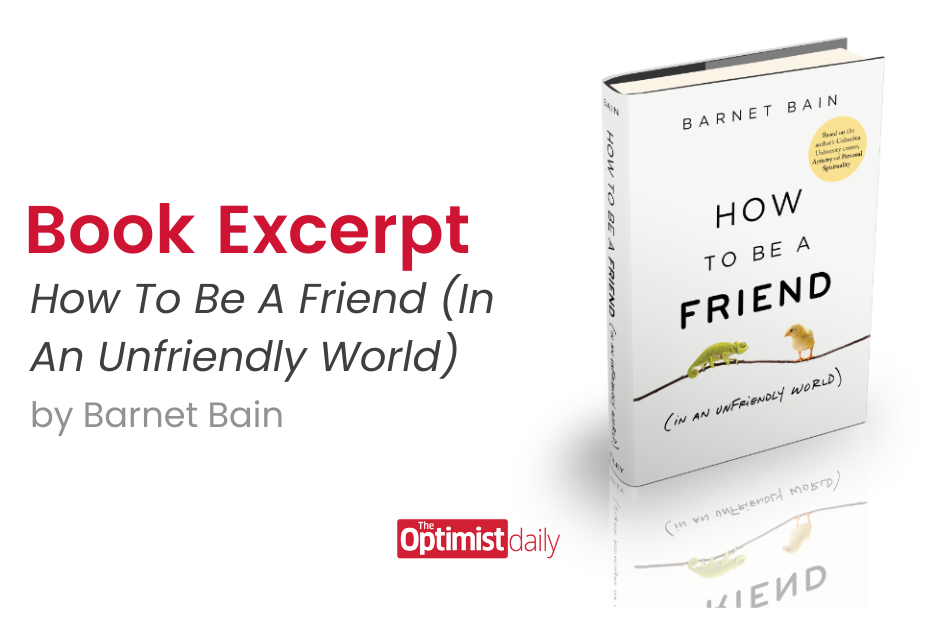
Book Excerpt: How To Be A Friend (In An Unfriendly World) by Barnet Bain
How To Be A Friend (In An Unfriendly World) by Barnet Bain
At The Optimist Daily, we believe that real, tangible change often begins with the simplest acts of humanity: listening deeply, showing up for one another, and choosing connection in a world that feels increasingly divided. That is why we are delighted to share an excerpt from How to Be a Friend (in an Unfriendly World), the forthcoming book by award-winning filmmaker and educator Barnet Bain.
Drawing on decades of creative work and his teaching on the psychology of connection, Bain explores friendship not just as a soft skill but as a powerful, practical pathway to personal and collective wellbeing. His message that friendship is both a refuge and a catalyst for healing resonates deeply with our ethos as a solutions-focused publication. At a time when so many people are seeking belonging, clarity, and compassion, Bain’s work feels not only timely, but profoundly needed.
If you’ve found yourself longing for more depth, kindness, and warmth in your relationships, then this is the book for you.
Preorder a copy for yourself here (and one for a friend who could use a meaningful read this holiday season). The book is scheduled to be released soon on Tuesday, December 9th.
Barnet kindly shared the introduction to his book with us. Read on for a preview!
Introduction
This book is for anyone who’s ever needed a friend—that is to say, everyone. Whether you’re a teenager figuring out who your people are, a young adult navigating new cities and shifting circles, or someone in midlife or beyond, wondering what happened to the closeness you once felt—this is for you. Friendship isn’t a phase we outgrow or a luxury reserved for the lucky; it’s a human need. At every age, we long to feel seen, known, and supported. This book offers tools, stories, and reminders for building and sustaining that kind of support—starting with yourself and reaching out from there.
When you think about the greatest gifts of your life so far, I have no doubt that the friends you have known and loved over the years figure prominently. Friends from childhood and college days. Friends you’ve met in adulthood, through your work and other avenues. Next to my extraordinary wife, Sandi, and my daughter, Sophie, my friends are some of the other great loves of my life. For each of us, these are the people we have shared some of our most soulful moments with—laughing heartily, sharing enthusiasm for new projects we’re working on, asking for input on big decisions, sitting in silence with each other when grieving or afraid. The value of friendship is unquantifiable, and the beauty of friendship… ineffable.
What you will find in these pages isn’t a typical take on friendship. We will take an inside-out approach, looking at what it takes to be the kind of friend we value in others, and we will head into new territory as well. Together, we will explore friendship as both a pathway to healing the emotional wounds of the past and a portal to awakening in the present—to experiencing life more fully and wholeheartedly than we previously thought possible.
Where we find ourselves today, with our human family facing what some are calling polycrises—the intricate, overlapping issues of our time—signals a potent opportunity to lean in to friendship and look with curiosity and optimism at the solutions we may find together.
Rather than settle for the deterioration of relationships of all kinds—from neighbors next door to neighboring countries—we can find out what it means to be a friend on a large scale, even to those we will never meet.
I don’t know anyone who isn’t feeling the repercussions of the divisiveness, conflict, and fear that are causing untold pain inside our homes, our cities, and across the globe. In place of connection and caring, there is a lack of civility—and a growing crisis of dignity, where the innate worthiness of every human being appears to have been largely forgotten.
The relationships we foster online aren’t much help. In the midst of a dizzying amount of images, video clips, marketing copy, and discount offers that expire at midnight, we find ourselves getting more and more isolated from each other. We can’t upload enough material or “like” enough posts to outrun the feeling of being cut off from the very people we’re trying to reach.
The news headlines we read each day are predictably based on an “I’m right, and you’re wrong” storyline. There are winners and losers. Villains and heroes. Those being blamed and shamed, and those pointing the finger. We are ready to call each other out and tell each other off, but are we willing to listen to one another? Can we have conversations with others with whom we don’t share the same life story—the same history, cultural norms, spiritual beliefs, and lifestyle choices—without privately tallying up the differences between us and positioning ourselves against them?
Can we tell a new story about who we are to each other and where we’re headed?
I have been a storyteller and filmmaker all my adult life, and I’ve come to understand something that has changed not only the way I work, creatively speaking, but the way I experience life. No matter how we categorize movies, for example—comedy, action-adventure, coming-of-age, sci-fi, fantasy, and so on—every story and everything is about relationship.
When we boil it all down, what are we doing in these stories? We’re either trying to find our way back to something or someone or to find a brand-new horizon to move toward (and sometimes both). We’re seeking to forgive and be forgiven—to finally be free from the hurt, blame, and regret of the past. We’re seeking healing and sometimes redemption. We’re looking for the light after a long journey through darkness. And very often we are looking for a way to reconnect—whether the reconnection is to a lover, to family, to a friend, or to ourselves.
No matter how grand the scale of the story, the driving force, the thing that keeps us going, is always deeply intimate. Relationship makes all things, in every hour and every epoch, worthwhile. It is abiding friendship—with each other and with life—that is the heart of every story. And never have I been more passionate about exploring a new story of friendship than I am right now, in the middle of our shared uncertainty, chaos, and confusion. I have long sensed that it offers one of the greatest opportunities to grow and evolve that we have ever known.
In the days immediately following September 11, 2001, a fellow storyteller, Clarissa Pinkola Estes, wrote a stunning essay. She began by saying “Do not lose heart. We were made for these times.” This assurance resonates powerfully today as well. Individually and collectively, we have the inner resources to meet this moment, and they are at the very heart of this book.
We are being asked by life to dig deep. What is really going on here? Who are we? And who are we willing to become?
The first time a book on friendship asked and answered some of the most important questions of the day was in 44 BC, when Marcus Tullius Cicero’s essay on friendship was published. In his rendition of How to Be a Friend (De Amicitia in Latin), Cicero acknowledged that there is a depth of friendship that allows two people “to find in each other another self who doesn’t seek profit or advantage from the other person.” Discovering this “other self” is, in some ways, at the heart of How to Be a Friend (in an Unfriendly World) as well—but in ways that may surprise you and possibly change the way you look at your life.
More than 2,000 years have passed since Cicero’s brilliant contribution. Today, the call to collaborate, to care, to have compassion for each other has even greater urgency. That need has called me to write this book, a new book on friendship that can serve to bring us back into the fold with one another.
A Map for the Exploration Ahead
In Part I (Separation), we explore the stories that have shaped us and our ways of being in relationships of all kinds. We see how the walls of separation between us came to be and where the drive to judge, blame, and compete with one another took root. Eventually, the “me against you,” “them versus us” way of living loses its fascination, and we are called beyond it, leading us into the next section of the book.
In Part II (Healing), we continue our compassionate investigation (not a mission of gathering evidence against ourselves), now looking more specifically at the early wounds and unresolved hurt, pain, and fear that keep fueling the story of separation. We explore how and why we get triggered and pull away from others. And we delve into how to release the emotional pain that has long been held in the body. In addition to discussing the healing nature of self-understanding, compassion, forgiveness, and other emotional states, we also begin to explore awareness itself as one of our greatest tools for transformation.
The self-investigation and healing pathway offered in the first two sections of the book prepare you for the exhilarating journey that is Part III (Revelation). The first chapter of Part III, “The Nine Tools of Friending,” is where the rubber meets the road. It is both a guide for applying the central ideas discussed in the previous chapters and a bridge into the final three soul-expanding chapters. After contemplating the nine tools, you will be primed and ready to go into territory that is altogether new—a realm of active caring, giving, and loving that uplifts you and everyone you touch.
Excerpted with permission from How to be a Friend (In an Unfriendly World) by Barnet Bain, Publisher: Wiley, 2025.The post Book Excerpt: How To Be A Friend (In An Unfriendly World) by Barnet Bain first appeared on The Optimist Daily: Making Solutions the News.








 New Posts (Home)
 ChatBox
 Popular Posts
  Game Zone
 Top PodCasts