www.thegospelcoalition.org
How Sacrifice in Leviticus Leads Us to Christ
Whether we admit it or not, one of the central desires of every human heart is to come before God and be approved by him. That’s the root of the psalmist’s questions: “Who shall ascend the hill of the LORD? And who shall stand in his holy place?” (Ps. 24:3–4).
It’s the same question David asks in Psalm 15: “Who shall dwell on your holy hill?” His answer is weighty: “He who walks blamelessly and does what is right and speaks truth in his heart” (vv. 1–2). We can’t simply prance into God’s presence. We have to be holy and righteous. That creates a real problem for every human, because none of us meets those conditions. We need some way to be atoned with God before we can meet him face to face.
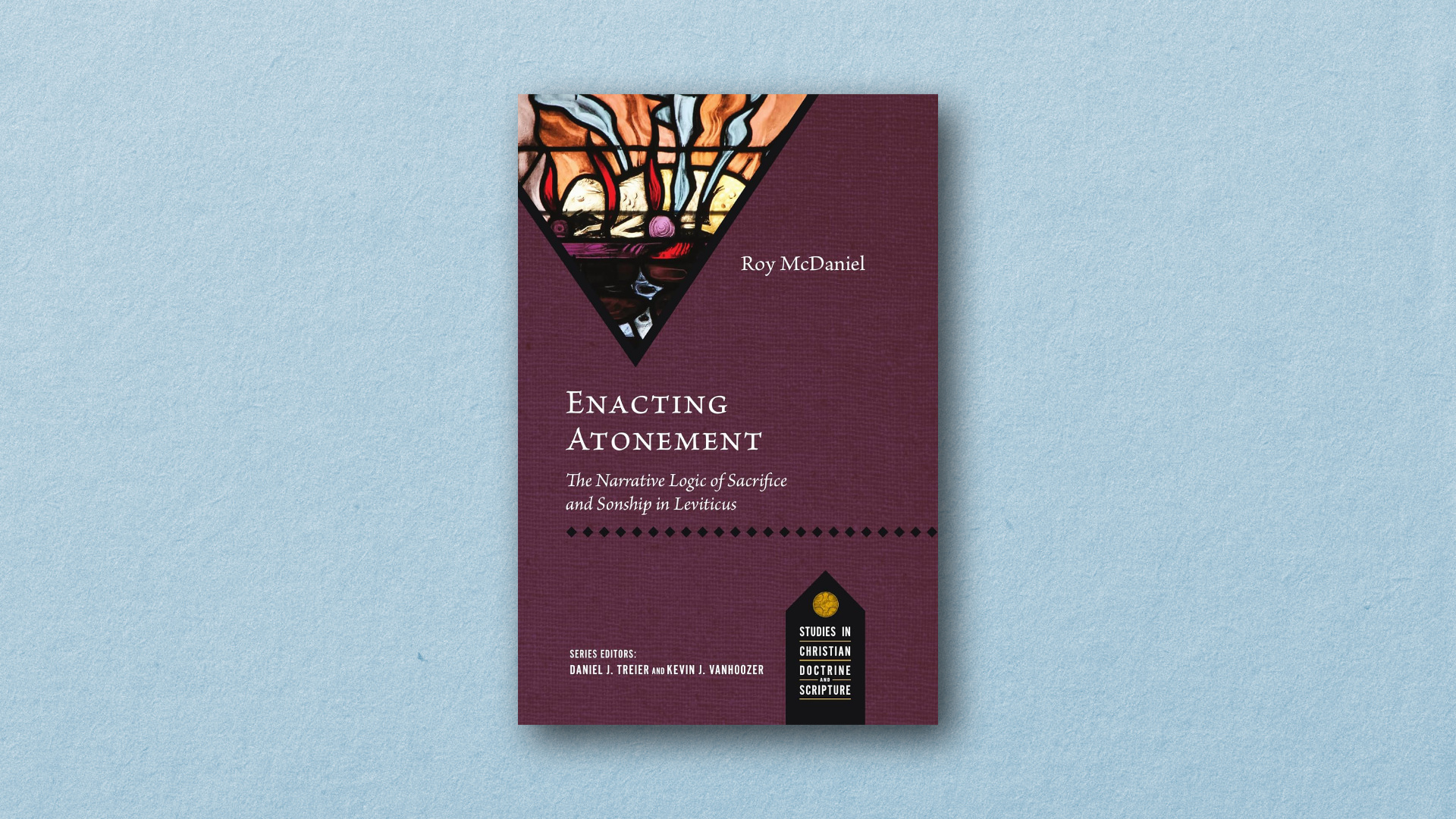
In Enacting Atonement: The Narrative Logic of Sacrifice and Sonship in Leviticus, Roy McDaniel—assistant pastor at Westminster Presbyterian Church in Huntsville, Alabama—shows how Leviticus depicts the process of being made right with God. McDaniel’s goal is to offer “a theological exegesis of Levitical sacrifice, specifically the burnt offering (as prescribed in Lev 1:1–9)” (xviii). He breaks down the features of this specific offering to analyze it exegetically in light of its context in Leviticus and theologically in light of its place in the whole of redemptive history.
This book is a tour de force in theological exegesis. McDaniel never departs from close attention to the text and its contextual features. Nevertheless, he also has a strong grasp of typology. He recognizes the Old Testament as Christian Scripture. Accordingly, he sees Christ as the reason that God established the Levitical sacrificial system in the first place. It was always meant to lead us to Christ.
Sacrifice in a Biblical Framework
The burnt offering takes place within a narrative framework that points to Christ’s full incarnate ministry. This typological content includes penal substitutionary atonement. Yet it goes beyond substitution to include Christ’s obedience and even his ascension as a necessary part of full-fledged atonement.
McDaniel focuses on a deep reading of Leviticus 1:1–2: “The LORD called Moses and spoke to him from the tent of meeting, saying, ‘Speak to the people of Israel and say to them, When any one of you brings an offering to the LORD, you shall bring your offering of livestock from the herd or from the flock.’”
The burnt offering takes place within a narrative framework that points to the full incarnate ministry of Christ.
The strength of McDaniel’s argument lies in his grasp of the broader biblical theology that shapes his understanding of the offerer in the burnt offering. He breaks down Leviticus’s teaching about the burnt offering into its smaller components. In this respect, McDaniel demonstrates exegetical savvy in situating small details of this text in a wider canonical framework.
As he analyzes each aspect, he considers God’s address, the offerer’s identity, the kind of offering that must be brought, and the offering’s significance. These verses in Leviticus might seem to be passing details at the outset of a long biblical treatment of ceremonial law. McDaniel shows how, taken together in full biblical significance, they’re pointers to Christ’s person and work.
Fuel for Doctrinal Development
As a more specific part of his exploration of the Levitical burnt offering, McDaniel recognizes a creational and covenantal framework wherein a faithful and obedient son was always meant to bring a satisfying offering before God. As he argues, “The burnt offering preaches the good news of atonement through the entire sequence of events that constitute the life, death, and resurrection of Jesus Christ” (183).
These exegetical pieces provide material fit for reassembling into a fuller theological puzzle. McDaniel’s case that obedience was a key component of the burnt offering adds new exegetical support for the traditional Reformed distinction between Christ’s active and passive obedience. The creational and covenantal context for this Levitical offering shows how this sacrifice was about satisfying debts we owe to God from creation as well as on account of sin.
The creational and covenantal context for this Levitical offering shows how this sacrifice was about satisfying debts we owe to God from creation as well as on account of sin.
This view of atonement then provides fruitful new consideration for the Reformed doctrine of the covenant of works. This doctrine is about God covenanting with Adam to reward his perfect obedience with glorified life. McDaniel’s emphasis on the burnt offering as pointing to obedience as well as sacrificial death highlights the basic idea of the covenant of works with its terms of obedience as well as its consequence of death.
Redemptive-Historical Question
One area for potential confusion centers on how McDaniel relates the burnt offering to creational structures, specifically concerning its demand for death. I wonder if he has drawn the lines clearly enough regarding the redemptive-historical pattern of creation-fall-redemption.
McDaniel affirms the standard reformational account of death as he articulates the significance of Christ’s death for our sin. However, there are a few points where the argument could have been clearer. In chapter 2, for example, McDaniel argues that the “plot” of the Levitical burnt offering is grounded in creational, covenantal structures of filial obedience. These structures were then part of God’s purpose to create us so we would return to him.
Was death part of a creational demand for atonement? Traditional theology, especially of the Augustinian and wider Reformed varieties, has never accepted death as a natural part of the human experience. Adam and humanity owed God obedience simply by their nature. Death was an intrusion on account of sin.
The potential confusion comes when McDaniel locates the necessity of death within this plot of creational, covenantal return to God. He gives the impression that the death involved in sacrifice is a necessary part of the story of the creature’s obedience. McDaniel could have strengthened this part of his argument by clarifying how death functions as a contingent requirement God places on sinners within the creational and covenantal structures for returning to him. This is a subtle but important point.
Above all, McDaniel makes a powerful exegetical case for the nature of substitution involved in Leviticus’s burnt offerings. This book prompts readers to more thoughtful, rich, and deep readings of complicated but overlooked features of the sacrificial system. As questions about the nature of the atonement abound, Enacting Atonement will help pastors and scholars see Christ’s glory more fully and articulate it more clearly.








 New Posts (Home)
 ChatBox
 Popular Posts
  Game Zone
 Top PodCasts