www.dailysignal.com
China’s Development of the Scarborough Shoal
In recent days, in the South China Sea, the USS Nimitz carrier strike group has been conducting operations and bilateral exercises with the Philippines, to include anti-submarine warfare drills. This comes as tensions have increased between China and Japan, on top of a simmering confrontation at the flashpoint of Scarborough Shoal with the Philippines.
For decades, China has been conducting illegal maritime encroachments into its neighbors’ waters and is now trying to mask its malign activities with a new tactic—environmentalism. This is particularly hypocritical given China has destroyed many pristine coral reefs under an archipelago of man-made island military bases. China now plans to establish a maritime nature reserve that will consist of two parts: A “core zone” that will include the damaged reef within the Scarborough Shoal that will prohibit any human activity, and the “experimental zone” which will cover 400-800 yards of water on either side of the reef where research, the breeding of fish, and tourism may take place.
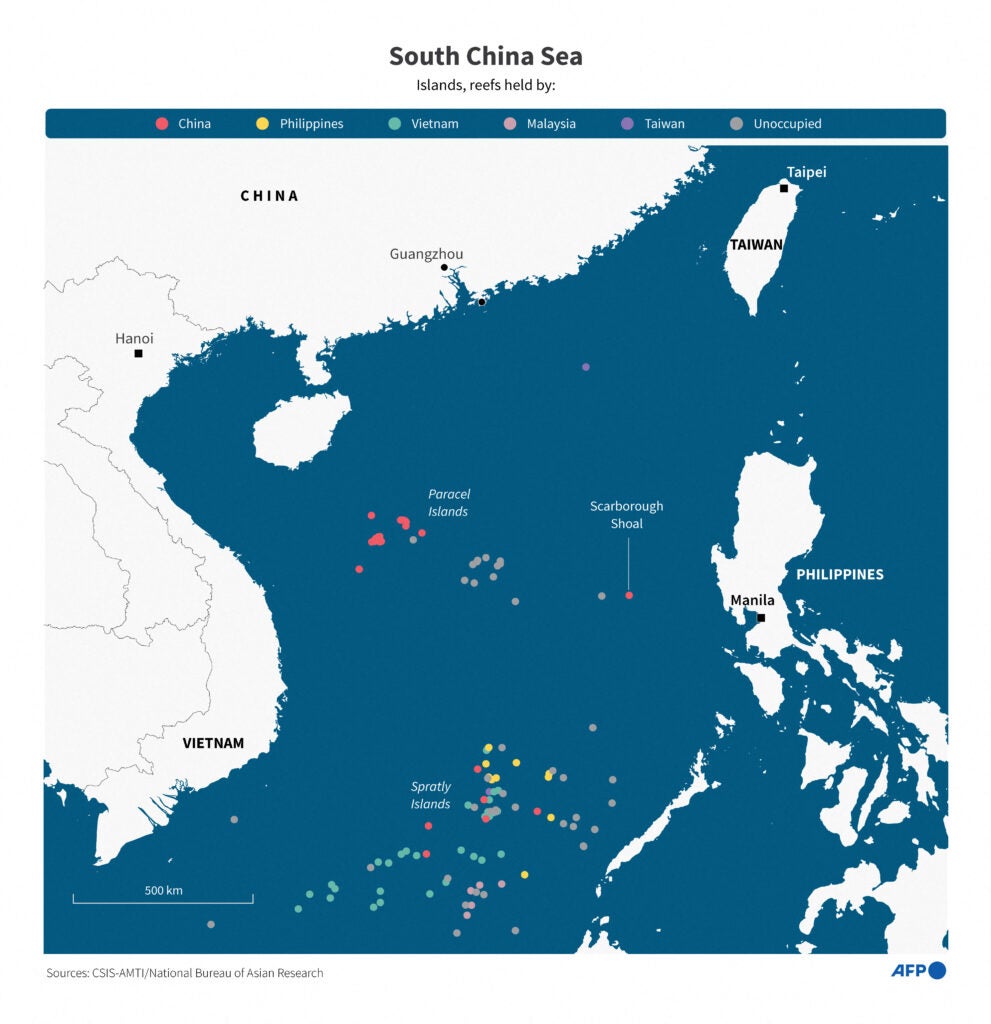
Scarborough Shoal is not just a grouping of rocks and coral; it is a rich fishing ground. Fishermen from the Philippines, Vietnam, and Taiwan have been active in the area for generations. That changed drastically in 2012, when China reneged on a negotiated deal brokered by the U.S. and forcibly seized control of it from the Philippines. Today China has effective control of the shoal and is limiting access and increasing intimidation of non-Chinese fishing vessels.
Infographic showing Scarborough Shoal and other islands and reefs in the disputed South China Sea. (Graphic by JOHN SAEKI/AFP via Getty Images)
In recent years, China’s increased presence around the shoal is up from an average of 48 ships a month near the end of 2024, to 95 ships a month during the first half of 2025. Countries with vested economic interests in the region are not happy about China’s actions, especially the Philippines, which stands staunchly opposed to China’s increasingly brazen dominance in their water. Scarborough Shoal is within the Philippine’s 200 nautical mile Exclusive Economic Zone, making China’s plans particularly problematic given its proximity to the capital of Manila and strategic port of Subic Bay.
One potential protection against China’s activities is the U.S.-Philippine Mutual Defense Treaty, which states: “If one nation’s ’metropolitan’ territory, military, aircraft, islands, or public vessels are attacked, the other must respond in accordance with their ’constitutional processes.’” The United States has affirmed commitment to protecting the Philippine’s sovereignty under the Biden administration which released a joint statement with the Philippines president saying “An armed attack on Philippine armed forces, public vessels, or aircraft in the Pacific, including in the South China Sea, would invoke United States mutual defense commitments under Article IV of the 1951 U.S.-Philippines Mutual Defense Treaty.”
With all this in mind, it is critical the U.S. act quickly with the Philippines to deter Beijing from moving forward with its plan to establish a marine preserve at Scarborough Shoal. This should be done through both diplomatic pressure and increased military presence like the current U.S. carrier strike group in the region.
In response to Chinese duplicity, in 2013, the Philippines filed an arbitration case against China and won. That case concluded with the international tribunal at the Permanent Court of Arbitration under the United Nations Convention on the Law of the Sea ruling in 2016 that China’s Nine-Dash Line violated the U.N.’s conventions and that fishermen from the Philippines and China have traditional fishing rights within the shoal.
China does not recognize the Permanent Court of Arbitration ruling and continues to claim sovereignty over the territory using the same disproven historical arguments.
China may want to appear as if it’s protecting the damaged reefs within Scarborough Shoal, but China has shown it does not care about the environmental impact of its activities in the region. Chinese fishing vessels have participated in damaging practices when harvesting clams, and within the South China Sea, China is thought to have caused the destruction of around 4,600 acres of reef. Why does China suddenly care about this reef, and why build a nature reserve now?
Satellite images released on Oct. 8 depict the placement of a barricade at the mouth of the Scarborough Shoal, which has been confirmed by the Philippine Navy. This is not the first time a barricade has been placed at the shoal, but paired with the plans for a nature reserve, it demonstrates China’s goal of gaining full control. As of Oct. 17, China was operating fighter jets and patrol aircraft in the skies overhead, as well as maritime security vessels nearby, and placed new buoys within and around the shoal to assert dominance over the disputed feature. On Nov. 16, China moved eight maritime ships and coast guard vessels that had previously been stationed at the shoal to Subi Reef, near Thitu Island which is claimed by China but is occupied by Philippine troops.
Besides resources, China may be able to further strengthen its de facto administrative control of nearby waters, further restricting activities by the Philippines and other nations in the Scarborough Shoal. If China moves forward with its plan for a nature reserve, it is highly likely that there will be heightened law enforcement activity and presence near the shoal further burnishing its control of the shoal and surrounding waters. This was indeed suspect back in 2016, with China to turn Scarborough Shoal into a man-made island garrison, as it has done with several features under its control in the Spratly Islands.
If this were to happen, it would threaten United States operations and exercises with the Philippines, along with access to the Enhanced Defense Cooperation Agreement. The bases open to U.S. forces under this agreement include Fort Magsaysay, Basa Air Base, Antonio Bautista Air Base, Mactan-Benito Ebuen Air Base, and Lumbia Air Base. If China succeeds in constructing this nature reserve, we should expect increased Chinese military presence, maritime coercion by paramilitary forces, and further encroachment. With rising tensions in the region and the recent deadly collision between a Chinese destroyer and a Philippine Coast Guard cutter, China will likely not back down lightly. The United States has strategic interest in this region. A little demonstration of resolve today could go a long way toward preventing a more intractable long-term problem at the Scarborough Shoal from getting worse.
The post China’s Development of the Scarborough Shoal appeared first on The Daily Signal.








 New Posts (Home)
 ChatBox
 Popular Posts
  Game Zone
 Top PodCasts