allthatsinteresting.com
The Tragic Story Of Mumtaz Mahal, The Woman Whose Death Inspired The Taj Mahal
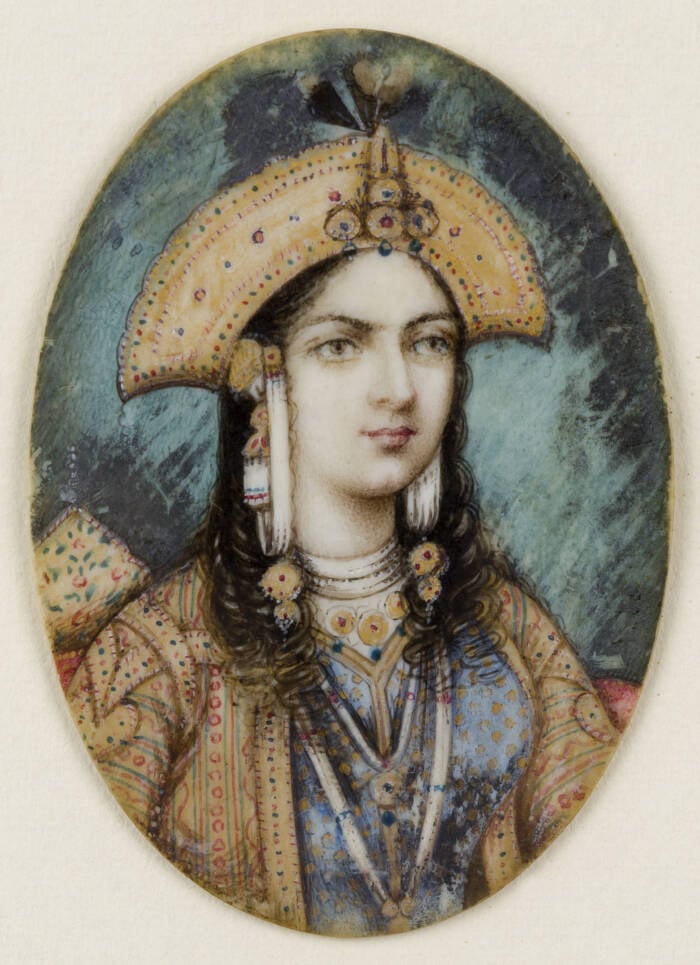
Wikimedia CommonsMumtaz Mahal’s death inspired the Taj Mahal.
India’s Mughal Empire was one of the largest and most powerful empires in the world. Emperor Shah Jahan, who ruled from 1628 to 1658, poured his empire’s wealth into building the stunning Taj Mahal, a gleaming white monument that looms over the city of Agra. Visited by millions every year, the towering marble structure was constructed for one reason: to remember the emperor’s lost love, his wife, Mumtaz Mahal.
So who was Mumtaz Mahal, the woman who inspired the construction of the Taj Mahal — one of the Seven Wonders of the World?
Born a Persian princess, Mumtaz Mahal married her husband in 1612. Trusted by the emperor and loved by the people, she became an important figure in the empire. Mahal served as the patron for humanitarian programs that supported the needy, and was her husband’s loyal advisor.
Tragically, the empress died during childbirth at the age of 38. And Shah Jahan built the Taj Mahal to honor her memory.
Who Was Mumtaz Mahal? The Life Of The Empress Consort
Born Arjumand Banu Begum on April 27, 1593, Mumtaz Mahal came from a powerful Persian family. Her grandfather had become a trusted advisor of Mughal emperor Akbar (1556 to 1605), and her aunt married Mughal emperor Jahāngīr (1605 to 1627) in 1611, intertwining the family with royalty.
When she was around the age of 14 years old, the princess crossed paths with Prince Khurram, Jahangir’s son and heir, at a bazaar. The two quickly fell in love and, in 1607, were betrothed.
Wikimedia CommonsBefore marrying into royalty, Mumtaz Mahal had many family connections with power. Her grandfather, aunt, and father were all connected to Mughal Emperors.
Five years later, on a date selected by court astrologers, the two wed. And Arjumand Banu Begum’s husband gave her a new name: Mumtaz Mahal, which meant “Chosen One of the Palace.” When he became emperor Shah Jahan in 1628, Mahal became the empress consort of Mughal Empire.
While many royal marriages were meant to cement political alliances, the union between Shah Jahan and Mumtaz Mahal was a love match. And though the emperor had two other wives, Muhal remained his favorite. She traveled across the empire with her husband, serving as his loyal advisor. In return, Jahan gave her his imperial seal, the highest possible honor.
As empress, Mumtaz Mahal also won the hearts of the people. She served as a patron of the arts and a champion of the poor. She sent food to widows and orphans and spent her free time writing Persian poetry, as well as enjoying the beauty of a riverside garden in Agra.
Public DomainThough Shah Jahan had three wives, Mumtaz Mahal was his favorite.
She and her husband also had 14 children together – but sadly, childbirth would eventually lead to Mumtaz Mahal’s death.
The Tragic Death Of Mumtaz Mahal In Childbirth — And The Intense Mourning Of Her Husband
Shortly after Shah Jahan became emperor, he led a military campaign in the Deccan Plateau. Mumtaz Mahal traveled with her husband to Burhanpur, in spite of the fact that she was heavily pregnant with her 14th child.
Wikimedia CommonsShah Jahan, a prince of the Mughal Empire met Mumtaz Mahal at a royal bazaar.
After traveling more than 400 miles with her husband and his army, Mahal went into labor. She struggled through a 30 hour labor, finally giving birth to a daughter. But Mahal then suffered from postpartum hemorrhage and, despite the efforts of her lady-in-waiting, her doctor, and the many midwives summoned to help, Mahal was beyond saving.
The emperor rushed to his wife’s side, but there was nothing to be done. Mumtaz Mahal died in his arms on Jan. 17, 1631. She was 38 years old.
Shah Jahan was devastated. The emperor purportedly wept for eight days and went into seclusion for a year. He stopped listening to music, gave up his luxurious clothes and jewelry, and emerged from seclusion with his black hair suddenly stark white. Because Mumtaz Mahal died on a Wednesday, the emperor also banned any entertainment on that day.
Metropolitan Museum of ArtShah Jahan ruled over one of the richest empires in the world.
Mahal’s body was temporarily buried in a walled garden near the military encampment in Burhanpur. But soon after her death, the emperor ordered his wife’s body disinterred. Encased in a gold casket and escorted by one of her sons, the body of Mumtaz Mahal returned to Agra.
Then, Shah Jahan began to plan a monument that would encapsulate his love for Mumtaz Mahal for all time.
The Woman Who Inspired The Taj Mahal, One Of The Seven Wonders Of The World
After putting down the rebellion that had brought him to Burhanpur, Shah Jahan returned to Agra with a plan to memorialize his lost love. Shah Jahan vowed to build a tomb fit for the empress.
Public DomainThe Taj Mahal in the 1860s.
According to the Taj Mahal website, the emperor put together a group of architects to build a mausoleum like no other (though the names of the monument’s designer are sadly lost to time). Ultimately, the magnificent monument would take 22 years and 20,000 workers to construct.
Over more than two decades, workers transported white marble from a quarry 200 miles away. A thousand elephants carried the marble to Agra, where a 10-mile ramp was constructed to move marble upward.
Inside the imposing structure, a master calligrapher etched Quran verses into the white marble. Stonecutters chipped away at the marble to create floral designs in which they embedded dozens of different kinds of precious stones, including jade from China, turquoise from Tibet, and malachite from Russia. The Taj Mahal also glitters with the color and light of carnelian, agates, chalcedonies, lapis lazuli, bloodstone, and garnet.
In a nod to how “Paradise” in Islam is described as a garden, the Taj Mahal was designed to look like heaven on earth. It includes a garden divided by rivers which flow into a central pool.
Philip Nalangan/Wikimedia CommonsThe Taj Mahal was built to resemble “Paradise,” which, in Islam, is depicted as a garden.
At the core of the mausoleum complex, under the majestic dome, rests the cenotaph tomb of Mumtaz Mahal. But it stands empty – the empress’ body was interred beneath the Taj Mahal in a crypt.
The Taj Mahal: A Tomb For Mumtaz Mahal And Shah Jahan
Shortly after the Taj Mahal was completed, Shah Jahan fell ill. His weakness led his sons to fight amongst themselves and his third son, Aurangzeb, eventually seized power. Aurangzeb then confined his father in Agra Fort, where the aging emperor could see the Taj Mahal from his window.
Then, in 1666, Shah Jahan died.
Though the emperor had once dreamed of building his own mausoleum, a black version of the Taj Mahal, his son Aurangzeb instead ordered that Shah Jahan be buried in the original Taj Mahal. Today, Shah Jahan and Mumtaz Mahal are the only people buried in the mausoleum.
Asitjain/Wikimedia CommonsDetails, including calligraphy, on the outside walls of the Taj Mahal.
But after Aurangzeb died in 1707 the Mughal Empire began to decline. The British soon swept into India, carving precious stones from the walls of the mausoleum. However, the Taj Mahal has since been preserved.
After an early 20th-century restoration project, the monument gained world renown and a spot on the UNESCO World Heritage list. Today, it’s considered one of the Seven Wonders of the World.
Yet while the Taj Mahal’s architectural brilliance captures the wealth and culture of the Mughal Empire, few know the story of the woman who inspired it. The gleaming white monument is a mausoleum, but it’s also an eternal symbol of the love of Shah Jahan for one person — his beloved wife, Mumtaz Mahal.
After reading about Mumtaz Mahal, the woman who inspired the Taj Mahal, discover the incredible stories of the Seven Wonders of the Ancient World. Or, learn about the Koh-I-Noor Diamond which Shah Jahan placed atop his Peacock Throne — and which is now part of England’s Crown Jewels.
The post The Tragic Story Of Mumtaz Mahal, The Woman Whose Death Inspired The Taj Mahal appeared first on All That's Interesting.








 New Posts (Home)
 ChatBox
 Popular Posts
  Game Zone
 Top PodCasts