www.theamericanconservative.com
Another Pointless Trump-Era Protest
Uncategorized
Another Pointless Trump-Era Protest
Sincerity is not a strategy.
Days after President Trump called a reporter “piggy,” a group of women boarded a bus in Ohio for a 36-hour “turn and burn” trip to Washington, DC to fight for “regime change.” At least a half dozen protesters were dressed as Miss Piggy. They carried handmade “Impeach, Convict, Remove” signs and transgender pride flags; others wore the red hooded cloaks and white bonnets made famous by The Handmaid’s Tale. A mother of three teenagers, one of them transgender, explained, “Something has to change, and we have to start somewhere.”
I feel bad for her and the others. They don’t understand how naive they sound, wanting to believe some signs and a long bus ride might affect anything—never mind something as extreme as forced regime change in a democracy. They are not alone in their naivete; elsewhere, colorful ribbons in the red and green of the Mexican flag woven into twin braids have emerged as a new symbol of “resistance” among Latinas.
Part of the perceived pointlessness of such protests comes from how institutionalized protest culture has become. In the Midwest labor demonstrations and coal mine strikes of the 19th century, protesters risked their lives to hold up signs while hired Pinkerton thugs beat them. In New York and elsewhere, draft protests during the Civil War were put down at bayonet-point by the regular U.S. Army. Antiwar protests during the Vietnam era often turned violent, most notably at Chicago in 1968, with phalanxes of helmeted cops breaking up crowds with batons and tear gas. And there was the massacre at Kent State University in Ohio, where National Guardsmen used their service rifles to gun down four and wound nine unarmed college students in 1970. All those at any protest risked rough arrest.
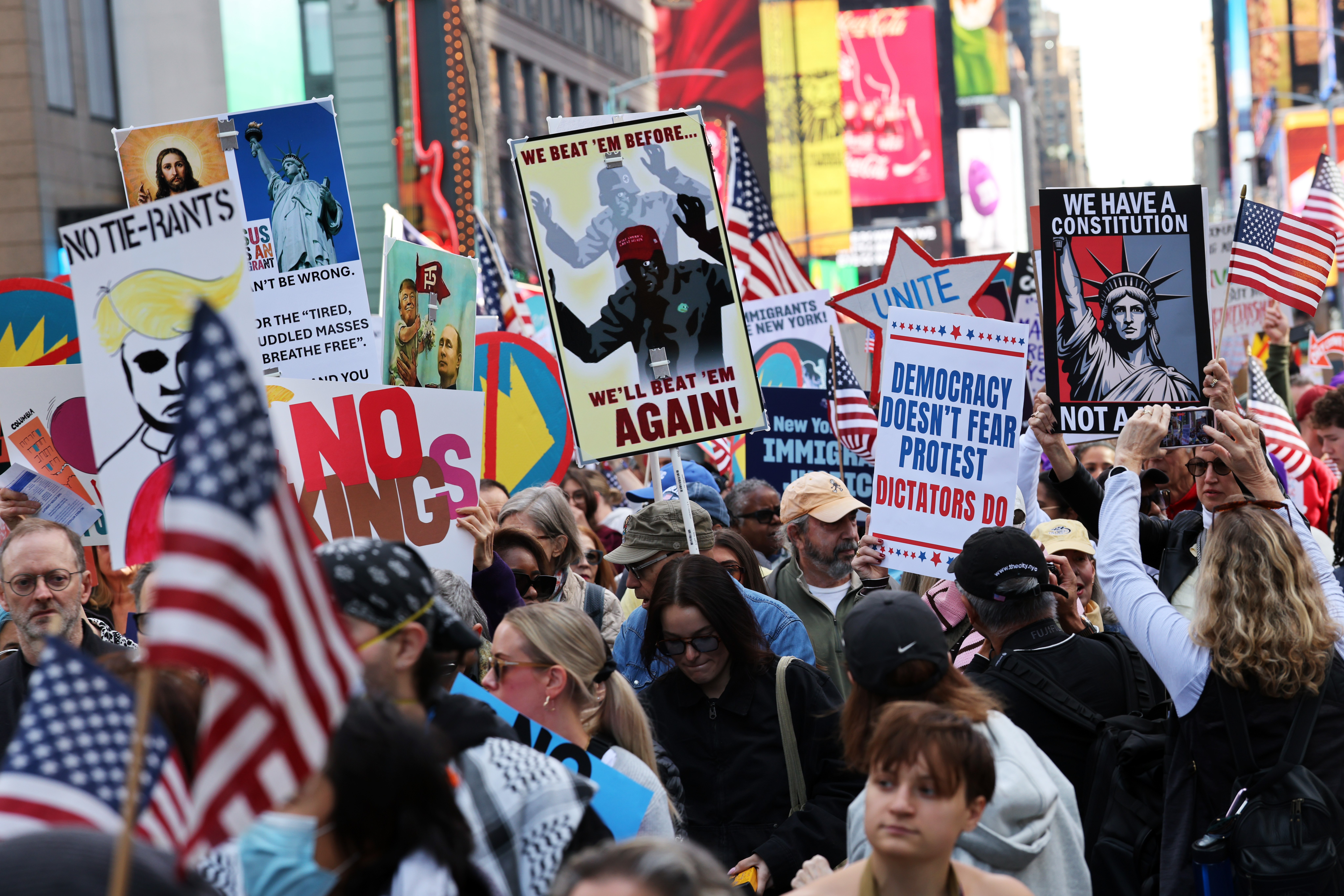
For the women now seeking regime change, what once carried genuine risk turned into political pageantry. Cities now issue permits for marches, police escort crowds along predetermined routes, and the media broadcasts images of the wittiest signs and t-shirts. Everyone takes pictures and the whole typically dissolves into a carnival atmosphere. Bring your kids and the t-shirted dog.
Old protests were dangerous because they seriously threatened entrenched economic or governmental power. New protests are safe because they do not threaten power at all, because power does not take them seriously. Ask the pink pussy hat marchers of 2017, whose efforts failed to stop Trump across multiple administrations. The question is if these actions (along with petitions, social media blasts, hashtags) never deliver outcomes, why do people continue to pour time and moral purpose into them? “This will probably end up in history books, if we have real history books,” said one of the Ohio protesters, dressed as a handmaid. “I’m glad I was able to be a part of it instead of watching it on TV.”
They are united in a visceral hatred of Trump, and see him as a stand-in for everything they dislike or disagree with. It is not as if they adore illegal immigrants; their support arises solely from the fact that Trump is opposed to them. They protest seeking nothing short of “regime change” because calls for regime change are easier than the long, unglamorous work of civic participation. People feel they have done something, but the machinery they are pushing against barely notices. When Marine One flew over the Ohio women as Trump returned to the White House, fists and middle fingers rose into the air; nothing happened. Sincerity is not a strategy. There is a brutal mismatch the protesters do not see between the scale of their efforts and the scale of actual power.
Though signing your name, holding a sign, or shouting in the street feels good, legislation, budgets, and institutions rarely move by feelings alone. The protest thus becomes not a strategy but group therapy. It is catharsis disguised as activism. The social reinforcement of gathering, even if it is just 36 women from Ohio, validates their own sense of moral vision, that they are part of something meaningful instead of residents in a decayed industrial wasteland.
Notice what the protesters are asking for: regime change here, “No Kings” before that, “End the Patriarchy,” amorphous issues like that. There is little anyone can do about those things, if they are even real. The pointlessness of the act of protest is built into the act itself. So when the next end-of-democracy event arrives, such as a Supreme Court ruling that goes against someone’s wishes, protest becomes a way of reconciling oneself to the absence of change and the reality of failure. Faced with no tools other than a vote statistically very few of them ever exercise, and that only available every few years, protests are a psychological palliative for nihilism. Like calling to make up new rules if a presidential election goes the wrong way, it is all an alternative to admitting there is nothing to be done about the status quo.
The women protesters from Ohio have good reason to dislike the status quo, one enforced on them for the last several decades as the Heartland became the Rust Belt. One protester, a 36-year-old from Georgia, said the president’s treatment of women was a big factor in drawing her to Washington for her first-ever protest. Yet she described herself as the wife of a disabled veteran and a mother of six who relies on SNAP. Another protester in the group was described as “currently unemployed after spending years on an assembly line building steering wheels for Ford vehicles.” Her husband is a fully disabled Navy veteran dependent on benefits from Veterans Affairs. She said she is protesting for him and also for other women like her, for her LGBTQ+ family members, for immigrants in her community and for her 69-year-old mother, who relies on subsidized housing. A constant question that runs through her mind, she said, is, “When is it going to come for me?” Answer: It is already here.
People’s socioeconomic precarity makes them vulnerable to political fear, while protest offers them some shred of meaning in a world where they feel little control. Their personal struggles only serve to highlight the unclosable distance between their needs and what symbolic activism can deliver. In the age of Trump, the real engine behind protest culture is not hope but fear. Some hope that their voices matter, sure, but with fear of discovering they do not at its heart. It was a 36-hour bus ride back to Ohio. Maybe they had time to think about some of this on the way back—before the next protest.
The post Another Pointless Trump-Era Protest appeared first on The American Conservative.








 New Posts (Home)
 ChatBox
 Popular Posts
  Game Zone
 Top PodCasts