reclaimthenet.org
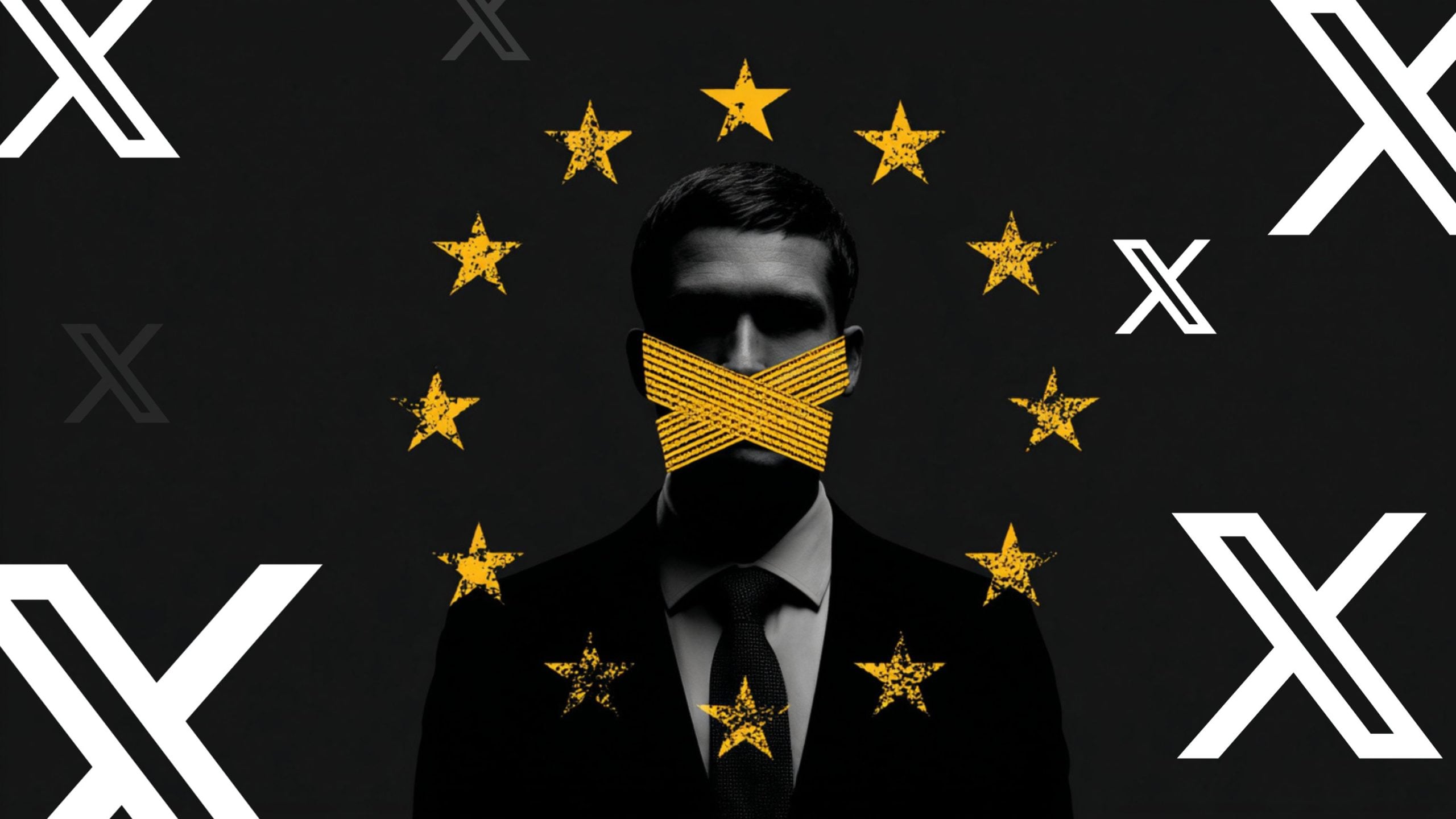
The EU Insists Its X Fine Isn’t About Censorship. Here’s Why It Is.
If you're tired of censorship and dystopian threats against civil liberties, subscribe to Reclaim The Net.
When the European Commission fined X €120 million on December 5, officials could not have been clearer. This, they said, was not about censorship. It was just about “transparency.”
They repeat it so often you start to wonder why.
The fine marks the first major enforcement of the Digital Services Act, Europe’s new censorship-driven internet rulebook.
It was sold as a consumer protection measure, designed to make online platforms safer and more accountable, and included a whole list of censorship requirements, fining platforms that don’t comply.
The first target is Elon Musk’s X, and the list of alleged violations look less like user safety concerns and more like a blueprint for controlling who gets heard, who gets trusted, and who gets to talk back.
The Commission charged X with three violations: the paid blue checkmark system, the lack of advertising data, and restricted data access for researchers.
None of these touches direct content censorship. But all of them shape visibility, credibility, and surveillance, just in more polite language.
Musk’s decision to turn blue checks into a subscription feature ended the old system where establishment figures, journalists, politicians, and legacy celebrities got verification.
The EU called Musk’s decision “deceptive design.” The old version, apparently, was honesty itself. Before, a blue badge meant you were important. After, it meant you paid. Brussels prefers the former, where approved institutions get algorithmic priority, and the rest of the population stays in the queue.
The new system threatened that hierarchy. Now, anyone could buy verification, diluting the aura of authority once reserved for anointed voices.
However, that’s not the full story. Under the old Twitter system, verification was sold as a public service, but in reality it worked more like a back-room favor and a status purchase.
The main application process was shut down in 2010, so unless you were already famous, the only way to get a blue check was to spend enough money on advertising or to be important enough to trigger impersonation problems.
Ad Age reported that advertisers who spent at least fifteen thousand dollars over three months could get verified, and Twitter sales reps told clients the same thing. That meant verification was effectively a perk reserved for major media brands, public figures, and anyone willing to pay. It was a symbol of influence rationed through informal criteria and private deals, creating a hierarchy shaped by cronyism rather than transparency.
Under the new X rules, everyone is on a level playing field.
Government officials and agencies now sport gray badges, symbols of credibility that can’t be purchased. These are the state’s chosen voices, publicly marked as incorruptible. To the EU, that should be a safeguard.
The second and third violations show how “transparency” doubles as a surveillance mechanism. X was fined for limiting access to advertising data and for restricting researchers from scraping platform content. Regulators called that obstruction. Musk called it refusing to feed the censorship machine.
The EU’s preferred researchers aren’t neutral archivists. Many have been documented coordinating with governments, NGOs, and “fact-checking” networks that flagged political content for takedown during previous election cycles.
They call it “fighting disinformation.” Critics call it outsourcing censorship pressure to academics.
Under the DSA, these same groups now have the legal right to demand data from platforms like X to study “systemic risks,” a phrase broad enough to include whatever speech bureaucrats find undesirable this month.
The result is a permanent state of observation where every algorithmic change, viral post, or trending topic becomes a potential regulatory case.
The advertising issue completes the loop. Brussels says it wants ad libraries to be fully searchable so users can see who’s paying for what. It gives regulators and activists a live feed of messaging, ready for pressure campaigns.
The DSA doesn’t delete ads; it just makes it easier for someone else to demand they be deleted.
That’s how this form of censorship works: not through bans, but through endless exposure to scrutiny until platforms remove the risk voluntarily.
The Commission insists, again and again, that the fine has “nothing to do with content.”
That may be true on a direct level, but the rules shape content all the same. When governments decide who counts as authentic, who qualifies as a researcher, and how visibility gets distributed, speech control doesn’t need to be explicit. It’s baked into the system.
Brussels calls it user protection. Musk calls it punishment for disobedience. This particular DSA fine isn’t about what you can say, it’s about who’s allowed to be heard saying it.
TikTok escaped similar scrutiny by promising to comply. X didn’t, and that’s the difference. The EU prefers companies that surrender before the hearing. When they don’t, “transparency” becomes the pretext for a financial hammer.
The €120 million fine is small by tech standards, but symbolically it’s huge.
It tells every platform that “noncompliance” means questioning the structure of speech the EU has already defined as safe.
In the official language of Brussels, this is a regulation. But it’s managed discourse, control through design, moderation through paperwork, censorship through transparency.
And the louder they insist it isn’t, the clearer it becomes that it is.
If you're tired of censorship and dystopian threats against civil liberties, subscribe to Reclaim The Net.
The post The EU Insists Its X Fine Isn’t About Censorship. Here’s Why It Is. appeared first on Reclaim The Net.








 New Posts (Home)
 ChatBox
 Popular Posts
  Game Zone
 Top PodCasts