allthatsinteresting.com
44 Vintage Images Of Asia’s Hippie Trail That Promised Enlightenment And LSD To Thousands Of Western Travelers
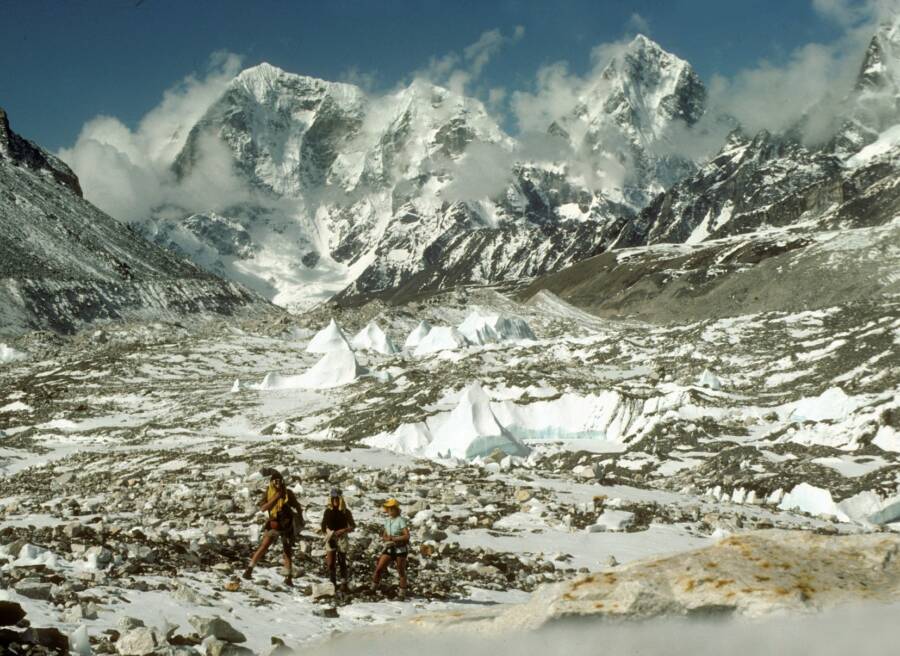
Henry Parkman/FacebookHippies trekking through the Nepalese mountains. 1978.
The sight of brightly-painted vans with psychedelic designs and peace symbols became an increasingly common occurrence throughout the United States in the 1960s and 1970s. More and more people were embracing the freewheeling, sometimes nomadic lifestyle associated with the counterculture and traveling wherever the winds (or drugs) took them.
But when traveling within the U.S. in a van wasn’t exciting enough, some hippies set their gaze on more adventurous locales on the other side of the world. Thousands of backpackers and tourists traveled more or less the same route that stretched from Europe to Southeast Asia.
They called it the Hippie Trail.
Click here to view slideshow
What Was The Hippie Trail?
In the 1960s and 1970s, the Hippie Trail was an overland route that became popular among young Western travelers — mostly hippies and counterculture enthusiasts. It was an opportunity to travel without spending a lot of money, experiment with drugs, and experience new ways of thinking.
But it didn't just appear overnight. Beat Generation writers like Jack Kerouac and Allen Ginsberg had already written romantically about Eastern spiritualities and alternative lifestyles. Then, the 1960s counterculture explosion transformed what had been a trickle of travelers into a flood.
As Western youth grew increasingly disillusioned with materialism, the Vietnam War, and conventional society, they looked eastward for answers.
"I didn't know what I was learning there," travel writer and Hippie Trail veteran Rick Steves told Condé Nast Traveler. "I was just soaking it up. I did realize that the most frightened people are those who have yet to travel. They haven't had their hippie trail... If you've done a philosophical hippie trail, you're more inclined to build bridges and less inclined to build walls."
Hans Sandberg/FacebookA hippie-packed bus departing for the trail.
The trail, which typically followed old "Silk Road" paths that connected the East and West, could begin in any number of major Western European cities and then head toward Istanbul, Turkey. From there, routes varied, with some travelers exploring Afghanistan and Pakistan, others spending time in India (especially Goa), and yet others going as far as Thailand.
Lured by the vague promises of enlightenment and adventure in foreign lands, with cultures that were sometimes celebrated by iconic musicians like The Beatles (as well as the promise of cheap and readily available drugs), these young Western tourists flocked by the dozen to try and find some sort of higher understanding, or at least a good time, along the trail.
In turn, locals in the countries along the trail often seized upon the opportunity to make some money off these "Intrepids," as Hippie Trail adventurers were often known. Residents quickly set up tour bus companies and even offered the services of "gurus" to help accommodate the young foreigners suddenly flocking to these areas.
Soon enough, travel guidebooks about the trail began to pop up, including the 1973 book Head East! Besides offering standard information on expenses and visas, the guide also had sections labeled "dope" and "munchies." It also cautioned travelers against "white devil syndrome" (something similar to what a modern reader might call "white privilege").
Elsewhere, Head East! succinctly described the ideas that led to the loose creation of the Hippie Trail in the first place: "People of the East, for the most part, have a much better perspective on life, time, people, drugs, and living in general than do those of them who come from the West."
The Golden Age Of The Hippie Trail
Of course, Head East! was not the only book about the trail at the time. In fact, the origins of the well-known Lonely Planet guidebooks also lie with the Hippie Trail. The founders of Lonely Planet, Tony and Maureen Wheeler, explored the trail in the 1970s and wrote what would be the first book in the series (1973's Across Asia on the Cheap) about their experience.
The book was a hit, other similar guides were published, and a new era of travel guidebooks was born. Some even suggest that the modern notion of cheap travel was, in part, born out of routes like the Hippie Trail.
Today's Lonely Planet guides may be a bit less hippie-friendly than the original, which advised travelers on where to score pot and how to "recoup" some travel expenses by selling one's own blood. What's more, the original guide certainly dates itself when it notes things such as "you can get stoned just taking a deep breath in the streets" in Afghanistan. The country may have once been an essential part of the Hippie Trail, but it's now listed by the U.S. Department of State as a "Level 4- Do Not Travel" destination.
Back then, though, Kabul was known for offering cheap accommodations, readily available hashish, and, shockingly (to modern readers), a relaxed atmosphere that seemed tailor-made for the counterculture set. Chicken Street was an especially legendary destination, lined with shops selling Afghan coats, jewelry, and textiles, among other things.
M. Kashif Mufti/FacebookA monkey joining some hippie musicians in Goa in the 1960s.
And marijuana seemed to be everywhere.
"At that time, in Afghanistan, in India, in Nepal, marijuana was just part of the culture," Rick Steves explained. "Not a big deal. Much like people clink glasses of wine in our culture, I think."
By the 1980s, however, traveling along the Hippie Trail was already largely a thing of the past. The flood of Western backpackers once again slowed to a trickle — and some even recommended against it. So, what changed?
To put it simply, political turmoil in the region made many former tourist hotspots unsafe or undesirable to most Western tourists.
The Iranian Revolution in the late 1970s was a particularly significant contributor to the end of the trail, as it transformed what had been a relatively liberal stopover into a theocratic state that was largely hostile to Westerners. Around the same time, the Soviet invasion of Afghanistan ended Kabul's role as the trail's beating heart. Drug enforcement also intensified in the region, meaning that outsiders could no longer indulge freely.
All of this, combined with a declining enthusiasm for the counterculture in the West, effectively closed the Hippie Trail for good. On top of that, air travel became more accessible, making it easier for travelers to skip the overland journey. To many, the romance of roughing it through Asia had lost its appeal, but for those who made the journey years ago, it was a defining experience.
Whether travelers on the Hippie Trail found what they were seeking is perhaps less important than the fact that they looked, they believed transformation was possible, and they were willing to travel the world to find it.
After this look at the Hippie Trail, check out the best hippie photos that truly capture the movement. Then, step inside America's 1970s hippie communes.
The post 44 Vintage Images Of Asia’s Hippie Trail That Promised Enlightenment And LSD To Thousands Of Western Travelers appeared first on All That's Interesting.








 New Posts (Home)
 ChatBox
 Popular Posts
  Game Zone
 Top PodCasts