www.theamericanconservative.com
Polish MP: ‘Maybe Europe Needs a Shock’ From Trump
Foreign Affairs
Polish MP: ‘Maybe Europe Needs a Shock’ From Trump
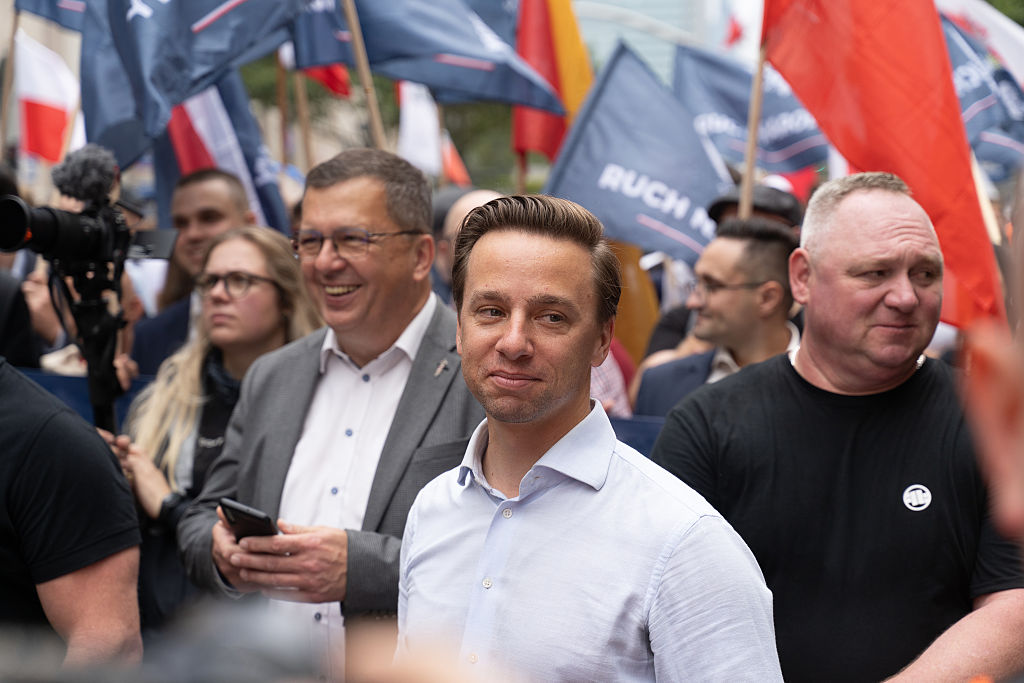
Krzysztof Bosak sat down with The American Conservative to discuss Europe’s civilizational decline and President Donald Trump’s aim to reverse it.
(Photo by Marek Antoni Iwaczuk/SOPA Images/LightRocket via Getty Images)
Last week, the Trump administration released a new National Security Strategy that warned of Europe’s “civilizational erasure” and lambasted its policies on migration, free speech, and environmental regulation, among other issues. The document shocked liberals on both sides of the Atlantic, and European elites worried that President Donald Trump seeks to betray their nations and align with Russia.
But some European politicians take a very different view of Trump’s approach to the old continent. I spoke to one such politician, Krzysztof Bosak, a Polish leader in the nationalist “Euroskeptic” movement, which is wary of the European Union. Bosak is the deputy speaker of the Sejm, the lower house of the Polish parliament, and a rising star in right-wing European politics. He offered insights on Trump’s provocative strategy document, Europe’s civilizational crisis, and the EU’s war with Elon Musk.
President Donald Trump’s National Security Strategy warns that Europe is facing “civilizational erasure.” It says some European countries are becoming “majority non-European” in the coming decades and that this will be bad for the United States. America’s mainstream media is presenting this document as the latest example of Trump’s hostility to Europe, and many European elites feel the same way. How do you see the concerns expressed in this document about Europe’s economic, military, and civilizational decline?
My perspective won’t be the typical European perspective, because I grew up in the Euroskeptic movement. So, the remarks from the strategy document have been typical talking points of my movement for 20 years or more. This criticism towards the European mainstream is also our criticism. I can’t say that I disagree with anything there.
Of course, the question is whether this criticism should be put in a strategic document. Are we still allies in one organization? This is a big question. And I think it sets a new precedent in international life to be so provocative. Although, of course, it’s also a continuation of Vice President J.D. Vance’s Munich [Security Conference] speech, which I agreed with completely.
So first, I agree with these opinions. I think they are true, unfortunately. I would like it to be otherwise, but they are true. Of course, there are also good things to say about Europe. And if the American administration had been in a better mood, maybe some good sentences about Europe also could have a place in this document. But this is a choice for your administration, what to put in your strategic document. I can imagine a European strategic document with some criticisms of America. It is also possible.
But the question is, What kind of result do we look for? And this is, I think, the most interesting question in this situation, because we have been trying to change the direction of the European Union for decades, since the 1990s. We have had criticisms of the centralization of the European Union and the overregulation of the European economy for more than two decades. We have had criticisms of climate policies for more than 10 years probably. And nothing is changing. Or the changes are only in a bad direction.
So, maybe Europe needs a shock from our good old friend America to start a true debate, because there was no debate in the European mainstream. In America, you have both sides of the political spectrum. In Western Europe, there’s only one side. If you have politically incorrect views, you can find yourself in prison, because you said too much, for example, in England or sometimes in Germany.
In Poland, we still have a big space for free speech, for politically incorrect views, in parliament and in media debates. But Poland is an exception. Maybe the whole Central and Eastern European bloc is an exception.
So, if the goal was to shake Europe and to help Europe find some solution for its disease, maybe it will work. But we’ll see. For now, it’s a huge shock. In my opinion, in most European capital cities, it was unimaginable to publish something like that. It’s completely against the logic of the mainstream attitude to transatlantic relations, which is just patting each other on the shoulders, taking photographs, repeating slogans.
In Europe today, right-wing nationalist parties are Euroskeptic. And liberals are pro–European Union and cosmopolitan. And I was wondering if there’s room for a synthesis here, such that the European Union remains cosmopolitan, but only for Europeans. Why do Euroskeptic parties want to abolish the EU or withdraw their countries from it, rather than take over the EU and turn it into a right-wing organization?
It’s not true that Euroskeptic parties or more alternative right parties or nationalist parties would like to withdraw from the EU. They are not against the presence in the EU. Why? Because European societies don’t want to leave. Britain was an exception.
So this, as you said, “synthesis” works in almost every European country. Even the more conservative and EU-critical parts of the society in every country would like to be a part of the bloc, and they would like it to work in a better way.
But the EU is constructed in such a way that it’s almost impossible to reform it in a more conservative and sovereignist direction. It was developed for many decades, and it was designed to change only in one direction: more European integration, more centralism, more federalism. In fact, not really federalism, because federalism gives you some level of autonomy….
And you have many political institutions and mechanisms that are preventing change. It’s not only mainstream media; it’s also institutions with hard power, for example, the European Court of Justice. To appoint a judge there you need an acceptance of the body based on European treaties. And this body excludes everybody who’s more sovereignist. They have mechanisms of putting sanctions on countries if they elect a government that is too conservative. They call it a “defense of the rule of law.” But it’s not about the rule of law. It’s about liberal values, a liberal agenda.
So, to change the situation, you need a majority in the European Parliament, and we are very far from that…. And you need also a majority in the European Council, which is the group of European prime ministers. So you have to win with the alternative right in more than half of European countries. It’s impossible. So, in the current situation, you can’t change the European Union….
And of course, you need power in at least one big European country to change the situation, France or Germany. If you don’t have a big country on board, it’s almost impossible. And in Germany, they used the internal security agency to investigate AfD [Alternative for Germany party]. And in France, they used the courts to take away [National Rally leader] Marine Le Pen’s right to be a candidate in the next presidential elections. So, on every level you are blocked if you are too conservative or too sovereignist.
What, then, is the strategy of Europe’s right-wing parties? If you don’t want to withdraw from the EU because doing so is unpopular, and if you don’t think that the EU can be reformed in the near term, do you just remain in the EU but resist it in the meantime?
Yes. We are in a trap. As one leader of the identitarian movement said, this is an open-air prison for European nations. But it’s not so bad. A big majority of society experiences economic freedom and individual freedom. But on the political level, it does not look good.
So I think every political party should try to be pragmatic in this situation. They should oppose the centralization of the EU. And they should try to raise consciousness in society, to increase our ability to oppose the progressive agenda and also to organize ourselves.
It may not be so obvious from an American perspective, but Europe is very divided, and even the European conservative movement is very divided. For one, because of language barriers. If you have more than 20 different languages, it’s not easy to build one movement. But we are working, and I think that every European right-wing party, truly right-wing party, is rising….
The European Union recently fined Elon Musk’s X $140 million and is investigating X’s content moderation practices. Here in the United States, we’ve seen Elon Musk and J.D. Vance push back against this ruling by the EU. And I’m wondering how you as a nationalist in Europe think about that. Do you resent having these American billionaires and politicians telling the EU how to govern tech and social media, or are you glad to see this pushback from America when it comes to the EU’s regulation of social media?
We have two problems in one question. The first is our relation with big American corporations. And the second is the particular case of Elon Musk, X, and freedom of speech. I believe that Elon Musk secured freedom of speech by buying Twitter and changing it to get rid of politically correct censorship, and giving this tool to us to communicate with each other. I use it a lot and I think it’s now much better than ever.
I do think that some people should be fined: first, [Meta CEO] Mark Zuckerberg, because he was censoring us hard. And he was censoring other right-wing movements without any legal basis. We are trying to take Facebook to court. We have been working on it for more than three years, because they interfered in our elections. They stole our profiles, our pages on Facebook. They blocked us for some years. They censored us, not only my party, but the whole right.
They did that to us too!
And you know what? They don’t want to go to court in Poland. They say that we should go to court in Ireland or in the United States. Our lawyers filed a lawsuit, and Facebook tried to not take correspondence from the post office for years. They use such dirty tricks to avoid accountability. It’s so stupid and disappointing.
So if the European Union truly cares about freedom of speech, they should go after Facebook first.
Now they’ve introduced some policies against misinformation or something. And if they want to fine somebody, they always will find some reasons to do it. It’s completely arbitrary. So we do not, of course, support such a policy….
In Poland, there was always big pro-American sentiment. So, I am sad to say to the American press that yes, unfortunately, now American corporations are a symbol for us of censorship, not a symbol of freedom. I hope that will change. It has already changed a little; now it’s much better. But we know it’s not because they are changing on their own. They’re only changing now because of the Trump administration.
Editor’s note: This transcript has been lightly edited for readability and conciseness.
The post Polish MP: ‘Maybe Europe Needs a Shock’ From Trump appeared first on The American Conservative.








 New Posts (Home)
 ChatBox
 Popular Posts
  Game Zone
 Top PodCasts