www.thecollector.com
How Did Justinian’s Plague Affect the Byzantine Army?
At the height of his power in the mid-6th century CE, Emperor Justinian I strove to restore Rome to its former glory. Soon, his armies regained North Africa from the Vandals and were now involved in a campaign to regain Italy from the Ostrogoths. However, as Justinian’s generals marched across the land of the old Romans, a very different type of adversary emerged – Justinian’s Plague. Spread by flea and rat-borne bacteria brought to the empire on grain ships from Egypt, the plague claimed millions of lives and greatly affected the Byzantine army.
The State of Justinian’s Imperial Army Before the Outbreak
The empire in 555 under Justinian I, its greatest extent since the fall of the Western Roman Empire, vassals shaded in pink.
To understand the extent to which the plague affected Justinian’s army requires understanding the pre-epidemic state of the Byzantine Army. For the Roman Empire to fight two wars simultaneously (in North Africa and Italy) it needed a huge number of soldiers as well as supplies, and other logistical needs for the soldiers. Estimates vary among historians today, but most agree that the approximate size of Justinian’s military forces totaled around 300,000 to 350,000 soldiers.
Historian Agathias, writing decades after the first epidemic, compared the idealized number of soldiers (645,000) in the older, unified Roman Empire’s army with the prevailing army of only about 150,000 in his time. Although Agathias’ numbers were likely exaggerated so as to critique the policies of the imperial government, the extreme comparison he made demonstrated the enormous manpower problems the empire faced immediately after the plague.
The True Extent of the Devastation
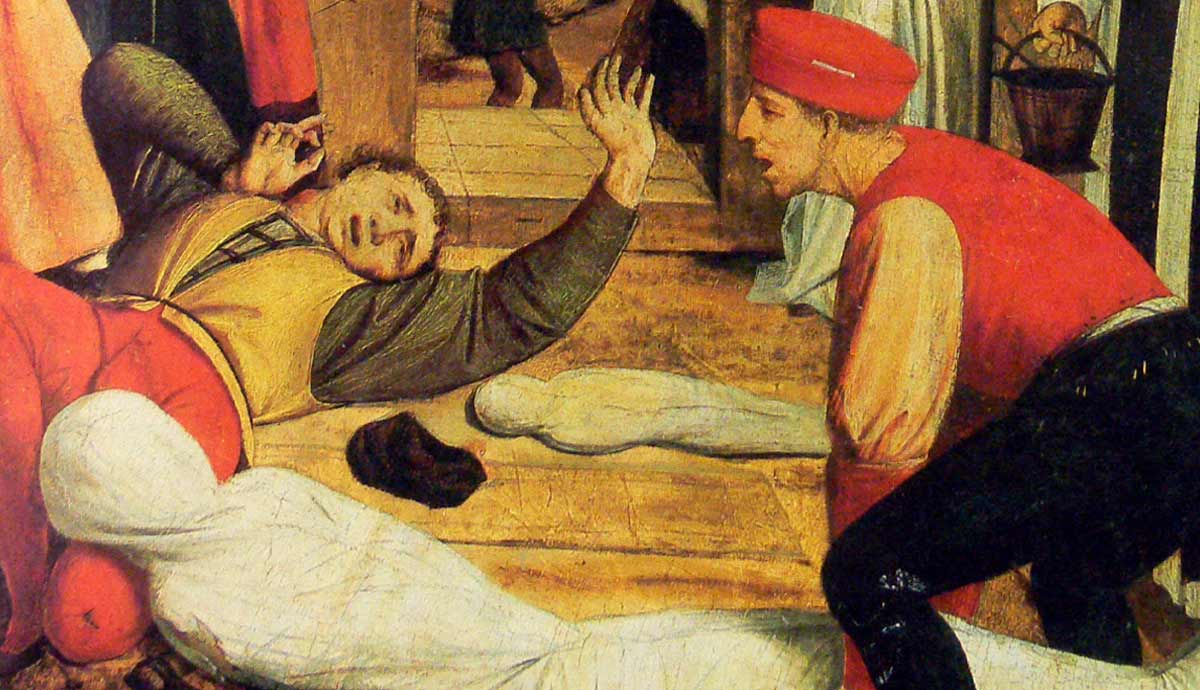
Saint Sebastian pleads with Jesus for the life of a gravedigger afflicted during the plague of Justinian. (Josse Lieferinxe, (1497 – 1499). Source: Wikipedia
When the plague hit the Byzantine Empire, it did so rapidly and with extreme devastation. It first emerged in the Egyptian port of Pelusium in 541 CE and by the spring of 542 CE, it had reached the epicenter of the empire, Constantinople. The densely packed capital soon turned into a plague-ridden city. Court historian Procopius talked about the horror in his History of the Wars text in which he described the widespread destruction. Procopius estimated that approximately 10,000 people died each day in the city at the height of the plague.
According to Procopius, the entire city of Constantinople collapsed socially due to the plague and healthy citizens were overwhelmed with the tasks of caring for the sick and burying the dead. Going by his depictions, the city was filled with bodies, and the emperor ordered the construction of mass graves on the outskirts of the city to bury them. Although Emperor Justinian eventually survived the plague, he too at one point fell ill due to the disease and was in a coma for several weeks.
How the Army Was Affected
A map of the Byzantine Empire in 550 (a decade after the Plague of Justinian) with Justinian’s conquests shown in green. Source: Wikipedia
Like all other members of society, soldiers were equally susceptible to contracting the plague. Furthermore, because military camps and garrisons were usually overcrowded, the environments in which they lived provided perfect conditions for the plague to spread. Some historians estimate that the plague reduced the empire’s total population by 25 to 50 percent over its two centuries long cycle of recurring outbreaks. Consequently, the pool of available recruits for the Roman army shrank dramatically.
The Impact on Military Campaigns
Belisarius, byJean-Baptiste Stouf, ca 1785–1791. Source: J Paul Getty Museum
The war against the Ostrogoths in Italy, which began successfully under General Belisarius soon stagnated after the outbreak, as the constant drain on resources and personnel prevented the military from achieving a decisive victory. When Belisarius returned to Italy in 544 CE, he did so with a severely diminished force and was unable to achieve a decisive victory against the resurgent Ostrogothic forces. The war continued for another decade until 554 CE. Its prolonged duration can largely be attributed to the plague-weakened state of the Roman military.
Similarly, the plague limited the military’s ability to respond to the ever-present invasion threat posed by the Sasanian Persian Empire. The situation led to the empire agreeing to a peace treaty in 562 CE that had mixed outcomes. While the treaty secured the contested territory of Lazica for the Romans, it also obliged the Byzantine Empire to make substantial annual payments in gold to Persia.
How the Byzantine Army Tried to Overcome Personnel Shortages
Byzantine Siege Assault, in Codex Græcus Matritensis Ioannis Skyllitzes (BNE MSS Graecus Vitr. 26-2), c. 12th century CE. Source: Biblioteca Nacional de España
Because the number of native-born soldiers available as recruits was severely reduced by the plague, the Byzantine Empire needed to recruit huge numbers of foreign mercenaries to supplement their remaining forces. The greater reliance on mercenaries led to a new set of problems. Among them were issues related to the loyalty of mercenaries and the cost of hiring them. These factors burdened the already strained imperial treasury and ultimately weakened the empire, making it susceptible to the Arab-Muslim conquests.








 New Posts (Home)
 ChatBox
 Popular Posts
  Game Zone
 Top PodCasts