www.thecollector.com
Truth or Propaganda? The Black Legend That Denounced Spain’s Colonialism
The Spanish conquest of the Americas is known to have changed world history, marking the transition from the Middle Ages to modern times. It allowed the encounter of two worlds separated for millennia. However, like almost any imperial and colonial project, it was accompanied by violence, exploitation, and oppression. Spain’s true role in this context has been contested by many, some denouncing horrors committed while others defend against this supposedly exaggerated history that served propagandistic purposes. The truth of the Black Legend may fall somewhere in the middle.
The Birth and Development of the Black Legend
Flemish illustration of the Duke of Alva killing the innocent inhabitants of the Netherlands by N.A. 1572. Source: Rijksmuseum, Amsterdam
The “Black Legend” encompasses a collection of accusations against the Spanish Empire and its people, particularly regarding its colonial activities in the Americas. Its historical origins are in Spain’s wars against the Dutch and the English during the 16th and 17th centuries. During this time, Protestant propaganda used events denounced during the Spanish colonization of the Americas to demonize the empire and the Catholic Church. These accusations often, as argued from the Spanish perspective, exaggerated the allegedly violent and horrific interactions between the conquistadors and Indigenous communities.
The starting point of this propaganda is widely agreed to be the work of Spanish Dominican friar Bartolomé de las Casas, who in 1552 published A Brief Account of the Destruction of the Indies, where he reported the violence being carried out. De las Casas’ father had participated in Christopher Columbus’ trips, and in 1502 he himself arrived in the Antilles. He visited several enclaves of Spanish expansion and denounced the abuses being committed against the Indians. His account reached the emperor Charles V, who, after reading it, promulgated additional laws designed to protect native peoples, 1542’s New Laws of the Indies for the Good Treatment and Preservation of Indians.
Cover of Brevísima relación de la destrucción de las Indias (A Short Account of the Destruction of the Indies) by Bartolomé de las Casas, 1552. Source: Wikimedia Commons
One of the most important contributions of this new legal framework was the prohibition of enslavement by instituting the encomienda system. This system consisted of Indigenous peoples exchanging labor for protection from Spanish colonizers. Although intended to give Spanish imperialism a more humane veneer, the change caused discomfort among Spanish colonists, as some saw it as a threat to the profit they were acquiring from Indigenous labor. Other colonists, such as Spanish jurist Juan Ginés de Sepúlveda, argued that Indians were servants by nature.
Although it is difficult to confirm that de las Casas’ account was accurate, his denouncements were indeed used as Protestant propaganda against Catholicism and the Spanish Empire, which led to a change in the perception of Spain in Europe. By the 18th century, Italian Illustration used Spain as an example of despotic imperialism and abusive religious practices. By the 19th century, American nations had become independent from colonial European powers, and the previous years were seen as periods of oppression, particularly under the Spanish political system of viceroyalties.
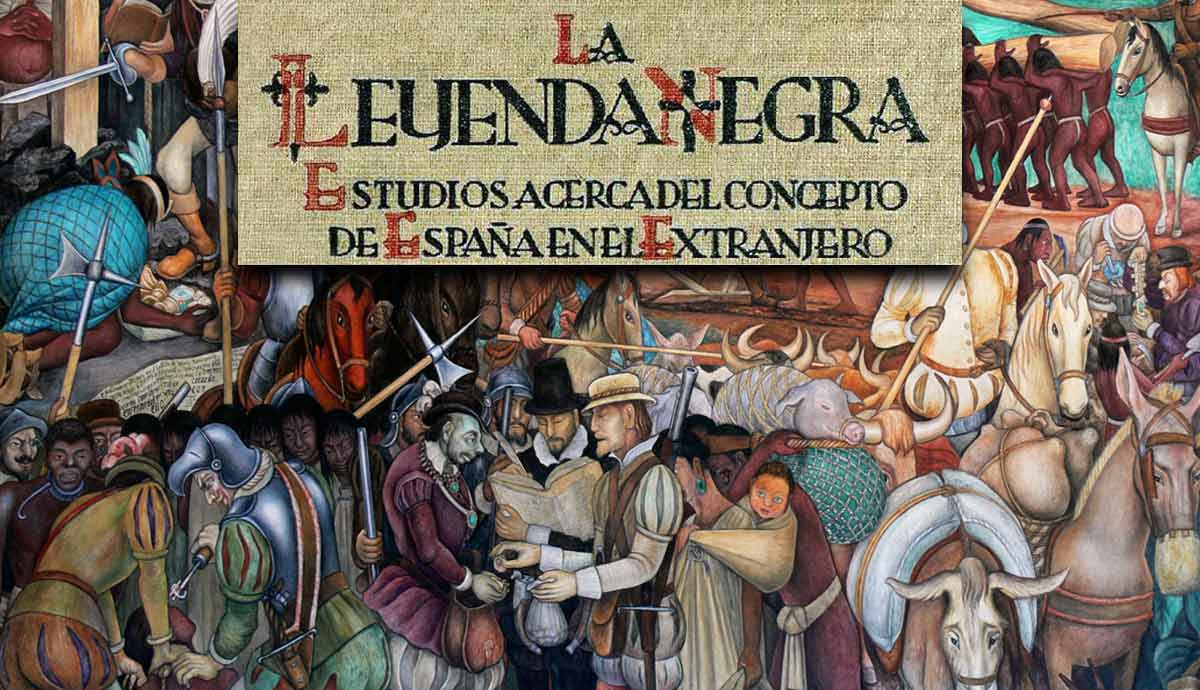
Cover of La Leyenda Negra. Estudios Acerca del Concepto de España en el Extranjero (The Black Legend: Studies of Spain’s Perception Abroad) by Julián de Juderías, 1943. Source: Biblioteca Digital Hispánica
The Black Legend gained more popularity in the late 19th century, when Spain lost Cuba and the Philippines to the United States. It was especially popularized by one of its most relevant critics and detractors, the conservative Spanish Crown official, historian, and sociologist Julián de Juderías, who claimed that the history of Spain in foreign countries had been perceived through the lenses of exaggeration and manipulation, specifically the horrors committed during the Spanish Inquisition and the Spanish Conquest of America.
A book comprising this work called La Leyenda Negra y la verdad histórica (The Black Legend and Historical Truth), published in 1914 and re-edited several times, gave way to numerous critiques of Spanish history and intense responses from Latin American historians, sociologists, and anthropologists. The latter’s response has been, in part, because Spanish academics have long used pro-Spain rhetoric to deny the oppression and violence the Empire committed in Indigenous Latin American lands during the colonial period.
The Debate Gains Momentum
Mural depicting the exploitation exercised by Spanish conquistadors. Diego Rivera, c 1952. Source: Archivos de la historia
Spain’s colonial influence in the Americas between the 16th and 18th centuries has become a hot topic in recent years, becoming a contentious political issue between Latin American countries and Spain. More specifically, in 2019, Mexico’s then-president, Andrés Manuel López Obrador (popularly called AMLO), asked the Spanish state to apologize and recognize publicly the horrors and abuses committed during colonial times against the native Indigenous communities of Mexico. This demand led to an ongoing diplomatic crisis between the two countries; the king of Spain, Felipe VI, who never responded to AMLO’s formal request, was not invited to the 2024 presidential inauguration of Mexico’s first female president, Claudia Sheinbaum. Consequently, neither the king nor the president of Spain, Pedro Sanchez, attended the event.
Apologies offered by ex-colonial powers to colonized countries are not new or rare: Germany apologized to Tanzania for colonial violence carried out in 1907; Belgium to the Republic of Congo for the exploitation, domination, and inequality that marked its colonization; The Netherlands to the former colonies impacted by slavery; Portugal for its role in the transatlantic slave trade; and the United Kingdom to the Kenyan Mau Mau people. The question remains, then: why has it been so difficult for contemporary Spain to acknowledge its colonial past and the negative impact it had on other countries that in many ways, still suffer from the echoes of the 16th and 17th centuries?
The Consequences of Spain’s Expansion in the Americas
Page 53v of Book 12 of the Florentine Codex, describing the conquest of Mexico and depicting Indigenous Nahua people getting sick with smallpox. Compiled by Fray Bernardino de Sahagún, c. 1585. Source: Digital Florentine Codex
Although the Black Legend’s use for propaganda is well documented, it does not twist historical realities too much. Because of Spanish expansion in the Americas, most of the Indigenous population was extinguished, up to 90%. People vanished rapidly, not only because of the harsh treatment Spain employed while imposing its foreign social and economic systems and religion, involving executions, mutilations, and violations (Elcofidencial, 2013), but also because of the diseases the Spanish brought with them, such as smallpox, chicken pox, bubonic plague, malaria, and typhus. The disappearance of Indigenous groups was described in detail by Fray Bernardino de Sahagun, a Franciscan missionary who arrived in Mexico in 1529 and wrote an encyclopedic work about central Mexico called The Florentine Codex, also known as the History of the Things of New Spain.
Detractors of the Black Legend argue that no empire cared more for the protection of Indigenous communities who were being colonized than Spain. However, although historical legal evidence may support this argument, including the aforementioned New Laws, the Spanish crown inarguably sought expansion. To achieve this goal, Spain established settlements through land dispossession, prohibited any expression of Indigenous cultures, and created a market trade based on the extraction and exploitation of natural resources. These events had long-lasting negative consequences that shaped Latin American societies through to the present.
Photo of Parque Colón (Columbus Park) in Santo Domingo, the Dominican Republic by Mario Roberto Durán. 2017. Source: Wikimedia Commons
Spain’s colonial expansion initiated the erasure of not only Indigenous people but their beliefs and world views. Crosses were planted on native sites of worship and offerings. Catholicism became the dominant religion that prohibited and punished any expression of Indigenous belief, as it was seen as an expression of barbarism or demon worship. As a result, Indigenous communities lost their capacity to sustain their societies at the deepest level of faith and belief, which made them vulnerable and easily co-opted by Spain’s foreign societal structures.
Spain’s establishment of a social structure based on race and caste in the Americas produced deep divisions between communities. While Indigenous groups were disappearing, it is estimated that almost 2 million Spaniards settled in the Americas. At the same time, 1.5 million African slaves were introduced to replace the Indigenous people dying of disease and maltreatment. During the colonial period, different ethnicities would mix, producing diverse ethnic combinations. The system of castes had as its primary objective the classification of these racial variations, stratifying people in a hierarchical social system, where white Spanish would be at the top and Indigenous and Black communities at the bottom.
This system, although it has received some recent skepticism as a historical fact, reflects a discriminatory society that shaped still-present racial divisions in different American countries, where many more privileged sectors of society still discriminate against Black and Indigenous communities.
A caste portrait depicts the social system of racial division the Spanish implemented in the Americas. Unknown artist, 18th century. Source: Lugares INAH
In economic terms, the relationship between American lands and the Spanish crown was one based on labor and land exploitation. Through the encomienda, Spain was able to dominate Indigenous territory, forcing Indigenous people to become its workforce. Although the encomienda was distinct from outright slavery, it worked comparably: Indigenous people were tasked with the most demanding work and were also traded among merchants and travelers to provide transportation.
Alongside this system, trade between Spain and the American settlements incorporated many forms of looting and exploitation of precious minerals and natural resources that many impoverished merchants saw as an opportunity to gain more social and economic power. This led in many cases to dispossession of native lands and resources.
The Debate Continues (But Reality Remains)
Book cover La Leyenda Negra, Historia del Odio a España (The Black Legend, A History of Hating Spain) by Alberto G. Ibáñez, 2023. Source: Almuzara Libros
Returning to an earlier point of contention, after the Mexican government asked Spain to apologize for the abuses committed during Spain’s colonial period, many Spanish academics retaliated intensely, offering aggressive counterarguments that sometimes mix moralist opinions with historical revisions. These range from arguing that Spain cannot apologize to Mexico because it did not exist as a state in the 16th century, to arguing that the phenomenon of war and dispossession was common at that time. Perhaps one of the most painful arguments is that, if Latin American people are to ask anyone to apologize, it is their own ancestors, as they are the descendants of the colonizers who arrived in the Americas and committed the alleged crimes.
Many of these academics refuse to acknowledge that, regardless of any historical minutia supporting an alleged altruist attitude from the Spanish crown, its uninvited presence on the American continent broke apart pre-Columbian societies, cultures, and belief systems. This reality is easier to perceive from inside countries in Latin America and the Caribbean, where historians and anthropologists have proven that unequal modern societies are the result of centuries of racial and economic divisions and exploitation that originated in the 16th century. Moreover, in terms of modern geopolitics, historical and anthropological research has shown that ex-colonial powers owe their current economic wealth and power to, precisely, the colonized lands they exploited for resources and labor. As an act of historical reparation and accountability, and in line with its neighboring countries who have already done so, an apology from Spain would be appropriate.








 New Posts (Home)
 ChatBox
 Popular Posts
  Game Zone
 Top PodCasts