www.thegospelcoalition.org
2 Corrupted Christianities in ‘Wake Up Dead Man’
The latest in Rian Johnson’s Knives Out franchise is, like the previous entries, a Clue-esque murder mystery. The movie invites viewers to consider who among a colorful cast of suspects is guilty. Yet in Wake Up Dead Man (rated PG-13 for violence and vulgar language)—a whodunit set in a Catholic church—we’re invited to also consider another question: Who among these clergy and churchgoers are true believers, and who are charlatans?
As “proud heretic” detective Benoit Blanc (Daniel Craig) seeks the material truth of what happened in this particular murder mystery, a parallel question emerges: What is the supernatural truth, if any, at the core of Christianity?
These questions aren’t just interesting plot devices. They’re personal for the exvangelical Johnson, who grew up a “youth group kid” in Protestant churches but no longer professes to be a Christian. As Blanc probes the guilt or innocence of murder suspects, Johnson is also weighing the merits of different expressions of Christianity. The picture that emerges isn’t entirely surprising, with Trumpian conservative Christians as the villains and inclusive progressive Christianity as the ideal.
Tomb Is Empty
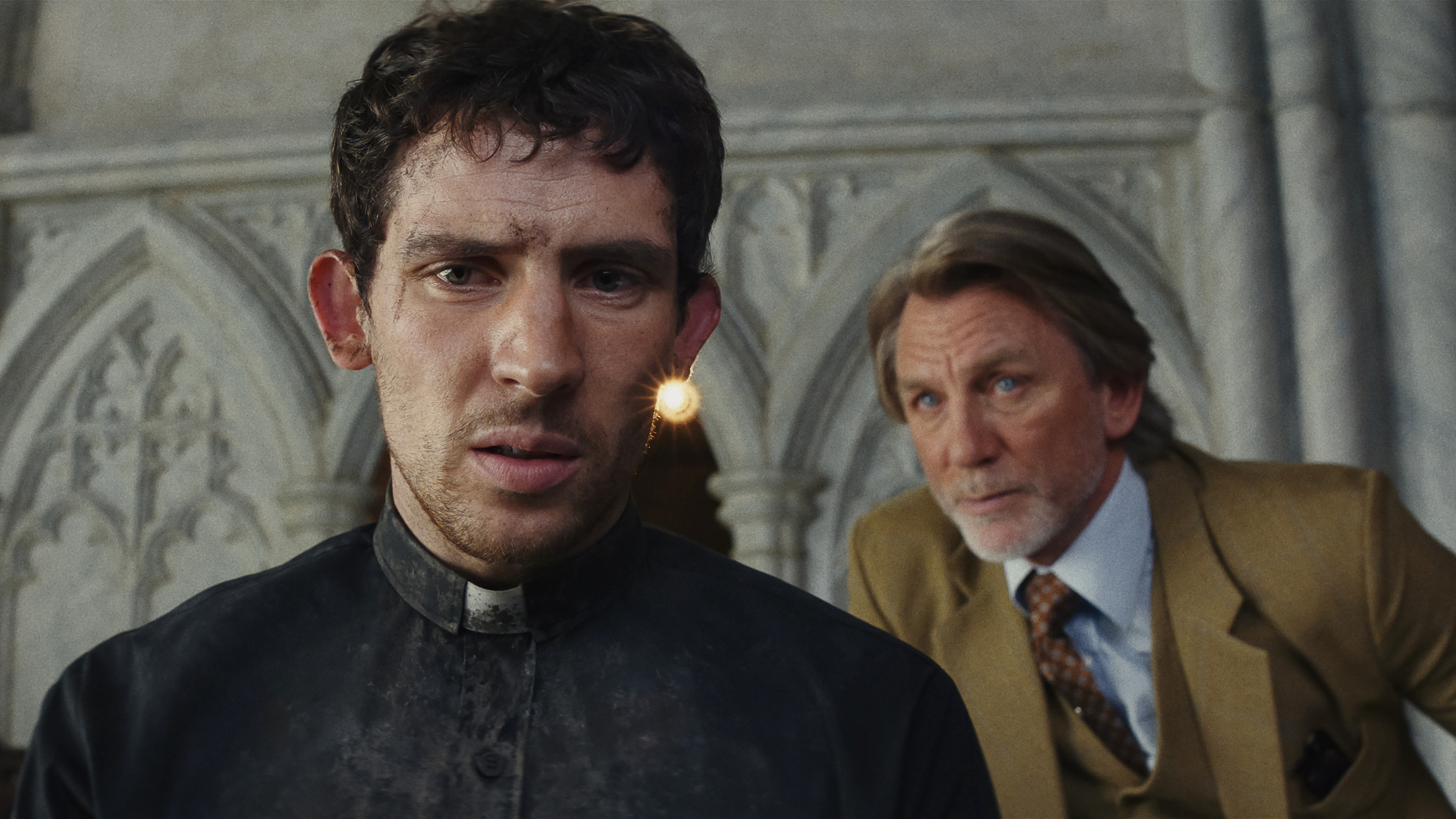
The plot setup is simple: A young priest, Father Jud Duplenticy (Josh O’Connor), is sent by the local diocese to help out at a dwindling congregation—Our Lady of Perpetual Fortitude—led by a firebrand conservative Catholic priest, Monsignor Jefferson Wicks (Josh Brolin).
During the first Holy Week of Jud’s tenure at the church, a shocking murder takes place in the middle of the Good Friday service (when else?). The handful of congregants are all immediately suspects in the murder, which also includes a “resurrection” twist on Easter Sunday (of course!). Lines like “Martha says the tomb is empty” and “It is finished” make the Gospel allusions unmissable. Blanc is soon on the case, and the usual array of motives, alibis, twists, turns, and red herrings ensues.
As Blanc probes the guilt or innocence of murder suspects, Johnson is also weighing the merits of different expressions of Christianity.
Characteristically for the Knives Out franchise, the cast of Wake Up Dead Man is full of talented actors in juicy, memorable roles. Glenn Close is particularly fun as a classically uptight, legalistic church secretary and busybody appropriately named Martha. But it’s the three leading men—and their different ways of relating to Christianity—that form the film’s thematic heart. Let’s look at each carefully.
Monsignor Wicks: Trumpian Faith
Wicks is obviously a proxy for Donald Trump. This makes it clear from the first minutes that Johnson intends this film not just to examine Christianity’s faults generally but rather to specifically assess what he sees as the corrupting influences of Trumpism on American Christianity.
Wicks preaches fiery, political sermons that keep his flock hardened, angry, and in fear. He advocates church-versus-world Christianity. Because the church has “lost so much ground” in a liberalizing secular culture, it’s time to get tough, fight back, drop inoffensive “winsomeness” and beat back the lib barbarians at the gate.
Wicks derides limp-wristed Christians who have gone with the grain of modernity. He wants Our Lady of Perpetual Fortitude (note the church’s name) to stay strong, hold the line, and champion right-wing political values with no apologies. Clips of his sermons on YouTube have titles like “Non-binary | Non-godly,” “Racism Does Not Exist in God’s Kingdom (USA)” and “There’s G-O-D in DOGE.” He’s essentially the stereotype of the American pastor who “knows what time it is” and justifies bullying tactics and crass rhetoric in the name of a greater good.
Wicks’s us-versus-them Christianity is decidedly not seeker-sensitive. He relishes driving progressive-leaning congregants away. At one point in a montage, we see a series of walkouts during sermons: a single mom, a gay couple, a mask wearer. Anyone with a shred of woke sympathies isn’t welcome in Wicks’s church.
As for the devoted remnant in his congregation, Wicks disciples them not to be more like Christ as much as to be resentment-filled, paranoid culture warriors and hype men for his own agenda. Politically ambitious online influencer Cy (Daryl McCormack) learns from Wicks the various evil acronyms that can be convenient political totems (e.g., BLM, CRT, CDC, DEI). Cy sums up the “basics” of political strategy as “Show them something they hate and then make them afraid it’s going to take away something they love.”
Cy’s relationship to Christianity is decidedly postmodern. It’s not about actually believing or disbelieving “truths” the faith professes; it’s about how Christianity’s storytelling cachet can be leveraged for clicks. It’s all narrative and spin; truth is irrelevant.
Paranoid conspiracy theorist writer Lee Ross (Andrew Scott)—who literally builds a moat around his fortress house—justifies Wicks’s cruel means because they’re “fighting an existential war” and “God chose Monsignor Wicks to be his warrior.” In one of the more on-the-nose jabs at Trump-supporting evangelicals, several characters express their unfailing devotion to Wicks, no matter how bad his morality is.
“We’re with you, Wicks,” Ross says. “And literally nothing you could say or do is going to change that.” When an incident of Wicks’s sexually immoral past is brought to light, one woman downplays it in a manner too similar to many Trump supporters: “I don’t need you to be a saint.”
When he comes into this broken congregation, Jud rightly observes that “this is not the true church.” But is the version of Christianity Jud espouses that much truer?
Father Jud: Progressive Inclusive Faith
If Wicks is the proxy for Trump, Jud is the proxy for the progressive exvangelical’s dream pastor. Johnson has said as much in interviews, noting that in Jud he wanted to “put all of the positive things that [he wants] more in the world that were part of [his] experience with Christianity into a character.”
If Wicks is the proxy for Trump, Jud is proxy for the progressive exvangelical’s dream pastor.
The result is a pastor with street cred (a former boxer) who curses like a sailor but is also compassionate. When he leads his first prayer meeting, he casts his alternate vision: “This is all about breaking down walls between us and God, us and each other, us and the world.”
Early in the film, Jud rejects how a senior clergy characterizes pastoral ministry: “A priest is a shepherd, the world is a wolf.” Jud doesn’t believe this. “You start fighting wolves, and soon everyone you don’t understand is a wolf. . . . Christ came to heal the world, not to fight it.”
In contrast to Wicks, Jud wants a Christianity more about hugs than fists (“We are here to serve the world, not beat it”). His ambition is to “show broken people like [himself] the forgiveness and love of Christ.”
Jud speaks from a place of receiving God’s gracious forgiveness himself. Having accidentally killed a man in a boxing match, he clings to God’s mercy: “He loves me when I’m guilty.” That becomes his mantra in pastoral ministry. He doesn’t inflict shame, guilt, or fear on his vulnerable parishioners. He tries to point them to Christ’s grace. He sums up his approach when he declares his purpose “is not to fight the wicked and bring them to justice, but to serve the wicked and bring them to Christ.”
Of course, there’s much to admire in Jud’s ministry. Aspects of O’Connor’s endearing performance make this form of Christianity attractive: a priest who prays over the phone with hurting people, who clearly loves his flock and isn’t just using them, a man who is quick to confess his own sins and slow to judge others. But is his form of Christianity too appealing? What about the Bible’s unpopular parts and the difficult necessity of repentance?
Notably, talk of sin is largely absent in Jud’s ministry (his preferred term is “brokenness”). And in the film, greed and ambition for power are the only behaviors warranting correction (“Your real inheritance is in Christ,” Jud rightly tells one money-hungry congregant). For all he talks of grace, is Jud’s a “cheap grace” that downplays turning from sin?
At one point, Jud describes the “miracle” Christianity offers. It’s not about “being cured or fixed,” he says. Nowhere does he mention the miracle of the gospel and our blood-bought salvation. Rather, the miracle is “finding the sustaining power to wake up every day and do what we’re here to do—in spite of the pain. Daily bread.”
Huh? The core of Jud’s gospel feels flimsy—more akin to“follow your heart” motivation than soul-saving, sin-atoning good news.
Detective Benoit Blanc: Materialist Faith
Blanc doesn’t show up until 40 minutes into the film. His grand entrance comes with a dramatic flourish of light (a recurring visual motif), as if to signal the illuminating arrival of reason-based, scientific enlightenment.
Blanc’s mom was “very religious,” and he grew up with Christianity. But in adulthood, he moved on from the “child’s fairy tale” of Christianity, which he says justifies all manner of violence, misogyny, and homophobia (Blanc is gay).
“I kneel at the altar of the rational,” Blanc declares, noting that the only thing he really appreciates about Christianity is its Gothic architecture. Late in the film, he summarizes his investigation’s conclusions while standing in the church’s pulpit. Blanc figures into the film as a sort of secular priest who administers justice with dogged, material objectivity.
Blanc is a proxy for Christianity skeptics. He has a forensic wiring and zealotry for justice akin to Saul before he became Paul (a connection the film makes explicitly). He wants to get to the real truth, but he desires “a truth [he] can swallow without choking.” What makes Christian truth hard to swallow for Blanc? No doubt the biblical stances (and the church’s consistent teaching) on sexuality are a big stumbling block. Perhaps the “inclusive” church that Father Jud dreams of is the sort of Christianity that might win over a “proud heretic” like Blanc?
Spoilers ahead. It’s telling that at the end of the film, when Blanc gets a goodbye hug from Father Jud, he brushes off a personal invitation to celebrate Mass. “That’s so nice of you,” he says to Jud. “There’s nothing I would rather not do. Toodaloo!”
Apparently, the “hugs, not fists” Christianity of Jud isn’t enough to compel a skeptic to take it seriously. It’s a nice, inoffensive, inclusive faith, but one most people can easily live without.
Two Toothless Christianities
Wake Up Dead Man reminds me of Paul Schrader’s First Reformed in how it contrasts two contemporary expressions of American Christianity. Schrader’s 2018 film juxtaposes a theologically liberal, activist-oriented church (First Reformed) with a seeker-sensitive, prosperity-gospel-preaching megachurch where the cost of discipleship is nil (Abundant Life). In their extremes, each church may appeal to certain people. But by smoothing over Christianity’s inherent paradoxes (justice and joy, cross and resurrection, repentance and grace), they miss the mark of biblical faith.
A similar dynamic defines the two types of Christianity Johnson presents in Wake Up Dead Man. In this case, the “seeker-friendly” church is the one Father Jud espouses—the one where the church marquee says “all are welcome” and personal sin is rarely called out. Wicks’s antagonistic church—with a dwindling, fearful, angry congregation—evokes First Reformed, except here it’s right-wing. Both films display two errors of the modern church: the error of political advocacy (left or right) overtaking evangelism and discipleship, and the error of seeker-oriented, therapeutic, “cheap grace” pragmatism.
Both Christianities end up being toothless. Political-advocacy Christianity offers partisan organization and a galvanizing moral rationale for certain public policy crusades, but you can get that from any number of other places too. Seeker-friendly faith offers feel-good therapeutic vibes and low-cost self-improvement, but you can also get that from any number of other places.
It’s no wonder Blanc leaves Wake Up Dead Man as disinterested in Christianity as he was at the start. What he sees on display from both Wicks and Jud is just not that compelling. It’s audience-captured Christianity, not true Christianity.
What this movie (and First Reformed) should leave us feeling is a desire for a tension-holding, faithful Christianity reflecting the best aspects of both Wicks and Jud, both First Reformed and Abundant Life. This is the church where sinners aren’t casually affirmed under the guise of cheap grace, nor cruelly shamed without hope. This is the church where sinners are led to repent but are also transformed: washed, sanctified, justified (1 Cor. 6:11).
This is the church that emphasizes both personal holiness and societal transformation, that loves the world as God does (John 3:16) but opposes its worldliness (1 John 2:15–17) and disciples believers to not conform to worldly patterns (Rom. 12:2). This is the church where the cross of Christ is neither a partisan weapon nor a neutered symbol, but rather the glorious means of our salvation, the wisdom of God, and the message we must preach (1 Cor. 1:22–24).
Had he encountered this sort of church over the course of his investigation, Blanc might still have rejected Christianity. But at least he would have, for a moment, looked true Christianity full in the face.








 New Posts (Home)
 ChatBox
 Popular Posts
  Game Zone
 Top PodCasts