www.theamericanconservative.com
On James Garfield, Netflix Prints the Legend
Culture
On James Garfield, Netflix Prints the Legend
A new miniseries looks at the life and times of the assassinated president.
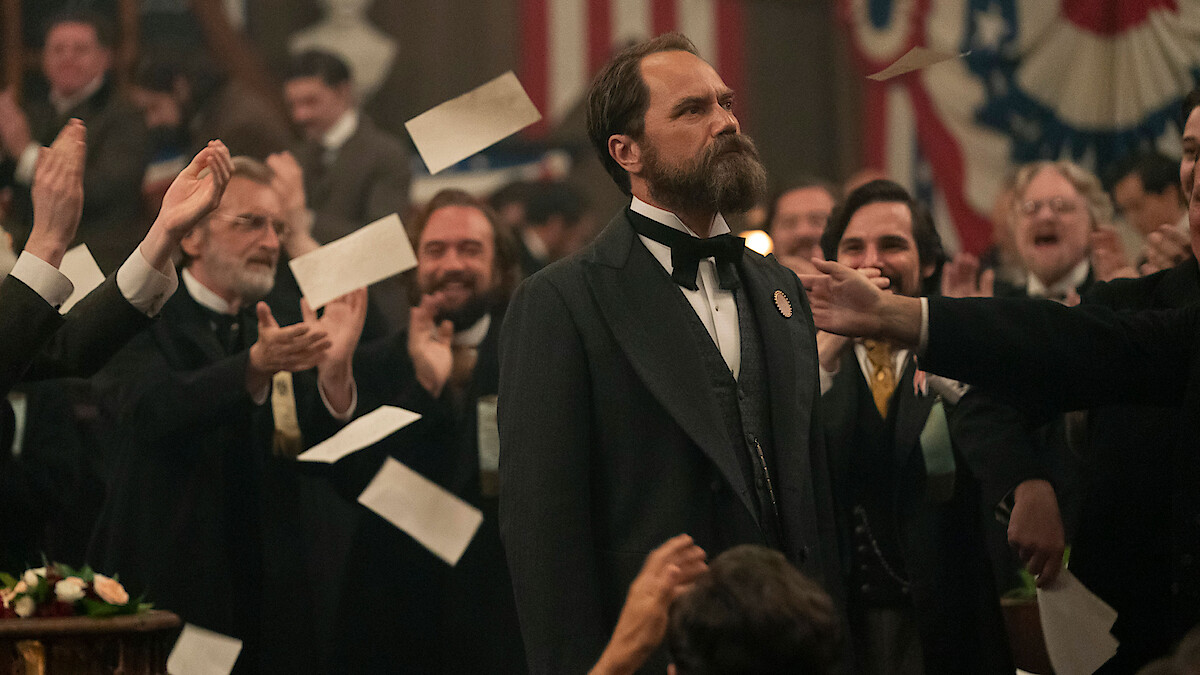
As we’re still receiving updates about last year’s two attempted assassinations on Donald Trump, Netflix has a new miniseries about the second assassination of a U.S. president. “This is a true story about two men the world forgot” reads the opening text—an accurate description of both President James A. Garfield and his killer, Charles J. Guiteau.
Adapted from the book Destiny of the Republic: A Tale of Madness, Medicine, and the Murder of a President by Candice Millard, in four episodes Death by Lightning intertwines the lives of Garfield and Guiteau—the only president and assassin to meet in person prior to the fateful event—as it chronicles the presidential election of 1880, the opening months and difficulties of Garfield’s administration, and his slow death which reset American politics.
At the dawn of the decade, the Republican Party was aching from incumbency; a Reconstruction of the South that was widely acknowledged as a failure, a stolen presidential election in 1876 that renewed partisan bitterness, and a divided base within the party.
The split was between the “Stalwarts,” led by New York’s Senator Roscoe Conkling, who believed in patronage and machine politics, and “Half-Breeds,” led by Maine’s Senator James G. Blaine, who favored more meritorious appointments. (Blaine himself suffered from charges of bribery, and it’s easy to make the case that it was more a battle of ego than principle.) The series is not kind to the former President Ulysses S. Grant, the Stalwart’s choice for a then-unprecedented third term, recognizing his “grift and corruption.”
Although he did not enter the Republican convention in Chicago as a candidate, the former Union general and Ohio Congressman James Garfield emerged as a compromise between the two factions to break a deadlock and after an electrifying speech. “In a profession with the lamentable tendency to attract show ponies instead of workhorses, and a period favorable to partisan grandstanding, Garfield had embraced undramatic efficiency in the driest fields of lawmaking imaginable, obsessively tending to the vital, oft-neglected inner clockwork of American government,” writes his biographer, C. W. Goodyear, in President Garfield: From Radical to Unifier.
Narrowly defeating Democratic nominee Winfield Scott Hancock “the Superb”—who does not appear in the series—in the popular vote with only a 2,000 ballot difference, Garfield spent his four conscious months as president navigating appointments and struggling with Conkling over dominance in Washington. When he finally seemed to have outmaneuvered his erstwhile party rival, Garfield was shot by Guiteau on July 2 in a Washington, DC train station.
“Assassination can no more be guarded against than death by lighting. It’s best not to worry too much about either one,” Garfield had written in a letter the previous November, which inspired the series title. After two and a half months of painful incapacity, he died on September 19, 1881, thanks in no small part to the gross incompetence of his doctors.
The Academy Award–nominated actor Michael Shannon brings a decency and demonstrable strength to the late president, introducing an admirable, self-made leader to an unfamiliar audience. Matthew Macfadyen’s presence is delightful, and his performance so light and humorous it almost garners sympathy for Guiteau, who’s portrayed more as delusional than the deranged man he was in real life. Nick Offerman is well cast as Garfield’s vice president and successor, but the choice to make Chester A. Arthur, a notorious dandy known for his iconic afternoon naps, a bruiser and inebrient is an odd one.
The series’s language is anachronistic, mostly for the benefit of swearing—the modern profanity is prolific, making the contrast with authentic speeches from the era feel even more incongruous. Although billed as a drama, it’s actually quite funny, making many of its significant departures from the historical record more forgivable, either for entertainment or service to narrative. (Although falsely portraying Guiteau as Catholic at any point of his life is a gross addition.)
Death by Lightning, just as contemporary clean-government advocates did in real life, lionizes Garfield as a martyr for civil service reform, helped by Guiteau’s claim to be a rejected office-seeker. In actuality, his middle-of-the-road record demonstrates “his softness on specifics, his preference for meeting bosses halfway rather than antagonizing them,” writes Goodyear.
But this is always the case with assassinated presidents, whose memories become glossier than their records: Lincoln on civil rights, Kennedy on Vietnam, and Garfield on civil service. The current historical rankings—which I’ve covered previously in The American Conservative—put Garfield and Arthur at 27th and 30th, respectively.
Unfortunately, despite positive reception the miniseries suffered from a weak opening, charting fifth among Netflix original series its first week with only 3.2 million views. The wider public is not accustomed to historical dramas, but hopefully Hollywood executives see that kept under a reasonable budget, there is societal benefit to chronicling these undertold stories in American history.
The post On James Garfield, Netflix Prints the Legend appeared first on The American Conservative.








 New Posts (Home)
 ChatBox
 Popular Posts
  Game Zone
 Top PodCasts