www.thecollector.com
6 Outrageous Facts About Jonestown & the Peoples Temple
As 20th-century America progressed into its second half, the seeds of revolution and change were planted, rooted in various ideas and causes. People looking for a better life, protection against a fearful future, or something to believe in the 1960s and 1970s often turned to charismatic cult leaders. Evangelist Jim Jones saw the opportunity to lead vulnerable Americans to a set of beliefs he constructed, promising a sense of community and a socialist utopia to his followers. The shocking collapse of his Peoples Temple in 1978 left many questions. Time has uncovered a few answers, but scholars and historians still marvel at Jones’ ability to engage and control his followers.
1. What Was the Peoples Temple?
Jim Jones in San Francisco in 1977, photographed by Nancy Wong. Source: Wikimedia Commons
James Warren Jones, known as Jim, was born in Indiana in 1931. He gained an interest in religion around the age of ten when he accompanied a neighbor to church. From there, he visited other houses of worship and became passionate about his spirituality. After marrying, he was called to become a minister in 1952.
Later, he branched out on his own, gaining a reputation as a faith healer and preaching in an evangelical manner. He created the Wings of Deliverance church in 1955, which later became the Peoples Temple. The mission of the Peoples Temple was to create a society of equality devoid of class and race issues. The congregation believed that living by socialist principles would lead to a kingdom of God on Earth. Jones called his method of living “apostolic socialism.”
2. The Temple Was Diverse
Jim Jones was praised with a Martin Luther King, Jr. Humanitarian Award in 1977. Photograph by Nancy Wong. Source: Wikimedia Commons
Unlike many aspects of society in the mid-20th century, the Peoples Temple welcomed members from all races. Their belief in equality was one of the foundational principles, and the church was one of the few places in America where whites were the minority. Members of the congregation varied not only in their racial backgrounds but in age and social class. People who had been maligned by society were welcomed with open arms and treated with equality at the Peoples Temple.
3. The Congregation Moved Several Times
Guyana is located in the Northeastern area of the South American continent. Source: Suriname Central / Wikimedia Commons
The Peoples Temple was founded in Indianapolis, Indiana, where it enjoyed considerable success with its involvement in the community, which led to a growing congregation. Jim and his wife Marceline were happily married, had a son, and adopted several children. However, in 1965, Jones claimed to have had a vision of a nuclear apocalypse. He decided to move his group to California, asserting that a safer location was to be had there. The group moved to Northern California originally but then headed south, spending time in San Francisco and Los Angeles. The congregation would move for the final time in 1977.
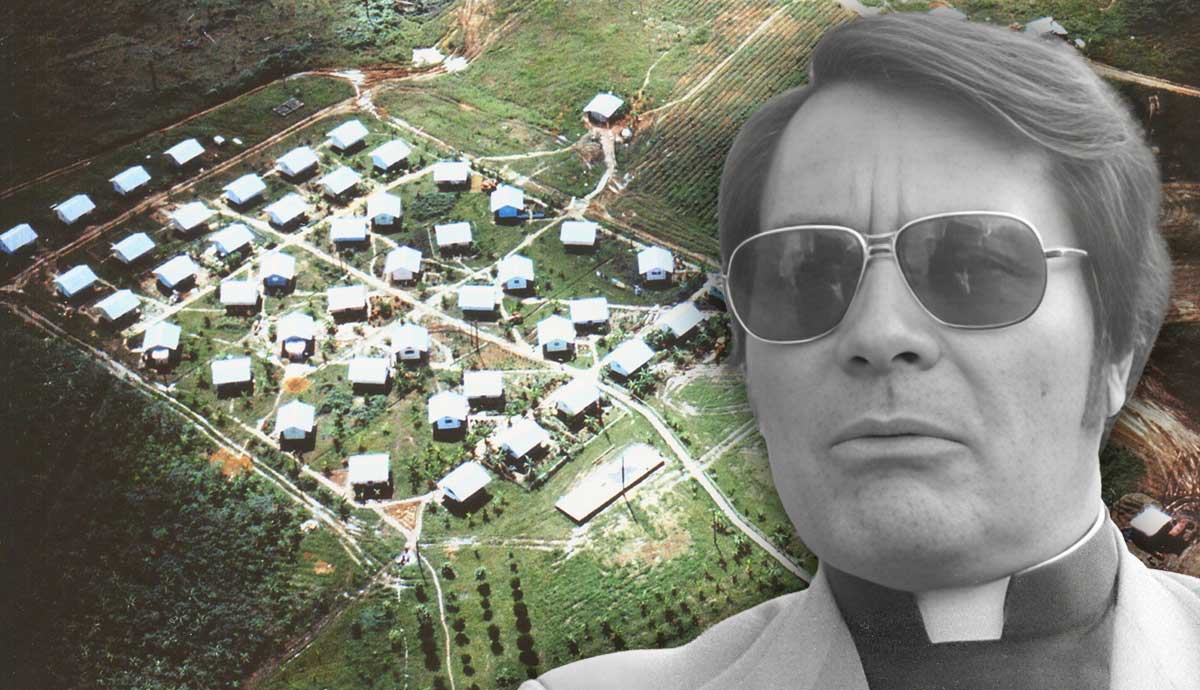
Jonestown from the air. Source: Federal Bureau of Investigation / Wikimedia Commons
The Temple rented land in Guyana, which borders the Atlantic Ocean, Brazil, Suriname, and Venezuela in the Northeast region of South America. Sparsely populated, the region offered a tropical climate conducive to agriculture.
Three years before the migration, Jones sent workers to the acreage to prepare it for settlement. The community that became known as Jonestown was secluded, requiring travel by air or boat followed by several miles of rough jungle roads. By the time the majority of the congregation moved in 1977, the settlement, known as Jonestown, or the Peoples Temple Agricultural Project, had already been built, with sixty homes, commercial-sized kitchens, food storage, laundry areas, an infirmary, two schools, and a large pavilion for meeting and worship. The goal was to create a utopia where the group could exercise their beliefs and create their idealistic community without government interference and oversight. It would also allow Jones to build and exercise his power further.
4. Families Were Divided
A sign welcoming visitors to Jonestown. Source: Wikimedia Commons
Another method that Jones used to control his congregation was to split up existing families. He declared himself the “father of all” and discouraged sexual relations while at the same time carrying on numerous sexual affairs himself. He saw romantic relationships as a threat to the egalitarian ideas of the Temple and encouraged members to focus on their work in the community rather than their individual families.
Jones instructed parents on when and how to punish their children and also held public punishments, both verbally and with a paddle. In addition to breaking apart families within Jonestown, the Peoples Temple was responsible for the division of multiple families in the outside world. Some married couples or other relations could not reconcile religious beliefs involving the Temple, leading to divorce and estrangement when one family member left to join Jones. Custody issues even arose when one parent chose to join the church, and one was against it.
5. A Six-Year-Old Served As the Catalyst for Mass Suicide
Bodies of Jonestown congregants photographed by a member of the US military in 1978.
A child custody battle is believed to be the incitement for Jones’ decision to lead his followers to death. As time passed, Jones’ teachings became more fanatical. Inquiries from the US government increased, largely encouraged by the Concerned Relatives organization that was founded by family members who had anxieties about the fates of their loved ones living in Jonestown. Jones became paranoid as a result, and this wariness was further fueled by drug abuse. The final straw came when Grace and Timothy Stoen attempted to retrieve their son, John Victor Stoen, from Jonestown.
Jones’s followers farming in Jonestown. Source: Julia Scheeres via Newsweek
Grace had defected from Jonestown in 1976. Her husband left a year later, but complications arose when he tried to remove his son, John. The couple had signed an affidavit not long after the child’s birth that claimed Jim Jones was John’s father. Jones cited the affidavit and claimed Grace was an unfit mother, retaining physical custody of the boy. California courts awarded the Stoens custody of their son in 1977, but there was no way to retrieve him from Jonestown. This court order also prevented Jim Jones from ever entering the United States again without facing contempt of court charges for failing to return the child to his parents. This court case became a major threat to Jones’ power, setting a precedent for other families to seek child custody or adult conservatorship of loved ones lost to Jonestown.
Congressman Leo Ryan. Source: Office of the Clerk, US House of Representatives / Wikimedia Commons
Tim and Grace Stoen visited Jonestown along with several other concerned relatives and Congressman Leo Ryan in November 1978. Ryan’s mission was to visit Jonestown and determine if people were being held there against their will. Cases such as the Stoens had brought national attention, which led to many in the US asking questions about the reality of Jonestown.
6. They Didn’t “Drink the Kool-Aid”
Photo of drink mix in Jonestown after the massacre. Source: Federal Bureau of Investigation / Wikimedia Commons
As his paranoia grew, Jones believed that if push came to shove, mass suicide was the only way to save his congregation and himself from the outside world. He put his followers through suicide drills, in which they would be woken in the night, forced to congregate at a central meeting place, and given a drink they were told was poisoned. After the visit from Ryan and his entourage on November 18, 1976, sixteen people elected to leave with the congressman. Jones ordered an attack on the group as it attempted to board planes to leave the local airstrip, then led his followers to their deaths, distributing cyanide-laced punch. Some argue that the event was not a mass suicide but a mass murder. While some may have drunk the punch willingly, it appears that some church members were injected or may have been forced at gunpoint to take the liquid. The 304 children who perished at Jonestown, including John Victor Stoen, certainly were not capable of making the decision to die for their church.
The kitchen at Jonestown. Source: Federal Bureau of Investigation / Wikimedia Commons
The phrase “don’t drink the Kool-Aid” has become a common saying in the United States when encouraging someone not to fall victim to false ideals. This trope arose as a result of reporting after the Jonestown incident, but it wasn’t Kool-Aid that poisoned the followers. Flavor-Aid was the drink used in the suicides.
Regardless, the saying has mixed connotations today and is considered offensive by many who had family members among the deceased. Nine hundred seven people died in the poisonings at Jonestown. Jim Jones and his nurse, Annie Moore, died by gunshot. At the Temple’s headquarters in Jonestown, Sharon Amos slit her children’s throats and her own, adding four to the death toll. Five people, including Leo Ryan, were killed in the attack at the airstrip. The total number of deaths as a result of the events in Jonestown on November 18, 1976, is 918.








 New Posts (Home)
 ChatBox
 Popular Posts
  Game Zone
 Top PodCasts