www.thecollector.com
The Life of Lady Bird Johnson, First Lady and Environmental Advocate
Claudia Alta Taylor, widely known as Lady Bird Johnson, was the First Lady of the United States from 1963 to 1969. She dedicated much of her role to environmental conservation and beautification campaigns. Almost always smiling, Lady Bird Johnson wielded a strong influence on her husband, President Lyndon B. Johnson. Influenced by her beliefs and interests in nature, President Johnson’s administration issued nearly 300 conservation measures, which ultimately led to the establishment of the Environmental Protection Agency in 1970.
Lady Bird Johnson’s Early Years
Portrait of Claudia Alta Taylor (age about 6 months) with Alice Tittle. Source: Lady Bird Johnson Presidential Library
Claudia Alta Taylor was born on December 22, 1912, in Karnack, Texas, in a plantation house on the outskirts of town. Her father, Thomas Jefferson Johnson Taylor, was a wealthy businessman who owned cotton plantations and general stores. Her mother, Minnie Lee Pattillo, was from an aristocratic family in Alabama, loved classical books and literature, and was often seen reading classics to little Claudia.
Lady Bird Johnson was only five years old when her mother died due to complications from a miscarriage. She was primarily raised by her maternal aunt, Effie Pattillo, who moved to Karnack after her sister’s death, and her nursemaid, Alice Tittle. Reportedly, it was Alice who nicknamed her “Lady Bird,” saying that she was as pretty as a ladybird.
A quiet and shy child, Claudia spent most days outdoors, near the shores of Caddo Lake in Texas, closely examining tall pines, moss, and wildflowers blooming. To some, she was lonely as a child. However, “Lady Bird” herself once said: “To me, it definitely was not … I spent a lot of time just walking and fishing and swimming.” Her love for nature would remain a lifelong passion and inspiration.
Lady Bird Johnson’s Education & Meeting Lyndon Johnson
Lyndon and Lady Bird Johnson on their honeymoon at the Floating Gardens in Xochimilco, Mexico, November 1934. Source: Lady Bird Johnson Presidential Library
Lady Bird Johnson enrolled at the University of Texas at Austin and received a Bachelor of Arts in History in 1933. In 1934, she earned a second degree in Journalism. During this period, she was introduced to a 26-year-old Lyndon B. Johnson, who was working as a congressional aide at that time.
They married after just three months. According to Mrs. Johnson’s own words, it was love at first sight: “Sometimes Lyndon simply takes your breath away.” The couple had two daughters: Lynda Bird and Luci Baines.
From the very beginning of her husband’s political career, Lady Bird Johnson supported the future president both emotionally and financially. She provided $10,000 (around $222,000 in 2025) from her inheritance for the first congressional campaign in 1937 and assisted in running his congressional office during World War II. In 1960, she remained beside her husband on a 35,000-mile campaign trail as Second Lady and visited 22 countries. Johnson once remarked that “voters would happily have elected her over me.”
In 1942, Mrs. Johnson, along with her family, purchased the radio station in Austin, Texas, which remained operational until 2003, thanks to the business skills inherited from her father.
Becoming the First Lady & an Environmental Advocate
Official White House portrait of Lady Bird, by Elizabeth Shoumatoff, 1968. Source: White House Historical Association/Library of Congress, Washington DC
After President John F. Kennedy was assassinated on November 22, 1963, Lyndon B. Johnson became the next president and moved to the White House. In her new role as First Lady, Lady Bird Johnson continued the cultural legacy initiated by her predecessor, Jacqueline Kennedy, by promoting the arts, historic preservation, music, and literature. She hosted exhibitions featuring American painters such as Georgia O’Keeffe and Andrew Wyeth.
Lady Bird Johnson also played a key role in organizing concerts by the National Symphony Orchestra, the American Ballet Theatre, and local school choirs. In 1965, she launched the White House Festival of the Arts, an ambitious gathering of artists, writers, and musicians with over 300 guests. These efforts aimed to make the White House a living center of American culture and history. In April 1965, Lady Bird Johnson completed Jackie Kennedy’s East Garden restoration project. The garden was later renamed Jacqueline Kennedy Garden.
Mrs. Johnson built on this foundation with her own quiet but determined leadership, expanding the role of the First Lady into one of cultural patronage and public engagement. Nevertheless, the environment and its protection remained her key focus throughout her career. The status of the First Lady gave her immense possibilities to translate her love for nature into a national policy.
The Beautification Campaign
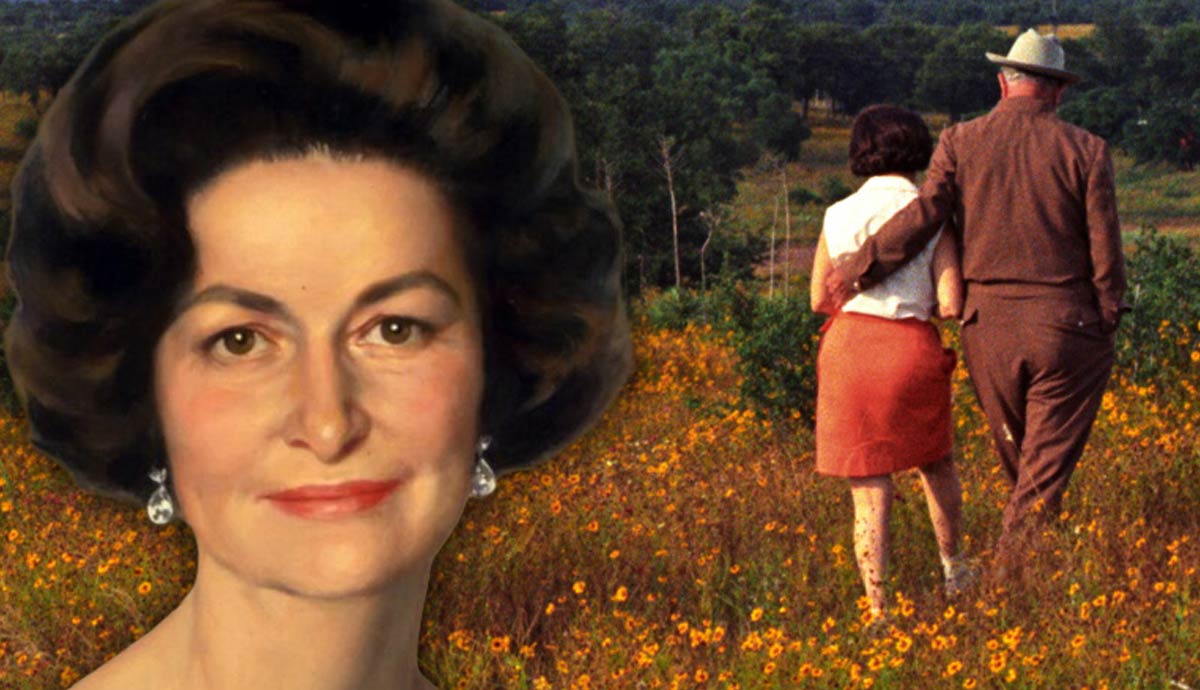
President Lyndon B. Johnson and Lady Bird Johnson walk through a field of wildflowers. Johnson White House Photographs. Source: National Archives Catalog
In 1964, Lady Bird Johnson established the First Lady’s Committee for a More Beautiful Capital and later expanded it to encompass larger areas. The Committee received private donations, and, in the initial phase, it organized a flower-planting campaign in malls, avenues, public housing properties, and other areas.
In addition to planting flowers, the society worked to raise public awareness and organized beautification campaigns in relatively remote neighborhoods of Washington DC. The committee also produced informative articles on these topics, such as The ABC’s of Beautification and Beautification: You too can help.
Many donated various types of flowers, trees, and other plants to be planted in Washington parks and outdoor public spaces. Lady Bird Johnson’s campaign also influenced and inspired businesses to support beautification measures, especially in low-income neighborhoods of the country.
Lady Bird Johnson among Texas wildflowers (Bluebonnets and Indian Paintbrush), by Robert Knudsen, 1968. Source: Lady Bird Johnson Presidential Library
Lady Bird Johnson’s persistent advocacy led to the enactment of the 1965 Highway Beautification Act, commonly referred to as “Lady Bird’s Bill.”
According to the legislation, outdoor advertising would be altered, and specific types of signs, as well as junkyards along the primary highways, would be removed. This would improve the roadside areas. Based on this bill, the Surface Transportation and Uniform Relocation Assistance Act of 1987 required that at least 0.25 of 1 percent of resources be allocated to planting native plants and flowers. According to “Lady Bird,” these efforts were meant to deliver “clean water, clean air, clean roadsides, safe waste disposal and preservation of valued old landmarks as well as great parks and wilderness areas.”
Lady Bird Johnson managed to acquire the support of both the private and public sectors, including Secretary of the Interior Stewart Udall, local Washington government officials, architects, landscape architects, as well as both public and private school groups.
To support the efforts of the First Lady, the White House produced two documentaries: Mrs. Johnson Goes to Washington and Showcase for the Nation. These documentaries have significantly contributed to highlighting the success of Mrs. Johnson’s program as well as galvanized wider public support for environmental activities.
Lady Bird Johnson’s Conservation Efforts
Sec. Stewart Udall, Lady Bird Johnson, and Laurance Rockefeller (left to right) look at an architectural model of Washington DC, LBJ Library photo by Robert Knudsen, 1967. Source: Lady Bird Johnson
In May 1966, the White House hosted the Conference on Natural Beauty. The meeting was organized in response to growing concerns about pollution, overcrowded cities, and the degradation of scenic landscapes. Lady Bird Johnson played a pivotal role in organizing the conference, both as a presenter and supporter of its cause. She opened the conference with a question: “Can a great democratic society generate the drive to plan, and having planned, execute projects of great natural beauty?”
Similar conferences were later held throughout the United States, sparking the national conservation movement, which emphasized not only the protection of wild lands but also the preservation of everyday environments in parks, neighborhoods, roadsides, and cityscapes.
The movement encouraged the protection of the natural environment to reduce environmental impact and preserve ecosystems for future generations. It also highlighted the role of public participation in shaping more thoughtful, livable spaces. In line with this, to Lady Bird Johnson, natural beauty should have always been protected as it represented one of the greatest resources the United States held.
To spread this message, she began visiting Native American reservations as early as 1964.
Lady Bird Johnson spreads seeds on the site of the National Wildflower Research Center, photograph by Frank Wolfe. Source: Lady Bird Johnson Library
Through Lady Bird’s public activism—media appearances, letters, and official discussions—the construction of dams at the Grand Canyon was stopped, and the Redwoods National Park was established. These measures were reinforced through the legislative initiatives passed by the Johnson administration. Among them are the Wilderness Act of 1964, the Land and Water Conservation Fund, the Wild and Scenic Rivers Program, and many additions to the National Park system.
As an illustration of his support for Lady Bird’s environmental activism, on July 26, 1968, President Johnson presented the First Lady 50 pens, which were used to sign 50 laws on environmental protection, conservation, and beautification. It was accompanied by the plaque, which stated: “To Lady Bird, who has inspired me and millions of Americans to try to preserve our land and beautify our nation. With love from Lyndon.”
Legacy of Lady Bird Johnson
Lady Bird Johnson and President Lyndon B. Johnson, photograph by Robert Knudsen, 1968. Source: Lady Bird Johnson Presidential Library
During the Presidency of Lyndon B. Johnson and when Lady Bird Johnson served as First Lady, about 300 conservation measures were initiated or transformed into law.
Her efforts live on today in the form of vibrant playgrounds at public schools, lush green spaces in parks and neighborhoods, blooming public areas, and highways.
Quoting British Prime Minister Winston Churchill’s speech delivered at the British House of Commons in 1943, Lady Bird Johnson said, “First we shape our buildings, and then they shape us. The same is true of our highways, our parks, our public buildings, and the environment we create. They shape us.”
Indeed, much like Churchill, Mrs. Johnson viewed the surrounding environment and physical structures as having a profound impact on human behavior and how people interact with one another.
After leaving the White House in 1969, Lady Bird Johnson continued her advocacy as a member of the Advisory Board on National Parks, Historic Sites, Buildings, and Monuments. To commemorate her activism, Columbia Island in the Potomac River was renamed Lady Bird Johnson Park.
Among her many awards and honors was the Presidential Medal of Freedom, granted by President Gerald Ford on January 10, 1977.
The medal was accompanied by the following words:
“One of America’s great First Ladies, she claimed her place in the hearts and history of the American people. In councils of power or in homes of the poor, she made government human with her unique compassion and her grace, warmth and wisdom. Her leadership transformed the American landscape and preserved its natural beauty as a national treasure.”
In a 1982 poll, ranking the most influential First Ladies, Lady Bird was ranked third, behind Abigail Adams and Eleanor Roosevelt, primarily for her work as a conservation activist.
Lady Bird Johnson died on July 11, 2007, from natural causes at the age of 94.








 New Posts (Home)
 ChatBox
 Popular Posts
  Game Zone
 Top PodCasts