www.theorganicprepper.com
Dear Diary: It’s Me, Jessica: Chapter 29 (Book 2)
By the author of Dear Diary: It’s Me, Jessica
Here’s where the story left off last time.
Dear Diary,
It’s me, Jessica.
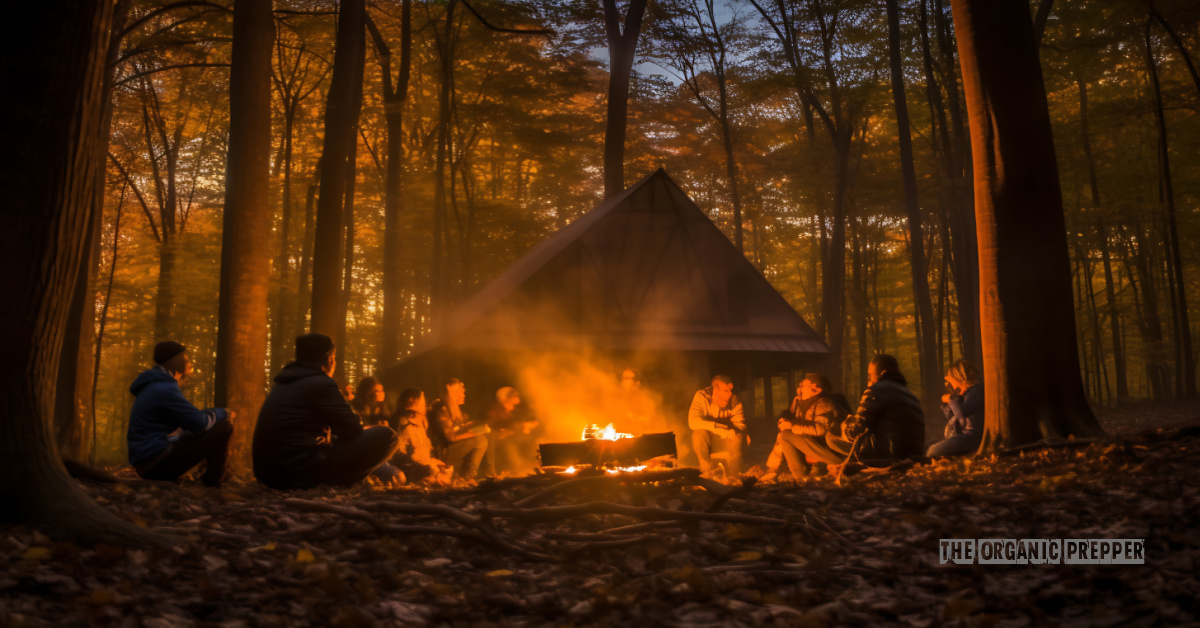
It was kinda odd, but nearly everyone in Four Corners gathered at the clearing where the bridge crossed the river, where we would hold Oktoberfest. They all wanted to hear what Captain Barnet’s story was.
Jack and I sat down on the ground and got our lunches out of our packs, while others sat on logs or brought their fold up camp chairs. Captain Barnet and his men sat on the big log next to Sean’s shack, with the lunch they had bought with some of the silver coins. Sean handed the Captain a large mug of ale. He took a sip and then started with their story.
…
The National Guard keeps a Standard Operating Procedure that, in the case of a prolonged power outage, they are supposed to report to their unit for peacekeeping, law enforcement, or humanitarian aid in support of the local and state government. Being Memorial Day weekend, a lot of Guardsmen were out of town.
“Only about ten percent of the unit showed up by Wednesday. I would like to think everyone else was out of town or they ran out of gas before they could get back.” He took another sip of ale and continued.
The base, having its own shooting range, was located on the outskirts of town. With the armory, the MRAPs, other military gear, and vehicles, the base had significant security. They also had generators and fuel.
“Only enough fuel for a rapid deployment. Ninety-six hours, once we set up the whole regiment with a few patrols for initial security in the immediate area. After that, we would need to refuel.”
With the power out, they set up one of the generators to power a command center and set up a radio farm to establish communications.
“It was a hot mess. No one knew anything. Not at the national level. The state or the local level. The National Guard, the military, even the civilian government side, many of them were out of town for Memorial Day weekend. All cell phone communications were down. Internet down. Even the classified government and military intranet was down.”
Captain Barnet looked down into his ale for a moment. Then looked at Jack. “You have heard the saying, ‘cut off the head of the snake and the body dies.” It was a statement. Not a question.
“Why bother cutting off the head if the head and body, by its own choice, leaves town for vacation? If there was someone behind this, they were cunning.”
“Any word on the source of the attack?” Jack asked as he leaned in towards Captain Barnet.
“Like I said, hot mess. Reports of a possible cyber attack on the grid. Possible physical attack on the grid. EMP. Multiple EMPs. We do know it was global. Then the reports of some kind of invasion from a foreign country. Some said it was the Chinese. Others, the North Koreans. Russians. Just intense fighting.”
“I saw a strange-looking tracked armored vehicle in the city. Front half blown off, on its side. No recognizable markings. Saw the remains of a soldier in a uniform I did not recognize, with what I think were name tapes, but did not recognize the language,” Jack said.
“What about the body?”
Jack shook his head.
“By then, decomposition, exposure to the elements, and every varmint from four blocks around had a go at it. Thought it best not to get too close.”
“Right.” Captain Barnet continued, “That is when things really got weird. Like, not just alien invasion theories, but inter-dimensional alien invasion theories are weird. Who could launch an attack like this on a global scale? Who benefits from something like taking us from a technologically advanced society to the pre-industrial revolution?”
“Who benefits?” Jack echoed as he looked into the dirt before him.
“By the second week, I no longer cared. I sent, went out with MRAPs to get our families and bring them to the base. It was absolutely insane to see how far society had fallen in such a short amount of time. We were picking up one of our men’s elderly parents when a mob showed up. They demanded we give them food, water, fuel, that kind of thing. We did not bring any of our food or water to give them. But they did not believe us. They began throwing rocks at us. Pieces of wood. Some were armed too. Rifles, shotguns, handguns, they were waving them around as well. Then someone took a shot at one of my men. Got him in the chest. His body armor saved him. But then the shooting started . . . from both sides. We lost several men to severe injuries and blood loss. Not sure how many civilians died or were wounded. We got out of there as fast as we could.”
He took a longer drink of the ale.
“We returned to base, locked the gates, barricaded them, and posted guards. A few other Guardsmen with their families showed up a few days later, but that was it. One of the Guardsmen’s husbands had the forethought to bring vegetable seeds with him and started a garden on the parade grounds. We had MREs, but that would only get us so far. And unless you drink a lot of water, constipation could be a problem, even dangerous.”
Jack actually chuckled at that. “Saw that once in a field exercise. They had to Medivac the Marine back to base for a bowel blockage.”
“Right. Being outside of town, next to a state forest, we were able to hunt. Winter got a little lean, but we made it through okay enough. That is when we really had to limit the use of the generators for heating, lighting and cooking. We would only use the radios once a day. National Guard units inside major cities, some tried a degree of humanitarian aid and law enforcement of local police departments. But once food ran out at the grocery stores, there were food riots. That many desperate people, they overwhelmed both the police and the Guardsmen. Thousands were injured, maimed, or killed. Dozens of National Guard units went silent. I assume they were overrun or had to run themselves. There were a few reports of Guard units who lockdown their bases and would shoot anyone who approached. Not sure if those were true or not. Heard similar reports about police departments too, but again, true or not . . .” he shrugged. “Then, suddenly, all the reports of fighting and an invasion just stopped. More wild speculation of who or where they came from.”
“In the spring we did get some reports of a few units that were still operating and made it through the winter. Surprisingly, most of them were in the North. They had cold weather gear and were accustomed to that kind of thing. We had some cold-weather gear, but nothing like those units. Every five years, they will do a two-week field exercise in places like Alaska or Maine in February. They are also outfitted to go a month of field operations before needing resupply. Some of them were conducting limited patrols, recon missions, and assessments, and even trying to rebuild what remained of society. But everyone’s main mission was food. How to grow it, how to raise it, or how to hunt it.
We could grow food, or hunt, but with the rifle range safety regulations, the state forest, there were no farms near by. We were doing okay, but there was real uncertainty about if and when we would take a deer, or trap a rabbit. Makes you think about how far removed we were from food production when you could just go to the grocery store and pick up a few steaks or walk by the lobster tank. Our seed bank was also getting thin, and despite our best efforts and letting vegetables go to seed, we were having limited success. Then, the fire happened. About two weeks ago, there was an electrical fire in the main box on the far side of the main building and armory where the generator hooked into in the middle of the night. By the time the night watch realized it, it was too late. We shut down the generator at night to conserve fuel. Even turning it back on, the electrical connections to the fire system water pumps were destroyed. We grabbed what we could in a rush and evacuated. There were other buildings but the main building had the kitchen, most of our supplies. The armory being a secure section of the main building, think of a concrete building within a building with a separate entrance like a bank vault, survived the fire. So we had weapons, ammunition, and the radios but we had to use the MRAPs to hook the radios up and then connect them to the antenna farm for long range communications. It was then we heard about other units gathering at the airfield. While the main building was still smoking, I made the command decision to make our way to the airfield. We loaded up what we had left, as much fuel and ammunition as we could, a tow behind generator, and came this way, East. After the confrontation with the mob, we tried to avoid cities and towns as much as we could. I did not want to have to shoot civilians. We have an electrical pump and tried to refuel at gas stations whenever we could. We got lucky twice. Once was an abandoned gas station that still had diesel fuel in the tank. The second time, a group of people had set up a barricade of cars and trucks around a gas station, had small generators for power. We traded some ammunition and a few silver and gold coins for fuel.”
“Where did you get the gold?” Sean asked.
“The one Guardsmen’s elderly parents, his father has been buying silver and gold coins in different weights, every month for over a decade. He had four hand-carrying safes full of coins in sleeves. He insisted we keep them in the hand safes, in an MRAP, and the MRAP locked at all times. Smart man.”
“Imagine that,” Sean said and rubbed his chin.
“Right. I think we have enough fuel to get us to the airfield if we have to go North to the interstate, but it will be close. I am not keen on hoping for us to find other gas stations for fuel. Hope is not a course of action.”
“Heard that,” Jack nodded. “What about other communities you have seen?”
“We rolled through mostly small towns. People would scatter or run. A few would stand outside their homes with a rifle or shotgun, looking as menacing as they could. One old man with a machete shouting obscenities. The one woman with what looked like a AK-47, by the way she held it and the look on her face, she knew how to use it. We kept driving. This place, Four Corners you call it, honestly looks like the most organized and peaceful place we have come across,” Captain Barnet gestured around him with the mug of ale.
“Aye. We do what we have to do. Priorities change when one has to wonder where and when his next meal is coming, if ’tis coming at all. You know that firsthand. As one of the local farmers said, many hands makes for light work. So, we work together when the need be for the community, but otherwise we stay out of each other’s way. To each their own by their own way and means. Not interested in having my neighbor up me arse.”
For the first time since we met him, Captain Barnet smiled and laughed lightly.
“Right,” and finished his mug of ale.
Entry two
Captain Barnet and his men stayed for another day, then backtracked to a road that would take them North to the interstate and continue their way to the airfield and other National Guard units. He seemed determined to reach the airfield, and his men seemed ready and willing to follow him.
Sean told him of our encounter with the state governor and that they should reach out to her. They could work together to put some form of government together. But he stressed that in the current situation, all government was very local. The Captain seemed to consider it and then simply said, “Right.”
When Jack and I returned to our own community and told the story about Captain Barnet and his Guardsmen to the others at dinner, HAM Guy noted, “Rather interesting, isn’t it? Prior to the power going out, we were so concerned with so many trivial things, first-world problems, then we got kicked off the top of the pyramid to the base levels.”
“Pyramid,” Rae asked with an arched eyebrow from across the picnic table.
“Maslow’s hierarchy of needs. We get to the top, self-actualization and metamotivation, but in doing so, we embraced the absurd. Like throwing a hissy fit when we once could binge-watch an entire season of some streaming service show in two days, and now they switched the model to only releasing one episode a week to keep your subscription going for six months at $12.99 a month. First world problems. Then the power goes out, and we get kicked back to the base of the pyramid: food, water, shelter, security. To some degree, the upper parts of the pyramid, like family and community. When was the last time you wondered or even cared about your social media likes?”
Diary, that really got me thinking. I am going to have to mull over what HAM Guy said a bit I think. But in the meantime, I have once again, filled up the pages of my diary and need to start a new book. So, I will see you in the next book!
About 1stMarineJarHead
1stMarineJarHead is not only a former Marine, but also a former EMT-B, Wilderness EMT (courtesy of NOLS), and volunteer firefighter.
He currently resides in the great white (i.e. snowy) Northeast with his wife and dogs. He raises chickens, rabbits, goats, occasionally hogs, cows and sometimes ducks. He grows various veggies and has a weird fondness for rutabagas. He enjoys reading, writing, cooking from scratch, making charcuterie, target shooting, and is currently expanding his woodworking skills.
The post Dear Diary: It’s Me, Jessica: Chapter 29 (Book 2) appeared first on The Organic Prepper.








 New Posts (Home)
 ChatBox
 Popular Posts
  Game Zone
 Top PodCasts