www.thecollector.com
How the Battle of Bannockburn Saved Scotland’s Fight for Independence
In the aftermath of the death of William Wallace, Robert the Bruce of Scotland sought to fight for Scotland’s freedom from English dominance. When King Edward II invaded with a massive army in 1313, the Scots managed to defeat them in detail. Bannockburn became one of the most important battles in Scottish history.
The Road to Bannockburn
The Trial of William Wallace before his execution by Daniel Maclise, 1870. Source: Wikimedia Commons
Towards the end of the 13th century, King Edward I of England became convinced that his realm could only be truly powerful if it controlled the entire British Isles. He set his eyes on Scotland and began sending armies up north to subdue the Scottish nobles. He hoped to force them to pledge allegiance to him, fearing that the country would otherwise become a French protectorate. From 1296 to 1304, English forces repeatedly fought Scottish forces led by independence leaders such as William Wallace.
Wallace won a notable victory at the Battle of Stirling Bridge and sent some of his forces south to besiege cities in northern England. His boldness and tenacity enraged the English, who sent additional forces north and began playing the Scottish nobles against one another. In 1298, Edward I defeated the Scots at Falkirk and Wallace was captured and executed in 1305 after returning to Scotland from exile on the European continent.
After Wallace’s execution, the English gained effective control of Scotland, and any Scottish noble who wanted to keep their power had to pledge allegiance to Edward I. In 1307, he died and was succeeded by his son, Edward II. In Scotland, a power struggle developed between two nobles that sought to rule all of Scotland: John Comyn and Robert the Bruce. When Robert killed his rival in 1306, he was crowned king of Scotland, prompting an English invasion. He began secretly raising an army to expel the English from Scotland entirely.
Edward and Robert
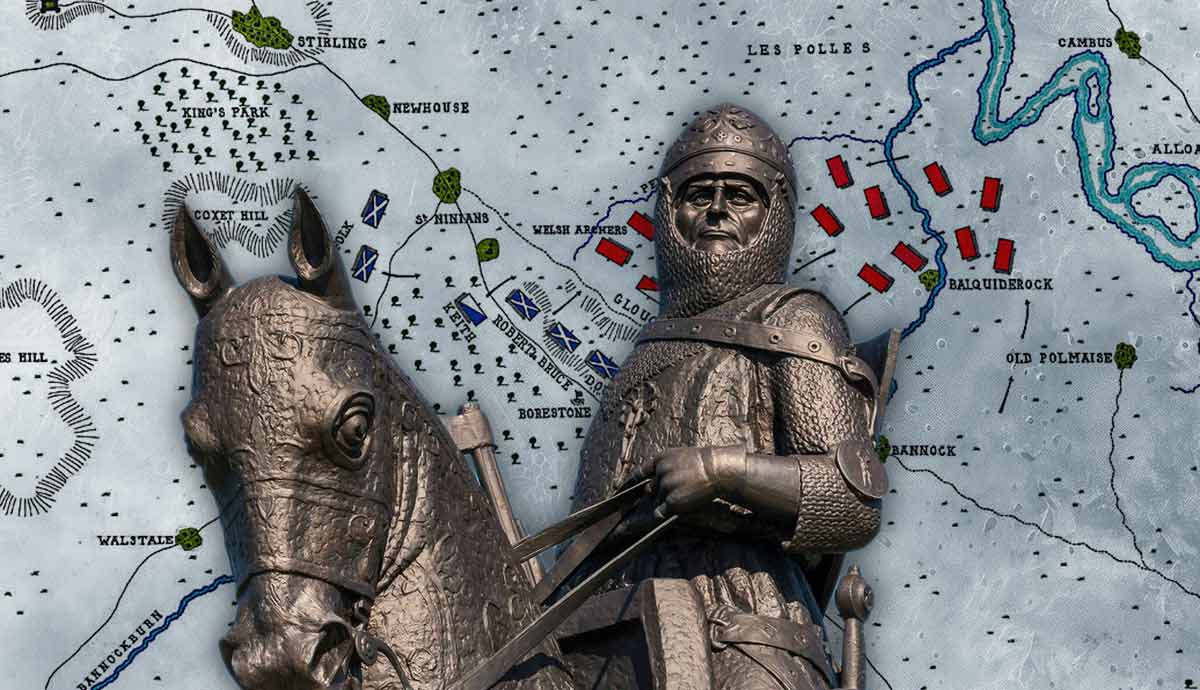
Statue of Robert the Bruce near Bannockburn. Source: Visit Scotland
When Edward II inherited the crown from his deceased father, he found himself facing the Scottish rebellion, threats from France, and doubts from some of his nobles. That made him determined to act quickly. Born in Caernarfon Castle in Wales in 1284, Edward II was 30 years old at Bannockburn and was determined to increase his royal authority.
As Prince of Wales, Edward lacked the reputation of his father, who was nicknamed the “Hammer of the Scots.” He married Isabella of France in 1308 when she was a mere 12 years old, but his close relations with his male favorite Piers Gaveston invited opposition from some senior nobles. By 1314, Edward was facing pressure from Parliament and dissenting nobles when he learned that Robert the Bruce had seized most castles in Scotland. This led him to order his army into Scotland.
In contrast to Edward, Robert the Bruce was an experienced warrior who believed that he could only rule Scotland through force. He was born in 1274 in Turnberry Castle, making him 39 years old at Bannockburn. Despite his initial support for Edward I’s invasion, he became a supporter of William Wallace and the cause of Scottish independence. Leading up to the battle, he was laying siege to Stirling Castle, one of the strongest English garrisons in Scotland.
Opposing Armies
Robert the Bruce reviewing his army before the Battle of Bannockburn, 1909. Source: Wikimedia Commons
As the two armies approached Bannockburn, a small creek south of Stirling, Robert’s forces were heavily outnumbered. He had a mere 6,500 men with him at most, the majority of whom carried spears. Prior to this battle, Robert had declined to fight the English conventionally. Instead, his forces pursued a strategy of guerrilla warfare, aiming to wear down the English over time. Nevertheless, he was an agile commander with experienced men under him by 1314. As opposed to the English, who had to march most of their forces overland with a heavy baggage train, the Scots could live off the land and were fighting on their own soil.
When Edward invaded Scotland in 1314, he brought with him the largest force to invade Scotland to date. Between 15,000-20,000 men marched northwards, a mix of archers, infantry, and cavalry. However, most of the English troops were ill-prepared to go against a more competent foe. They were slowed down by their baggage train and Edward foolishly ordered the archers to remain at the rear instead of acting as a vanguard. When his forces arrived at Bannockburn, they were surprised to see Robert’s forces deployed in front of them.
The terrain favored the defenders. To get to Robert’s forces, Edward would have to attack frontally across a stream into a narrow strip of grassland. Much of the terrain was too muddy for cavalry to operate effectively. The English forces were too large for a battlefield of this size and were exhausted by the intense marching. By choosing his terrain carefully, Robert nullified Edward’s numerical advantage.
The Battle Starts
Map of the initial phase of the battle. Source: British Battles
The Scots could see that they were outnumbered and they set up their defenses accordingly. Instead of infantry lines stretching as wide as possible, the Scots arrayed themselves in schiltrons, or square formations of spear-wielding infantry. As the English approached his forces, Robert took a small group of men with him ahead of his main body to conduct reconnaissance and ascertain the strength of the enemy force. The English ordered a small force of cavalry to strike Robert while he was ahead of his lines. In a celebrated moment in Scottish history, Robert slayed Sir Henry de Bohun on horseback and the English vanguard pulled back.
Robert’s army covered the road leading back from the creek, hoping that the English would not try to flank around. Because Edward did not see what the Scottish positions looked like, he ordered another cavalry assault led by Sir Robert Clifford against the Scots. Like the first force, this second assault proved to be a disaster. Horses were impaled on the Scottish spears or tumbled into ditches dug by Robert’s men. They failed to break through these defenses and the Scottish forces remained intact.
That night, Robert convened a military council to discuss how to proceed. One of his nobles suggested pulling back and letting the English march on until they ran out of supplies. The others advocated for remaining in place. They argued that the English could be defeated by counterattack. Meanwhile, English forces recovered from their losses and attempted to outflank the Scots from the east.
Edward’s Rout
Map of the second day of the battle. Source: British Battles
Early in the morning of June 24, the English crossed the Bannockburn and found the Scots inside the New Park woods. After a brief prayer, the Scots advanced towards the English lines. Both armies had more of their forces available to them than they did on the first day. Edward was surprised by Robert’s decision and ordered the Earl of Gloucester to launch a frontal assault. He was killed quickly and the Scots began attacking the rest of the English army.
English archers tried to fire volleys of arrows to stop the Scottish schiltrons but the Scots closed the distance quickly to engage in hand-to-hand combat. The archers then attacked by a force of five hundred Scottish cavalrymen. As the Scots pressed forward, the English line began to buckle. They suffered heavy casualties and lacked confidence in their leadership. To make matters worse, Scottish archers opened fire and caused chaos in the English ranks. The schiltrons proved impossible to break and the inexperienced English forces began to fall apart.
Once the rout began, it became impossible for the English to regroup. Many of the infantry drowned in the Bannockburn while taking flight. English commanders attempted to restore order to their forces, but to no avail. Edward found himself joining the rout in a desperate attempt to reorganize his army. The Scots took no mercy, hunting down every Englishman they could get their hands on. The result was that the English suffered thousands of casualties and their chance to relieve Stirling Castle was gone.
Robert’s Victory
Edward II repulsed from Stirling Castle, 1873. Source: Wikimedia Commons
One of Edward’s few surviving commanders, the Earl of Pembroke, managed to rescue Edward by directing him and a couple of knights northward towards Stirling Castle. The Scots were not aware that he was fleeing and they did not catch up with his retinue. When he arrived at the castle after the battle ended, the garrison commander, Sir Edward de Mowbray, urged him to stay away. He did not want Edward to fall into the hands of the Scots when he inevitably surrendered. The king agreed and moved on to Dunbar, where a boat spirited him back to England.
The Scottish victory was decisive. After years of fighting a guerrilla campaign, Robert the Bruce now had the opportunity to finish off the rest of the English garrisons and reclaim his territory in its entirety. He even felt emboldened enough to open a new front against the English by marching on Ireland. While this attack failed, he got his excommunication by Pope John XXII lifted and his successes in battle convinced the English to recognize Scottish independence in 1328 through the Treaty of Edinburgh–Northampton.
Edward had a much more ignominious end. Many English commoners accused Edward of angering God and he faced multiple revolts after returning home. An attempt to take the French crown led to a humiliating defeat in the War of Saint Sardos. In 1326, England was invaded by forces loyal to his estranged wife Isabella and her lover Roger Mortimer. Edward was forced to abdicate by his rivals and the French, leading to his imprisonment and death in 1327. Much of his failure to govern came from his foolhardy attempt to destroy Robert’s army at Bannockburn.








 New Posts (Home)
 ChatBox
 Popular Posts
  Game Zone
 Top PodCasts