www.theamericanconservative.com
J.D. Vance’s Mixed Signals on Iran
Foreign Affairs
J.D. Vance’s Mixed Signals on Iran
The vice president’s realist impulses sit uneasily alongside reflexive hawkism.
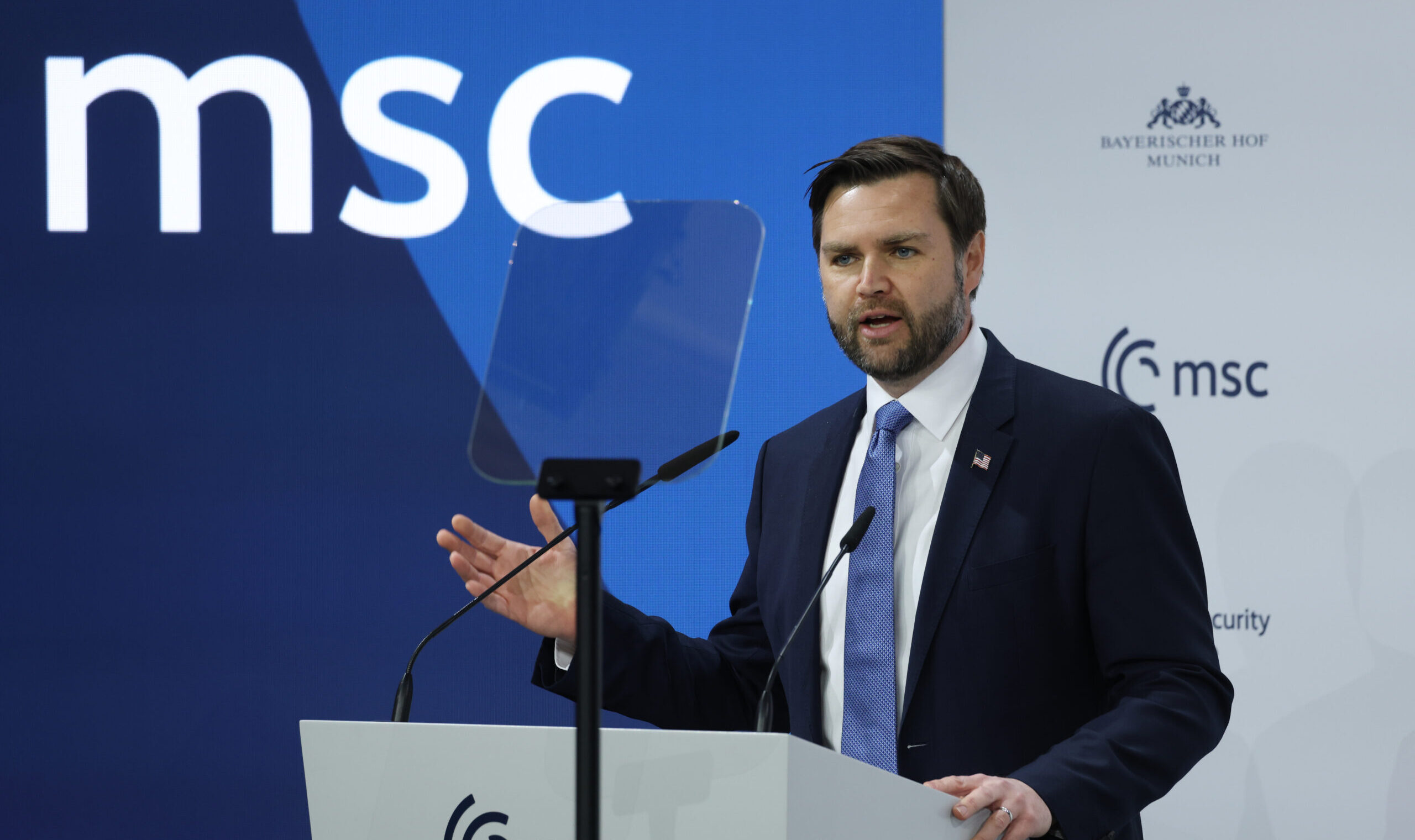
Credit: Sean Gallup/Getty Images
As the U.S. and Iran are engaged in a diplomatic effort to avert an all-out war, Vice President J.D. Vance’s recent comments on Iran present a study in contradictions. They exposed the unresolved tension within the Republican Party’s foreign policy—a tension between a pragmatic desire to deal with the world as it is and a reflexive hawkishness.
In an interview with Megyn Kelly, Vance said the Trump administration did not want to repeat the quagmire of the Iraq war and was focused on American security, not trying to spread democracy to Iran. He said President Donald Trump was willing to talk to everybody but noted that “the person who makes the decisions in Iran is the supreme leader” not Iran’s president.
That, of course, is not a new insight, but it does reflect a dispassionate analysis for which Vance deserves credit. He was stating an operational fact, not launching a moral crusade, and his frustration that “we can’t just talk to the actual leadership” stems from a transactional, realist mindset. He correctly identified the core dysfunction: the president of the United States can “pick up a phone and call” Russia’s President Vladimir Putin, Chinese leader Xi Jinping, or even the North Korean dictator Kim Jong-Un, but not the ultimate leader of Iran, which makes conducting diplomacy with that nation exceedingly difficult.
This framing by Vance is significant because it consciously sidesteps the dominant, moralistic one used by hawks in both the Republican and Democratic parties, especially after a recent massive crackdown last month on protestors in Iran. Vance praised the Iranian opposition but did not declare that talking to the regime grants it “legitimacy.” Instead, he focused on the mechanics of power—who holds it and how Washington can engage them to advance U.S. interests. This is a foundational insight of foreign policy realism: You must deal with regimes as they are, not as you wish them to be.
However, Vance undercut his own realist impulses in the same interview by inflating the threat from Tehran to U.S. interests. “Iran cannot have a nuclear weapon,” Vance said. “If [Trump] feels like the military is the only option, then he’s ultimately going to choose that option.” The problem, of course, is that military action is clearly not the only option, however challenging diplomacy may be.
Iran has consistently denied it is seeking nuclear weapons—a claim corroborated by U.S. intelligence—and engaged in negotiations with the U.S. during the first half of 2025 until it was struck by Israel, later joined by the U.S. And even after the June war, Tehran continued signaling its availability for nuclear talks—which is the very reason U.S.–Iran talks took place in Oman yesterday. And Iran has complied with a nuclear deal in the past and consented to an inspections regime.
Vance’s language, in that part, abandoned his own pragmatic analysis of impediments to diplomacy with Iran for implied maximalist goals, backed with a threat of war. This rhetoric does not create a diplomatic off-ramp; it builds a ladder to escalation. It is precisely the kind of framing that his comments on the Iraq war and Iran’s political system appeared to be moving beyond.
The political reaction was a perfect mirror of this tension. Vance’s threat was promptly endorsed by AIPAC, the standard-bearer for the hawkish, neoconservative foreign policy that Vance’s populist base distrusts. As Daniel McAdams of the libertarian Ron Paul Institute noted, this alignment is a liability with the rising generation of Republican voters. “AIPAC thanking Vance is not the win Vance may think it is. It is no longer a force-multiplier you want on your side and out front. It is a political liability you want to remain in the background,” McAdams wrote.
Vance’s statements expose a deeper, more personal political dilemma as he positions himself for 2028. The vice president is caught between a need to project unwavering loyalty to Trump and the strategic challenge of defining a distinctive, winning foreign policy lane for a post-Trump Republican Party.
Politically, Vance begins the 2028 cycle in a position of strength, widely regarded as the heir to the Trump movement. However, potential rivals are already maneuvering. Among them, Senator Ted Cruz of Texas has chosen to attack Tucker Carlson, a key Vance ally and staunch opponent of America’s endless wars in the Middle East. In doing so, Cruz is establishing a clear, hawkish, pro-Israel contrast to Vance’s more restrained posture. He is effectively staking an early claim to the neoconservative and traditional lane within the party.
This brings us to Vance’s fundamental political problem, which his Iran comments embody. On one hand, the traditional, interventionist wing of the GOP—represented by Cruz and institutional forces like AIPAC—remains a potent force. By endorsing the threat of military force against Iran, Vance signals to this faction that he can be trusted on core security issues.
On the other hand, the evolving Republican coalition, particularly the newer, younger, and more populist voters central to the MAGA base, show markedly different foreign policy instincts. They are more skeptical of foreign entanglements, more critical of unconditional support for allies, including Israel, and desire a foreign policy tightly focused on tangible national interests. Vance’s clear-eyed diagnosis of the dangers of Mideast wars and his focus on U.S. interests rather than spreading democracy spoke directly to this realist, deal-making impulse.
In trying to satisfy both camps, he may satisfy neither. Vance will never be seen as the natural candidate of the AIPAC–neoconservative establishment; that lane is already being occupied and fortified by rivals like Cruz and Secretary of State Marco Rubio. His comparative advantage lies in his connection to Trump’s populist base and a growing appetite among the Republican voters for a more focused, interest-based foreign policy.
Vance’s dilemma is thus not just about Iran; it is a preview of whether he can forge a coherent foreign policy identity that doesn’t sacrifice his unique political strengths in a futile attempt to win over a faction that will never be fully his.
The post J.D. Vance’s Mixed Signals on Iran appeared first on The American Conservative.








 New Posts (Home)
 ChatBox
 Popular Posts
  Game Zone
 Top PodCasts