www.thecollector.com
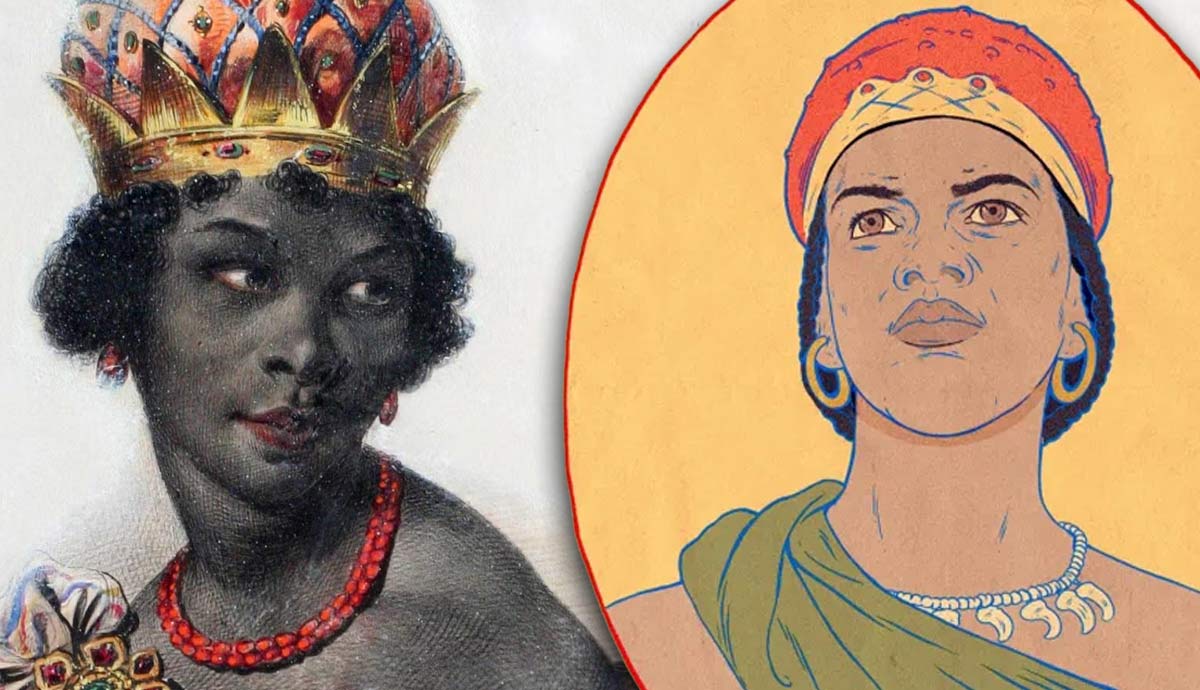
How Queen Nzinga Outsmarted the Portuguese Empire With a Human Throne
Nzinga Mbande was a 17th-century African Queen who ruled during the tumultuous times of European colonial expansion into Africa. Aiming to safeguard the indigenous kingdom from Portuguese influence and their expanding slave trade in Central Africa, Queen Nzinga demonstrated leadership, a strategic mindset, and diplomatic maneuvering, successfully navigating the complex geopolitical landscape of the 17th century.
Early Life of Queen Nzinga
Illustration of Queen Nzinga, by Louise Pomeroy. Source: Longreads
Ana de Sousa Nzinga was born around 1583 into the royal family of Ndongo in Kabasa, the capital of the Kingdom of Ndongo in central West Africa (modern-day Angola). In 1593, her father became the king of Ndongo.
According to local legends, Nzinga’s birth was challenging and complicated for her mother, Kengela ka Nkombe, and her name, Nzinga (“twist or turn”), refers to the umbilical cord wrapped around her neck. Local communities believed that a complicated birth meant that the baby was a spiritually gifted, powerful soul. Nzinga had two sisters and a brother, Mbandi, heir to the throne, who would later become King.
From a very young age, Nzinga underwent military training and became a skilled warrior. Being part of the royal family, she was often seen beside her father, observing how the king executed his duties. Nzinga also attended war and legal councils and participated in spiritual rituals.
During this period, the Kingdom of Ndongo frequently hosted European missionaries, and Nzinga learnt to write and read in Portuguese from Portuguese missionaries. Through these early experiences, she acquired a formidable knowledge and experience in statecraft, military strategies, and diplomacy, which proved crucial in her later roles as a diplomat and military strategist.
Historical Context of Colonial Angola
Queen Nzinga during negotiations, by Giovanni Antonio Cavazzi, 1690. Source: American Biography/John Carter Brown Library at Brown University
Nzinga was born during a tumultuous era. European colonial powers, particularly Portugal, were expanding in the African region, which often caused the sociopolitical and economic disruption of local communities. In 1571, King Sebastião of Portugal issued a royal order, dictating the establishment of settlements and the construction of forts to subjugate and conquer the Kingdom of Ndongo. The order significantly escalated tensions as it signaled the shift to direct Portuguese military engagement.
Before 1571, Portugal was already controlling the neighboring lands of the Kingdom of Kongo through vassalage and missionaries. The key interest of European colonial powers was the establishment and enhancement of slave trading, often referred to as the “black ivory” of Africa.
The Portuguese arrived in Ndongo in 1575, aiming to build a trading post near the coast. In 1576, this post became known as the city of Luanda. Refusing to submit, Ndongo faced military clashes with the Portuguese and the Kingdom of Kongo, which supported the Portuguese territorial expansion. During military clashes, the Kingdom of Ndongo was forced to cede the coastal and northern parts of its territories.
Becoming Queen
A 16th-century King of Congo on a podium receives a retinue of Portuguese, colored engraving based on a De Bry original. Source: Kongo Resources
Nzinga’s father ascended to the throne in 1593, closing Ndongo to Portuguese missionaries. The relationship between the Kingdom of Ndongo and Portugal became particularly intense in 1607 when the Imbangala, backed by Portugal, invaded Ndongo.
The Imbangala were fierce, nomadic warrior bands in Central Africa known for their brutal military tactics and mercenary services. They were often hired by the Portuguese to raid and destabilize local kingdoms like Ndongo.
Throughout the 1610s, the Portuguese continued to expand their dominance utilizing military expeditions, alliances, and the backing of rival groups.
Even though the exact date of the king’s death is unknown, it is thought that Nzinga’s brother, Ngola Mbandi, succeeded his father in 1617 and became the new king of Ndongo. Due to emerging chaos and instability, the royal authority was weakened, and Mbandi faced both internal and external challenges to maintain military and political control. Aware of Nzinga’s exceptional capabilities, he reached out for assistance to Nzinga and appointed her as his emissary to neighboring kingdoms and Portuguese forces.
Portrait of Queen Nzinga. Source: JStore Daily
Around 1621, Nzinga went to the Portuguese colonial administration in Luanda to negotiate with João Correia de Sousa, the colonial governor. Nzinga demonstrated excellent diplomatic capabilities, which resulted in a peace treaty between Portugal and Ndongo.
According to the treaty, Portugal withdrew their forces and helped Ndongo to oppose the Imbangala. In return, Nzinga opened the borders to missionaries and was baptized. She even took a Christian name, Ana de Sousa, which would later prove a powerful diplomatic tool in negotiations. The peace treaty appeared short-lived, however, and hostilities soon renewed.
During the following years, up until 1624, when Mbandi died under uncertain circumstances, Nzinga assumed many governing responsibilities.
After her brother’s death, Nzinga ascended the throne but was met with challenges and strong opposition from local nobles. According to the royal traditions, a woman could not sit on the throne. Nzinga, however, used strategic thinking, alliances, and in some instances, military force, ultimately becoming a legitimate ruler of the Kingdom of Ndongo.
Territorial Expansion & Emerging as a New Power
The Kingdoms of Kongo and Ndongo, ca. 1550. Source: Alternate History
By the second half of the 1620s, hostilities between the invading Portuguese forces and Ndongo resumed. Portugal recognized Nzinga’s rival to the throne, Ngola Hari, as the legitimate king and invaded Ndongo, forcing Nzinga to seek shelter. During this time, Nzinga formed an alliance, sealed through marriage, with the Imbangala. By entering into marriage with this warrior society, she envisaged building a new power, backed by a strong military.
Then, between 1631 and 1635, Nzinga conquered the neighboring Kingdom of Matamba. Matamba, located relatively far away from Portuguese colonial interests, had a tradition of female rulers; hence, Nzinga did not face strong resistance when she reinstated herself as the new queen.
Upon consolidating both military and political powers, Nzinga welcomed nobles from her homeland along with slaves who had escaped Ndongo. To instill loyalty, she granted many of the displaced nobles land and titles, forming Matamba into a strong resisting power, capable of disrupting Portugal’s rule in Ndongo.
Further Expansion & Forming an Alliance With the Dutch
Queen Njinga of Angola by British Broadcasting Corporation, 2024. Source: British Broadcasting Corporation (BBC)
During the 1630s, Nzinga’s influence expanded northward, and she acquired control over important trade routes along the Congo River, connecting Ndongo and neighboring regions. With this move, she disrupted the Portuguese slave trade.
This period also saw increased cooperation between Nzinga and the Kingdom of Kongo, where another European colonial power, the Dutch Empire, had already sent merchants as part of its broader Groot Desseyn (Grand Design) strategy. The strategy sought to weaken Portugal’s maritime power and gain control over the Atlantic slave trade.
Following military clashes between the Dutch and Portuguese forces, by 1641, the Dutch West India Company controlled Luanda, a key trading port of Portugal. Recognizing the rising influence of the Dutch and altered power dynamics in West-Central Africa, Nzinga sought a formal alliance with the Dutch.
The same year, Nzinga sent a diplomatic mission to Luanda to negotiate a cooperation opportunity with the new Dutch authorities. Nzinga’s envoy proposed the opening of the slave trade to the Dutch in exchange for political and, most importantly, military assistance from the Dutch against the Portuguese.
Queen Nzinga established a new trade system with the Dutch, exporting up to 13,000 slaves per year. This not only filled her coffers but also made her a significant player in the international slave trade. The Dutch accepted the offer, and in 1641, the first formal Afro-European alliance was established.
Guerrilla Resistance & Concluding a Peace Treaty With Portugal
Funeral of Queen Nzinga, printed by Delespine Paris. Source: Wikimedia Commons
Nzinga’s alliance with the Dutch provided the opportunity to reclaim part of the Ndongan territories, resulting in the decisive battle of Kombi in October 1647. In this clash, the combined forces of Nzinga’s 8,000 archers and 400 Dutchmen defeated Portugal near the critical fortress of Massangano. However, Nzinga failed to conquer Massangano itself.
In 1648, a more consolidated and prepared Portuguese army, under the leadership of Salvador Correia de Sá, reclaimed control over the port of Luanda. The Dutch were forced to withdraw.
Nzinga retreated to Matamba, but did not surrender. Her strategies after 1648 were more defensive, directed to halt the Portuguese advances. She adopted guerrilla warfare through a hit-and-run strategy. Despite her age, she continued to personally lead the troops and prolonged the spirit of resistance.
By the early 1650s, both Portugal and Nzinga’s Kingdom of Matamba were strained by the war. In 1651, peace talks were initiated. For Portugal, a successful peace treaty with Nzinga meant the end of the costly conflict stretching for over a quarter of a century. Additionally, Portugal was involved in another war of independence from Spain. The revival of the profitable slave trade was essential.
Christening of Queen Nzinga, by Giovanni Anatonio Cavazzi. Source: Wikimedia Commons
Nzinga, who was aware of her advancing age, sought to achieve the release of her sister, Kambu, from Portuguese capture. The negotiating process was challenging, with neither side making concessions. Finally, in 1656, an agreement and a peace treaty were ratified.
According to the terms of the treaty, Portugal formally recognized Nzinga as a legitimate and sovereign ruler of Matamba and Ndongo, and borders were demarcated between her Kingdoms and Portuguese Angola. Nzinga agreed to permit Portuguese traders and missionaries, including Christian Capuchin missionaries, into her court. Most of the warrior Imbangala bands were dismantled to avoid future instabilities, and Nzinga named her sister, who was considered to be living under Portuguese influence, as heir to the throne.
From Warrior Queen to State-builder & Reformer
The Missionary Gives his Blessing to the Local Ruler during Sangamento, by Bernardino d’Asti. c. 1750. Source: Smart History/Biblioteca Civica Centrale, Turin
After completing the peace treaty with Portugal, Nzinga concentrated on rebuilding the war-torn territories. She initiated reforms, introducing changes into her courts and the education system, abolishing concubinage, and enhancing trade.
Nzinga opened Christian missionary schools, where children, mostly from noble families, received education in Portuguese and Latin. Economically, Nzinga focused on restoring trade routes to increase trade relations with Congo, Angola, and European coastal posts. She licensed the slave trade and utilized her advantage to acquire weapons, textiles, and other luxury goods.
To avoid future crises, Nzinga’s reforms installed a hybrid Christian-African monarchy, guided both by Christian norms in order to gain legitimacy and recognition from European powers and by Mbundu traditions to conserve legitimacy locally. The court frequently hosted ambassadors, traders, and nobles from neighboring kingdoms. Ndongo became a regional and international political hub.
Legacy of Queen Nzinga
The statue of Queen Nzingha of Ndongo and Matamba in Luanda, Angola, photograph by Erik Cleves Kristensen. Source: Wikimedia Commons
In 1663, on December 17, Queen Nzinga passed away peacefully. Her death marked the end of an era.
Queen Nzinga remains one of the most extraordinary monarchs in African history. Her rule is considered a break from tradition, which solidified Nzinga’s political career in the short term and paved the long path to Angola’s independence in 1975.
Due to Queen Nzinga’s ability to navigate the complexities of colonial politics and local tribal dynamics, she is celebrated for her political and diplomatic wisdom, bravery, and excellent strategic mind against colonial rule, making her a symbol of resistance and a fight for freedom.








 New Posts (Home)
 ChatBox
 Popular Posts
  Game Zone
 Top PodCasts