www.thecollector.com
How Were Witch Marks Used to Ward Off Evil?
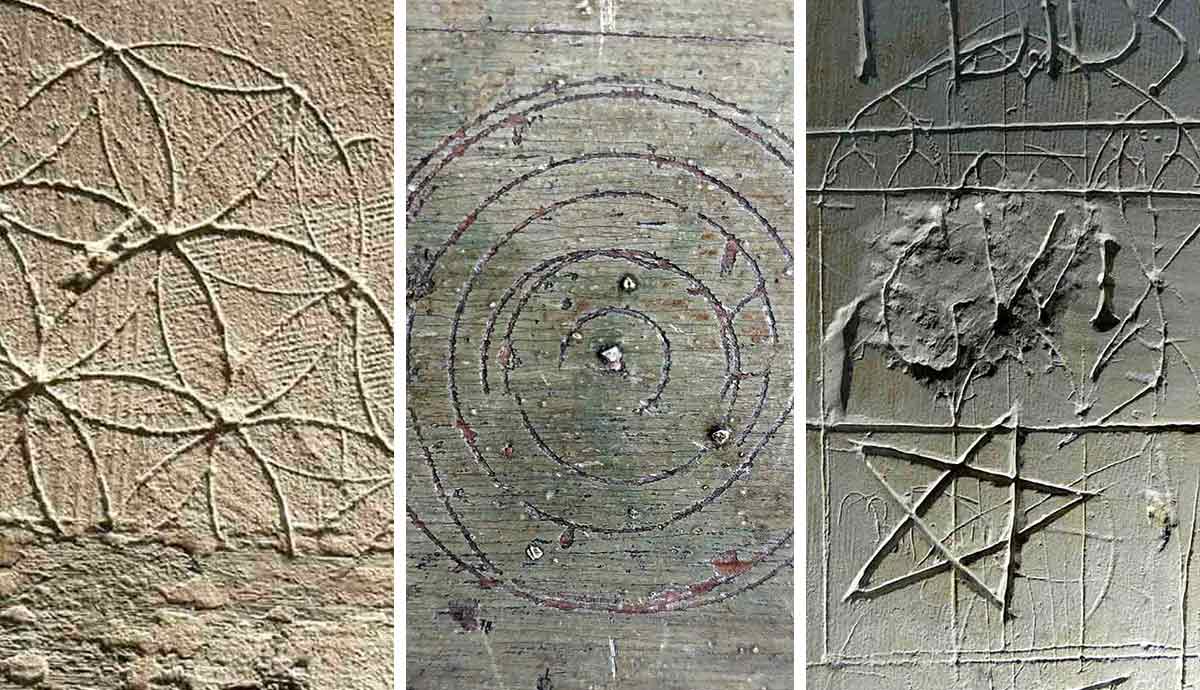
Looking closely at centuries-old buildings across England, you may find bizarre little symbols, scratches, and shapes carved into the wooden or stone walls. For 500 years, these marks were etched into homes, churches, barns, and even graves to protect one’s family, homestead, and property from the woes of witchcraft and bad fortune. These peculiar marks reveal how communities feared and fought against demonic entities and ill wishes lingering in the shadows.
History of the Marks
Medieval daisy wheel mark at Worlington Church, Suffolk, England, photographed by Medievalg, 2022. Source: Wikimedia Commons
Witch marks, also known as apotropaic marks or ritual protection symbols, appeared in England from the medieval period to the 19th century. A variety of designs were carved near the entrances, doors, windows, and dark spaces of buildings to protect against spiritual attacks and harm. Most believed that demonic spirits would sneak onto someone’s property, oftentimes hiding in secluded parts of a house, to attack and inflict bad luck, death, and damage to those cursed.
Medieval graffiti inside St. George’s Church in Larzicourt, France, photographed by Renhour48, 2024. Source: Wikimedia Commons
Researchers contend that the practice of using these marks was passed down through folk traditions and local superstition. Many have been dated to the reign of James I during his vigorous campaign against witches. Yet, most information about these marks remain a mystery. Dismissed as graffiti or random scrapes, little to no records exist about who or how these symbols were made. However, recent preservation projects by the Historic England Commission hope to change this. Since 2016, over 600 witch marks have been found across England in homes, barns, church, grain silos, and cellars.
Daisy Wheels or Hexafoil Marks
Medieval daisy chain carved into the walls of All Saint’s Church, Litcham, Norfolk, England, photographed by Medievalg, 2022. Source: Wikimedia Commons
The most widespread ritual mark in England is the hexafoil. Also known as the daisy wheel, this symbol either appears alone or as a set of interlinking circles called a daisy chain. Hexafoils have been discovered on door openings, windowsills, and walls of family homes, barns, and churches. The hexafoil has also been found on material objects like plates, chests, and other furniture.
These protective markings served multiple purposes. First, they blessed someone’s home, all who live there, and all who entered. Second, the hexafoil’s infinite loop was meant to tempt and trap spirits before they could enter someone’s property and bring bad fortune, pain, and suffering. Compass tools were used to create precise circles that were easy to carve into wood and stone.
Marian Symbols
Virgin Mary marks in North Muskham, England, photographed by Richard Croft, 2016. In the center are interlinking “VV” standing for the “Virgins of Virgins” invoke the power and protection of the Virgin Mary. Source: Wikimedia Commons
Marian symbols were one of the most common witch marks used for protection. These marks aimed to summon the power of the Virgin Mary, mother of Jesus Christ, to defend against spiritual attacks. To combat what lurks in the shadows, Marian marks are often found carved into arches, banisters, corners and fireplaces built during the early-modern period.
These symbols were created by carving a combination of letters “M” or “AM” into wood or stone. These letters stood for Mary or Ave Maria, meaning “Hail Mary”. Other variations included interlinking letters of “VV” to create a “W” shape that stands for Virgo Virginum, meaning “Virgin of Virgins”. These symbols reflect how Christian teachings and figures melded with English folk tradition over the centuries.
Taper Burns or Scorch Marks
Taper burn apotropaic marks at Craven Arms, Shropshire, England, photographed by Philip Halling, 2024. Source: Wikimedia Commons
Taper burns, or scorch marks, are found throughout homes built during the medieval and Tudor periods. Because these notches were found on wooden beams near fireplaces, they have been ignored for most of history as just simple burns accumulated over time from use or construction. However, archeologists now believe that these spots were intentionally made as protection symbols against harm and evil.
Researchers contend that the scorch marks were made to weaponize Satan’s element of fire against himself and his followers, creating a spiritual barrier to protect homeowners and their families. Folk tradition believed that this would also protect their homes, barns, and fields from property damage caused by fire. These marks were created by holding a candle or open flame against the timber until a teardrop burn mark appeared. Afterwards, the burn was gouged out to create a deep and permanent talisman.
Mazes and Knot Marks
Maze witch mark above a fireplace at Culross Palace, Fife, Scotland, photographed by Gillaween, 2023. Source: Wikimedia Commons
Mazes and knots are additional witch marks discovered throughout England. Despite their different shapes, they served the same purpose. Both preyed on how easily tempted demons are by attracting them with their complex designs. After luring evil spirits or witches in, they trapped them in their endless patterns and paths. Both symbols are found on the stone entrances of churches all over England to prevent demonic entities from entering or attacking the followers of God.
Solomon’s Knot marks discovered in a church in Lincolnshire, England, photographed by Richard Croft, 2015. The knots are the two-interlinking cross-like symbols behind the letter etchings. Source: Wikimedia Commons
One popular symbol was the Solomon knot. Found on church entryways, this knot lured and imprisoned evil entities into a never-ending cycle. The knot is composed of two interlocked loops that form a continuous cross with no specific beginning or end. This symbol also refers to the biblical role of King Solomon in the Old Testament who received special gifts from angels to control, battle, and slay demons.
Pentangles or Pentagram Marks
Pentangle mark discovered at The Church of St. Mary and St. Andrew, Whillesford, Cambridgeshire, photographed by Medievalg, 2022. Source: Wikimedia Commons
Geometric shapes, especially pentagrams or pentangles, were apotropaic marks used to summon the power of God to entrap demons. Even though pentagrams are now associated to Wicca and modern witchcraft, they meant the complete opposite during the medieval period. Instead, the five-pointed angles represented the five wounds inflicted on Jesus Christ during his crucifixion. A pentagram was therefore invoked as a strong symbol of Christ’s power and protection.
Many variations of pentagrams, pentangles that are encircled, are carved onto the walls and entrances of English churches. Throughout the medieval and early modern periods, pentangles enticed witches and demons with their star-like shape. Once they approached, these evil beings were pinned against the wall and trapped under the shape’s angles and lines. The mark intended to permanently imprison and prevent these entities from enacting their harmful bidding.








 New Posts (Home)
 ChatBox
 Popular Posts
  Game Zone
 Top PodCasts