www.thecollector.com
What Can Tombs Murals Tell Us About Goryeo Korea?
The Goryeo tomb murals tell us much about life during the lengthy Goryeo Period (37 BCE–668 CE) on the Korean Peninsula. Scenes of daily life, spirituality, and myth are depicted in these tombs, representing ordinary people as well as those in power. They also reveal the extent of Chinese influence upon Goryeo through both their locations and content. It is also important to note that many are situated in the Democratic People’s Republic of Korea, inaccessible to tourists and the general public, although they are UNESCO World Heritage sites.
The Three Kingdoms Period
Korea during the Three Kingdoms period, 476 CE. Source: Wikimedia Commons
Originating from local tribes who had formed towns, the Three Kingdoms Period in Korea is defined by the three groups that dominated the peninsula by 37 BCE. These groups were the Baekje, Goryeo, and Silla, however, there was a fourth, smaller kingdom named Gaya. With no stable centralized government, it was dominated by Silla during its expansion in the 6th century CE, meaning that it is often forgotten. Over 700 years, Baekje, Goryeo, and Silla continuously formed alliances and rivalries with each other and their neighbors, China and Japan. Their territories grew and increased in size, with Silla ultimately dominating the peninsula by 668 CE.
During this period, all three kingdoms operated as monarchies and were divided into rigid social rankings which dictated every aspect of life. Baekje, in the southwest, was a cultural hub, famed for its art and architecture and had good relations with Japan and China, which in turn accommodated the spread of Buddhism and other arts. Silla, in the southeast, saw itself to be divinely created and had distinctive art all of its own.
The Goryeo Period
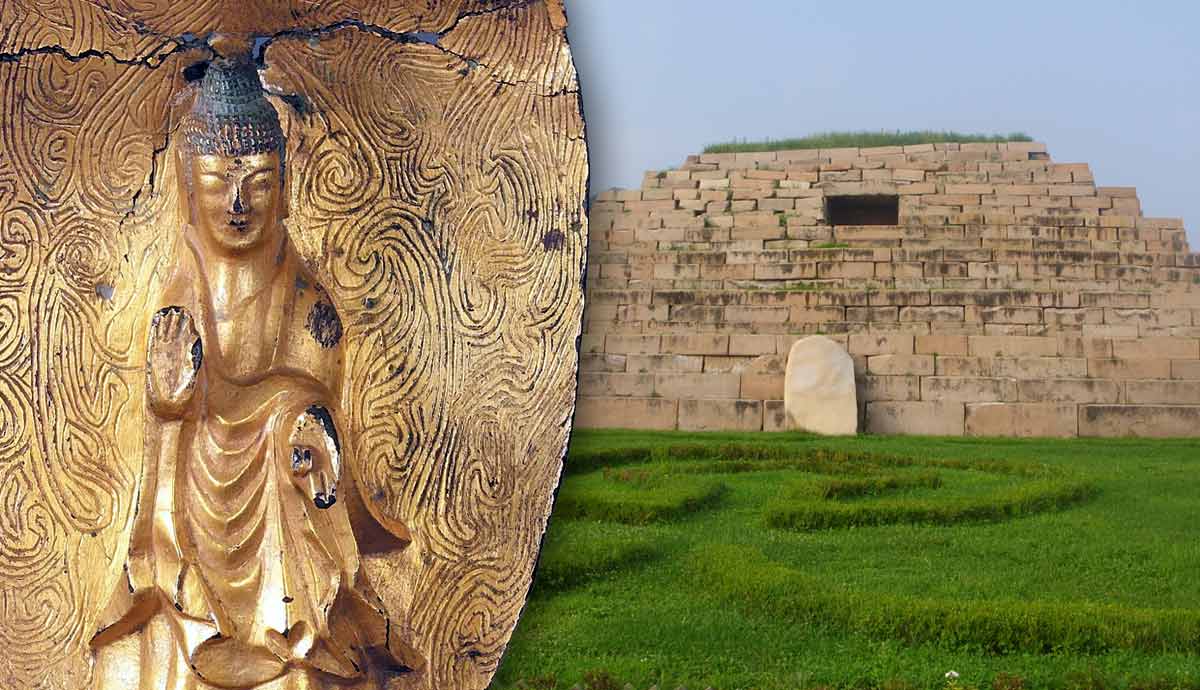
Gilt-bronze Buddha, 6th century. Source: National Museum of Korea
Dominating the northeast of Korea, the Kingdom of Goryeo (or Goguryeo) began in central Manchuria. Their territory was large, and they were in a perpetual state of warfare along their borders with the Manchurian tribes, Baekje, and Silla. The benefit of their position, however, meant they could control trade routes, increasing their prosperity. Goryeo was a militarily strong kingdom with a centralized military structure, known for its warriors and their strategies. They were essential in Goryeo’s defence and expansion.
In 372 CE, Buddhism was introduced, shaping the government ideologically. It influenced the art and architecture of the period as well. Confucianism also emerged during this time, maintaining a specific order in society based on hierarchical relations. The king held ultimate power but was still supported by the nobles who surrounded him. We know much about Goryeo society from their tomb paintings.
Goryeo ultimately fell in 668 CCE, defeated by both Tang forces from China and Silla, its southern neighbor which unified against it. Yet, after its fall, there was still resistance against Tang rule in the previous northern Goryeo territory, leading to forced evictions south. The Tang Dynasty would continue to exert power on the peninsula. Despite their previous alliance, Silla was forced to continue to defend itself against them.
Building the Tombs
Tomb of Gwanggaeto the Great, 391-412 CE. Source: Wikimedia Commons
The rulers and nobility of Goryeo began building tombs within pyramids made of stone blocks. Then they began developing the tombs’ architecture. Later, tombs were created in the form of earth mounds, in which the earth was blended with lime and small pebbles. An inner chamber was created by adding clay to this mixture, which ultimately led to the tombs’ preservation. Every tomb had at least one inner chamber, but some had multiple.
They were built without any specific defences against looting, making them the targets of grave robbers, particularly due to the luxury items that they contained. This means that unfortunately, many important artefacts from the Goryeo Period have been lost, making the wall paintings found in the tombs our main source of knowledge of life during this time. However, some artifacts have survived, including jewelry and pottery, as well as figurines of the Buddha.
Painting Style and Technique
Mural from Tomb No.3 at Anak, 357 CE. Source: Wikimedia Commons
The majority of Goryeo tombs contain murals which line the burial chamber walls. They feature a variety of representations, such as images of the tomb’s residents, hunting scenes, mythical animals, religious ceremonies, processions and daily life. They also feature images of Chinese influence, from the constellations painted on the ceiling to the Chinese animals painted on the walls.
The murals were painted directly onto the tomb walls or lime plaster. This method involved mixing pigments with a binder or lime (lime-secco painting). This differed from the “fresco” technique of applying paint to a layer of wet plaster that was popular in the West.
Power
Seated man, mural from Tomb No. 3 at Anak, North Korea, 357 CE. Source: World History Encyclopaedia
Tombs of those with power often featured images of their occupant. The most well-known of these murals is Anak Tomb Three, dated to around 357 BCE and located in the Hwanghae Province of North Korea.
The tomb is inscribed with the owner’s name, Dong Shou, and his position, a general of the Lelang Commandery territory. Yet, it is important to note that despite the inscriptions, the true resident of the tomb is still debated by scholars today.
The image of Dong Shou himself presents him as a ruler, sitting on a throne of state under a canopy, wearing Chinese clothing. There is also an image of his wife, shown in a similar fashion, being attended to by female servants. The paintings in this tomb also show scenes of everyday life, such as a kitchen attendant cooking rice. A military procession is also included, showing one method of how Dong Shou asserted his power in the region.
Chinese Influence
Mural from Ohoe No. 4, 6th to 7th century. Source: Wikimedia Commons
Tombs also included images of animals and celestial beings based on Chinese influence in Goryeo. China and Goryeo regularly engaged in trade, in which Goryeo would exchange gold, silver, and textiles in exchange for weapons and silk. They also had strong cultural ties.
In addition to adopting the Chinese writing system, iconography was also imported to Goryeo, as seen in the tomb paintings. Yet, its geographical position beside China meant that it suffered from China’s imperial ambitions, from which it would often have to defend itself.
One example is the Ohoe Tomb Four, from the 6th or 7th century, located in today’s Ji’an in China. This tomb features many animals, from snakes to dragons to birds. The tomb reflects the increasing influence of Daoism in Goryeo, a Chinese religion that names the “dao” the original source of the universe and is worshipped as such. It features Daoist immortals riding on birds, representing immortality, a subject significant to the deceased. Flying celestial musicians also welcome them into the afterlife.
Democratic People’s Republic of Korea (DPRK)
Mythical white tiger, 6th to 7th century. Source: World History Encyclopaedia
Over 70 of the Goryeo tombs are located in the Democratic People’s Republic of Korea (DPRK), or North Korea. Though inaccessible to most tourists and locals due to the strict rules of the country, the DPRK has been working closely with UNESCO to protect and conserve the murals. This has meant that UNESCO experts have been visiting the sites and that financial support has been provided to the DPRK for their conservation. In 2004, one of the tomb complexes was named a UNESCO World Heritage site.
This collaboration was significant in exploring the creation of these tombs and their murals. It also allowed local experts to adequately conserve them. This further culminated in an exhibition at the UNESCO headquarters in Paris, which featured replicas of the tombs. There are also 40 Goryeo tombs in Northeast China, near the border with the DPRK, in Ji’an City. These tombs were also named UNESCO World Heritage sites in 2004, following China’s opening of the region to archaeologists.








 New Posts (Home)
 ChatBox
 Popular Posts
  Game Zone
 Top PodCasts