www.dailywire.com
Why Israel Does Not Want America’s Military Aid Money Anymore
In the 1980s, Israel launched an ambitious program to develop its own fighter jet: the Lavi. Its name, which translates to “Lion,” reflected the aircraft’s promise — a sleek, agile jet praised by test pilots for its exceptional handling and designed to give the Israeli Air Force a superior edge in air combat.
Israel’s cabinet canceled the program in a narrow 12‑11 vote following pressure from American officials. Washington objected to the Lavi because its high costs would strain Israel’s defense budget, divert Israel from spending United States military aid on other American equipment, and compete with the F-16.
The Lavi remains a cautionary tale as Israeli Prime Minister Benjamin Netanyahu and other Israeli leaders seek to end the Jewish state’s reliance on American military aid.
“I want to taper off military aid within the next 10 years,” Netanyahu told The Economist in January, just a month after the prime minister unveiled a $108 billion, decade-long investment to build an independent Israeli munitions industry.
“That’s not saying I don’t want to fight for the allegiance and the support of the American people,” Netanyahu said. “I do. You’d have to be crazy not to.”
If Netanyahu succeeds, Israel will no longer accept the roughly $3.8 billion in annual U.S. aid — about $3.3 billion of which is required to be spent mostly on American companies.
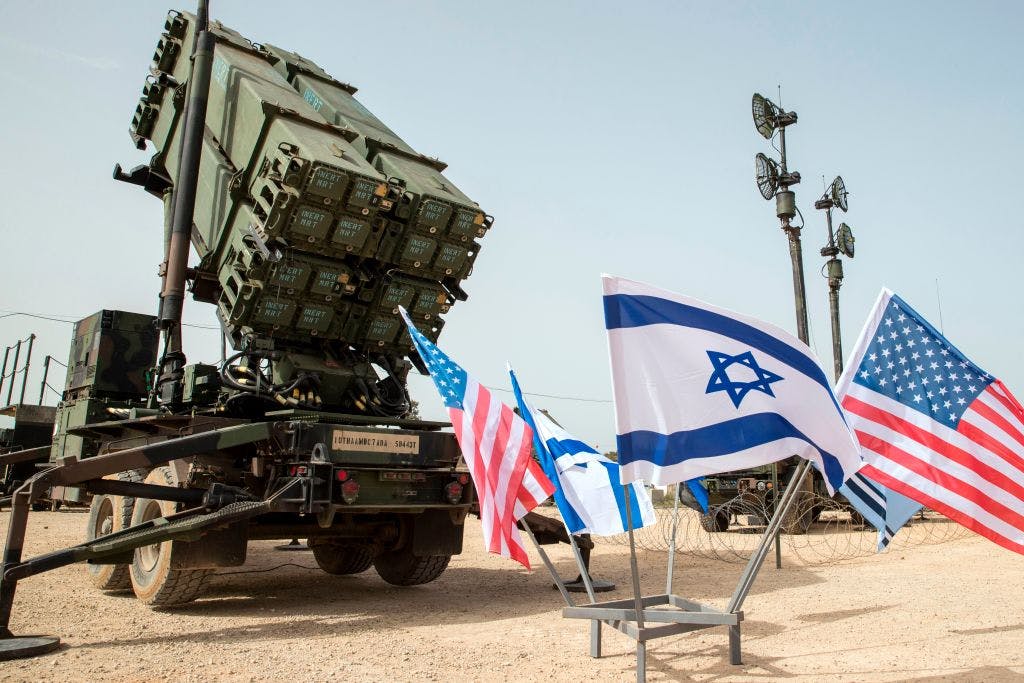
US and Israeli army officers walk in front a US Patriot missile defence system during the joint Israeli-US military exercise “Juniper Cobra” at the Israeli Hatzor Airforce Base on March 8, 2018.(JACK GUEZ/AFP via Getty Images)
Netanyahu is not alone in advocating for reduced U.S. military aid. Other leaders who spoke to The Daily Wire said the goal is not to weaken the relationship with the United States, but to transform it into a partnership based on mutual strength.
“This has nothing to do with the importance of the relationship between Israel and the United States,” General Amir Avivi, chairman and founder of the Israel Defense Security Forum, told The Daily Wire. “Israel wants to deepen relations, but Israel, and I, think also the United States are seeking a partnership rather than a relationship based on aid. Israel is not a third-world country. Israel is a regional power, and in some aspects even a global power.”
Netanyahu said he told Trump during their December meeting ihn Mar-a-Lago that he appreciates the military aid, but that Israel has “come of age” with its economy on track to soon reach about $1 trillion.
“Israel can afford to pay for its own defense establishment,” Avivi said, noting that U.S. assistance now represents only a small share of Israel’s overall defense spending.
U.S. military and missile-defense aid to Israel has totaled approximately $140.6 billion since 1948—equivalent to under four years of Israel’s 2025 wartime defense spending of $43.9 billion and about six years of Israel’s 2022 pre-war defense spending of $23.41 billion.
On top of an annual $3.8 billion in aid, Israel, in 2024, received supplemental aid of $3.5 billion in military assistance, $4 billion for missile defense, and $1.2 billion for its new Iron Beam laser missile defense system. That amount decreased to a total of $4 billion in 2025 and is expected to fall again in 2026.
Overall, U.S. annual funding made up 16.2 percent of Israel’s military budget in 2022, before the war began, and 28.5 percent when the war was at its height in 2024, including both annual and supplemental aid. U.S. aid is set to make up 10.66 percent of Israel’s 2026 budget of $35.64 billion.
Avivi said Israel’s new stance aligns with Trump’s foreign policy agenda, which has consistently pushed allies to contribute more — consider his frequent calls for NATO members to “pay up” — and is encouraging recipients of U.S. aid to develop plans for self-sufficiency with its new approach to foreign assistance.
Simcha Rothman, an Israeli lawmaker in the Religious Zionist Party, said he views it as more of a military partnership with the United States, saying it’s misleading to categorize the funding as “aid.”
“I think that the worst thing about U.S. military aid is that it is called aid, despite the fact it’s definitely not aid,” Rothman told The Daily Wire. “Israel is the cheapest aircraft carrier the United States has ever had and the benefits that the United States gets from the state of Israel, and our security establishment is almost unmeasurable.”
Rothman pointed out that the aid package itself, in addition to other purchases by Israel, subsidizes or “supports U.S. industries and their development of weapons like no other country” as well as the technology being tested by Israelis in real war scenarios to show proof of concept.
In announcing that Israel had added range-extending fuel tanks to its F‑35s, Ambassador Yechiel Leiter said in an interview Monday that when he visited Lockheed Martin, the company’s CEO told him that “Israel’s information and developments ‘are worth many billions to my company.’”
Credit: Petty Officer 2nd Class Cryton Vandiesa/U.S. Naval Forces Central Command / U.S. 5th Fleet
Rothman believes dropping the term “aid” and forging “mutually beneficial partnerships” is the way to move forward, especially as figures on both the American left and right use the aid as a way to attack Israel.
“The political consequences of calling it an aid is giving excuses to people who do not really deeply understand the relationship between the U.S. and Israel and so they badmouth Israel and to criticize this connection because they say it ‘costs the U.S. money,’” Rothman said.
Avivi also pointed to growing opposition to U.S. military aid for Israel among some American political voices, singling out commentator Tucker Carlson.
“In the United States, some — such as Tucker Carlson — use the aid to attack Israel,” Avivi said. “They ask why American taxpayers are funding Israel and its wars. Israel wants to remove this argument entirely and say: ‘We don’t want aid.’”
Lawyer and Israeli activist Ran Bar-Yoshafat said Israelis are aware of the rising anti-Israel sentiments in the United States and he thinks Israel should stop accepting aid entirely because it “creates antagonism both among the hard right and the delusional left.”
But Bar-Yoshafat cited several other reasons too, namely that he believes it has the ability to impact its military readiness.
He recalled that during Operation Protective Edge in 2014, when Israel fought Hamas in Gaza, the Obama administration tightened oversight of weapons transfers and suspended a shipment of Hellfire missiles.
“This really shook the Israeli defense establishment and an understanding that you cannot really rely, during a moment of truth, on getting what we need,” Avivi said.
He added that in that same year he was the chief auditor of the Israeli defense establishment and found in an audit that the readiness of Israeli industries to produce munitions was “terrible.”
“We really lacked the capabilities because we transferred many capabilities to the U.S., and this really hurt our readiness but also our sovereignty — our ability as a country to defend ourselves,” he said.
An Israeli Army officer watches as U.S. military personnel from the 5-7 Air Defense Artillery Joint Task Force take part in a ceremony marking the end of their mission April 20, 2003, at the Israeli army’s Tel Yona base near Tel Aviv. (David Silverman/Getty Images)
Many Israelis view the structure of U.S. military aid as a tool to make Israel more reliant on Washington and undermine the Israeli munitions industry. Under the agreement negotiated during the Obama administration in 2019, Israel was allowed to spend only 25% of the annual aid package on domestic procurement—a figure set to decline to 11% this year and to zero by 2028.
Bar-Yoshafat argued that as long as Israel depends on American munitions, U.S. leaders ultimately influence how — and even whether — those weapons are used.
“The use of force is constrained according to American preferences,” Bar-Yoshafat said, who is a reservist combat special forces officer. “The Americans, depending on the administration and military establishment, routinely dictate what weapons we can use and where in the field.”
More recently, during the war sparked by Hamas’s attack on southern Israel in 2023, the Biden administration halted a shipment of heavy bombs and threatened to withhold offensive weapons if Israel launched an assault on Rafah. It wasn’t until Trump took office that all of the weapons were shipped.
Last month, Netanyahu blamed the embargo for the death of soldiers because of the lack of ammunition.
“At a certain stage, we simply didn’t have enough ammunition and people fell, heroes fell,” he said. “Part of that shortage of ammunition was the result of an embargo.”
For many Israelis — who describe the conflict as a “seven-front” war — the episode reinforced deep concerns about relying on foreign supply during critical moments.
“I think at this point Israel decided we really need to be as independent as possible and take responsibility for our own future and defense,” Avivi said. “And now Israel is really investing huge amounts of money on building a reality that enables Israel to produce most of its capabilities, especially munitions.”
In unveiling his $108 billion, decade-long plan to build an independent Israeli munitions industry, Netanyahu emphasized the goal to “reduce our dependence on all players, including friends.”
Its close relationship with the United States impacts its trading partners in the space.
Bar-Yoshafat points to to Israel canceling its $1 billion agreement to sell China the “Phalcon” airborne early-warning system for reconnaissance aircraft amid American pressure in 2000.
The system contained no American technology and did not violate any U.S. agreements. Still, Washington was concerned China could use it against Taiwan, and influential members in Congress threatened to withhold Israeli aid if the deal proceeded. As a result, Chinese-Israeli relations suffered, and Israel was forced to pay roughly $350 million to China in compensation for breaching the contract.
Avivi said that Israel has no plans to sell sensitive technology to China but warned that Israeli reliance on U.S. aid carries real risks if the administration in power has disagreements on military and political strategies.
Israel is already a major player in the global arms market, ranking as the world’s eighth-largest arms exporter with $15 billion in sales in 2024. Yet the country continues to rely on imported munitions and military equipment.
The new initiative aims to strengthen self-sufficiency in munitions, though Israel has no plans to revive the Lavi fighter jet or other similarly costly programs, according to Avivi.
The first Alenia Aermacchi M-346I Lavi trainer of the Israeli Air Force taken at Venegono Airport, Italy. (Getty Images)
“Israel is not just pulling its weight—we’re destroying America’s enemies too. Hezbollah, Hamas, Iran, Shiite militias: these are threats to both our countries. Being closer geographically, we can act fast and decisively, protecting America’s interests while defending our own.”
Although the current U.S.–Israel military aid package is set to be renegotiated in 2028, Senator Lindsey Graham, a longtime supporter of Israel, said the aid should be cut off and should be expedited to support Israel’s self-sufficiency. Graham called the aid “a great investment” and said there is “no better ally” than Israel, but added that the billions in taxpayer dollars should instead be “plowed back into the U.S. military.”
The 2025 Israeli defense and security budget represents approximately 7.2 percent of its total GDP of $610.8 billion. That ranks Israel second in the world for military spending as a share of GDP, trailing only Ukraine. By comparison, NATO members are required to spend 5 percent of their GDP on defense by 2035, showing that Israel already exceeds that target and takes on a level of responsibility that other allies have still yet to match.
Today, Israel receives only military-related aid from the United States, but that wasn’t always the case. Until 2007, the country also received economic assistance to support its developing economy. Netanyahu was an early advocate for ending economic aid, arguing that Israel had grown strong enough to stand on its own.
“With America’s help, Israel has grown to be a powerful, modern state,” Netanyahu said to a joint session of Congress in 1996. I believe that we can now say that Israel has reached childhood’s end, that it has matured enough to begin approaching a state of self-reliance.”
Moving forward, Avivi says the best path is for cooperation and investment as a healthy, strong ally instead of dependency.
“America can definitely invest a lot in Israeli companies and in mutual projects,” Avivi said. “We want to see a combination of Israeli ingenuity and out-of-the-box thinking coupled with American economic capabilities and also production capabilities. So we can definitely do many, many things together and be very strong and close allies.”








 New Posts (Home)
 ChatBox
 Popular Posts
  Game Zone
 Top PodCasts