www.newsbusters.org
ABC Trumpets ‘Devastating’ Blow to Trump Presidency in SCOTUS Case on Tariffs
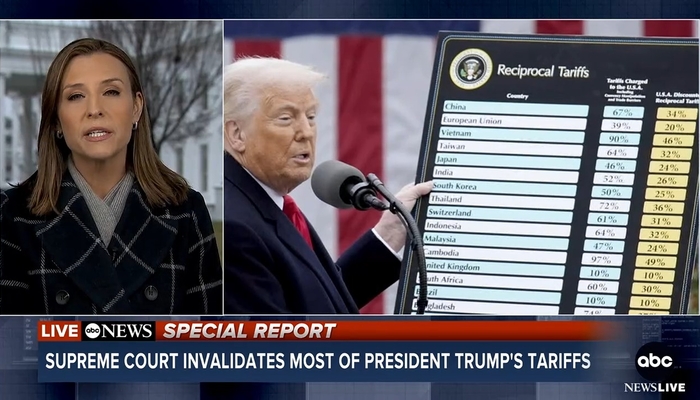
All the major broadcast networks — ABC, CBS, and NBC — broke in Friday morning with special reports on the Supreme Court’s 6-to-3 ruling declaring most of President Trump’s landmark tariffs unconstitutional. Unsurprisingly, ABC was almost ebullient in touting the ruling as “devastating,” “huge,” and “monumental” in hampering Trump’s presidency.
Correspondent Devin Dwyer — who took over as the lone Court reporter at ABC after Terry Moran’s axing — said this was “one of the most significant decisions on presidential power in decades”
ABC’s court reporter Devin Dwyer on SCOTUS deeming most of Trump’s tariffs illegal...
“This is one of the most significant decisions on presidential power in decades. The supreme court just moments ago, in a 6-to-3 decision authored by Chief Justice John Roberts, invalidated… pic.twitter.com/ermtNU5trX
— Curtis Houck (@CurtisHouck) February 20, 2026
Dispatch and SCOTUS editor and ABC legal analyst Sarah Isgur was even more explicit:
.@SCOTUSblog editor/@ABC legal analyst @WhigNewtons on the SCOTUS ruling against most of Trump’s tariffs...
“This has been a Supreme Court that has really been shrinking down executive power. We saw them do this during the Biden administration with his student loan debt… pic.twitter.com/4Ukxhcp77n
— Curtis Houck (@CurtisHouck) February 20, 2026
Of course, chief White House correspondent and Biden regime apple polisher Mary Bruce was almost giddy in touting the ruling as a “devastating,” “huge blow to this White House and to this President” with this entire presidency “now coming into question” with the tariff revenue possibly having to be refunded.
ABC’s @MaryKBruce celebrating the Supreme Court striking down most of Trump’s tariffs...
“Devastating is right. This is a huge blow to this White House and to this President. Trump, in the lead up to this decision, had said that a ruling against his tariffs would be ‘devastating… pic.twitter.com/S5PZpwYHkK
— Curtis Houck (@CurtisHouck) February 20, 2026
“There is a lot of questions about what happens to the money that has been collected so far...What happens to other issues, like, for instance, pharmaceutical prices....[I]t is the ripple effects of this will be tremendous. What does it mean for the manufacturing here in the U.S....I can tell you this: Based off of the President’s comments in the lead up to this, while we haven’t gotten a reaction from him just yet, he certainly is likely to be deeply frustrated and angry about this decision,” she added.
After correspondent Elizabeth Schulze pointed to the business fallout from small, medium, and large businesses that could become “very messy and very complicated,” chief Washington correspondent and four-time anti-Trump author Jonathan Karl boasted this was “both a monumental decision and frankly, an obvious one”:
ABC’s @JonKarl on the SCOTUS decision about tariffs...
“This is both a monumental decision and frankly, an obvious one. I mean, it seemed clear from the day that Donald Trump came out and announced his so-called reciprocal tariffs on the rest of the world, or most of the world,… pic.twitter.com/SawFe4jzHo
— Curtis Houck (@CurtisHouck) February 20, 2026
CBS spent nearly 13 minutes on-air, starting with longtime legal correspondent Jan Crawford framing it as “the most significant U.S. Supreme [Court] loss for a U.S. President, I think, in modern history” but should be seen as “a deeply divided issue” even within the 6-3 breakdown
.@JanCBS Crawford on SCOTUS ruling most of Trump’s tariffs are unconstitutional...
“This decision is 6-to-3, invalidating President Trump's use of the sweeping tariffs imposing tariffs on almost every trading partner worldwide. This is the most significant U.S. Supreme [Court]… pic.twitter.com/YGHq6IUN9r
— Curtis Houck (@CurtisHouck) February 20, 2026
“But the bottom line Tony, a major defeat for the President. I think you can put that right up there with some of the most significant Supreme Court losses by a U.S. president in history,” she emphasized.
CBS Evening News anchor Tony Dokoupil came back to her at the end and she reiterated something she has long said about the Supreme Court, including on December 28’s Face the Nation:
WATCH: @JanCBS Crawford argues this tariff ruling shows people should quit saying this Supreme Court is wholly beholden to Trump...
“And what this says is that all of these people who have been saying that this is a Supreme Court that’s in the tank for Donald Trump, need to take… pic.twitter.com/qYkJhuEiMG
— Curtis Houck (@CurtisHouck) February 20, 2026
Following more explanation of the Court’s reasoning from legal analyst Jessica Levinson, senior White House correspondent Ed O’Keefe floated possible alternative approaches the White House could take because the ruling will impact “not only the economic agenda, but arguably the foreign policy agenda...because the hope here at the White House, at times, was to be able to use the threat of tariffs as sort of a coercive tool to get their way with certain countries[.]”
Chief Washington correspondent Major Garrett and chief business and tech correspondent Jo Ling Kent offered historical and economic reactions, respectively (click “expand”):
GARRETT: Well, the Supreme Court is well aware of the Constitutional history of generating revenue, a power explicitly reserved to Congress in its origination in the Constitution. And before, we had an income tax in this country, we raised revenue principally through tariffs. And there were lots of conflicts that previous Supreme Courts dealt with about the legality of those tariffs. That precedent is a backdrop for this. President Trump has jawboned and criticized this Court, saying if you rule against me you’re going to destroy our economy, waging a very aggressive public relations campaign. But the Court cares what the Constitution says and what precedent says. It’s interesting to note, Tony, this 1977 law that Jan and others have referred to grew out of a crisis with Iran after the Iranian revolution, and it has been used principally to freeze assets or to levy sanctions. The Trump administration told the Supreme Court it had almost unlimited powers to impose tariffs, not just as an economic matter but as a diplomatic cudgel. And what the Court said and I think this is important. Summarizing the administration’s argument before it, “that view would represent a transformational expansion of the President’s authority over tariff policy. It is also telling,” the court wrote, “that in the IEEPA’s half century — that’s the law of existence — no president has invoked the statute to impose any tariffs, let alone tariffs, of the magnitude of this magnitude and scope.” So essentially, what the Court is saying is we have a Congress. Congress is negotiate laws with presidents, as this law was negotiated. If you follow that law, you can do it. If you expand way beyond that law, you can’t. And to Ed’s previous point, there’s another law in 1962 — law — the Trade Expansion Act, there’s a section 232 there. This President — previous presidents have used that to impose tariffs. There are many remedies this administration could look to and the trade representative, Jamieson Greer has said many times, if we lose in the Supreme Court, we have other remedies to advance our tariff agenda. This is not the end of the tariff conversation under this administration, but it is a setback significantly on this variant of using tariffs the way the President has attempted to enforce them.
(....)
KENT: [M]y phones are exploding right now with reaction from small business owners across the country we’ve been interviewing people about these tariffs for over the last year. And Emily Ley, a small business owner in Sarasota, Florida, tells me she’s thrilled. She’s relieved. It gives us clarity. She runs a very successful stationery and planner business. Another business owner, Beth, in Zumbrota, Minnesota, Southern Minnesota, she runs Busy Baby Mat and she says she’s seeing major relief that this is bittersweet. She just signed another $13,000 check to — you know for these tariffs to China last week. And now she feels like maybe she can start seeking a refund. Now when you pull back, how much does the average American household paid for these tariffs, you can see it’s about $1,700, according to the Yale Budget Lab. So what happens next? If this continues to move a pace, we expect overall prices, which could be good news for consumers to drop. But that won’t happen quickly. We also expect to see perishable items your fruits and veggies, they actually might go down in price a little bit more quickly. You might see durable goods like your tech products and furniture see a slight decrease as well. And you can see overall the price increases that you may be facing at home due to tariffs across the board there especially in apparel, things that are imported from overseas. But if you’re looking for a Trump tariff refund, if you will, as an individual family member, for example, that’s probably off the table. But we do expect businesses to start seeking tariffs and perhaps forming class action lawsuits to get this money back. As a result of this ruling those companies could get refunds from the Treasury. But overall, the small business reaction has been overwhelmingly positive, saying they feel that they’re thrilled and they’re relieved.
NBC was on the air for just over nine minutes and was relatively muted but matter-of-the-fact in relaying the ruling.
Chief legal correspondent and Saturday Today co-host Laura Jarrett emphasized the right-of-center justices who voted against the constitutionality of Trump’s tariffs, combining for half the majority that delivered “a major blow to the centerpiece of the President’s economic agenda” and could have ripple effects with forthcoming class-action lawsuits by affected companies.
Senior White House correspondent Garrett Haake said he could not “overstate how important these tariffs were as a tool for President Trump” in “address[ing] trade deficits, to try to bring money into the U.S. government...sending back out to the American people in the form of refund checks or to use to fund other programs...and he has claimed repeatedly that the tariffs have helped him solve global conflicts around the world[.]”
Jarrett herself wrapped by quoting from Justice Gorsuch’s concurring opinion and stating executive authority is the theme of this Supreme Court term (click “expand”):
Yeah, it’s interesting just to see Justice Gorsuch complaining in his concurrence here knowing the criticism that could be on the way at least from a political standpoint and he says, “all I can offer them that most major decisions affecting the rights and responsibilities of the American people are funneled through the legislative process for a reason. Yes, legislating can be hard and take time and, yes, it can be tempting to bypass Congress when some passing problem arises, but the deliberative nature of the legislative process was the whole point of its design, essentially saying the Constitution was set up this way, having the legislative branch be the one that can levy taxes. And the President, of course, can enforce the laws. He can regulate some imports, but he can’t go too far, and the Constitution does that by design.
(....)
Well, and this whole term, if you think about it, is the Supreme Court taking a hard look at some of the things Donald Trump has done that have never been done before, like trying to fire a member of the Federal Reserve board, Lisa Cook. It’s another big case on the docket. He’s tried to fire her. He’s tried to fire a woman who was on the FTC. They obviously have other big questions concerning his birthright citizenship plan. So, this is really the term of SCOTUS and the President, and how they see executive authority. At least as it results to tariffs, [this] is a big blow.
To see the relevant transcripts from the network special reports on February 20, click here (for ABC), here (for CBS), and here (for NBC).








 New Posts (Home)
 ChatBox
 Popular Posts
  Game Zone
 Top PodCasts