www.historyisnowmagazine.com
The Last Tsar - Nicholas II: Myths, Missteps, and Misunderstandings
What? You know not what you do was muttered by Nicholas just seconds before he and his family were executed by a Bolshevik firing squad on the night of the 16th-17th July 1918 in Yekaterinburg, Russia. Whether he truly spoke them or not, they have come to define the tragedy of a man condemned not only by revolution but by history itself. Yet a question still lingers of how did a man born into extreme privilege end up facing executioners in a dimly lit cellar? The answer is tangled in tragedy, misunderstandings, and myths. Nicholas’s legacy has been dominated by his weak, cruel, and helpless character – yet each story tells us much about those who wrote it as it does about Nicholas himself. He was seen as weak, yet every choice was bound by conviction. A ruler so certain by his divine calling that he mistook faith for strength and in the end, belief, not hesitation undid him.Sophie Riley explains.
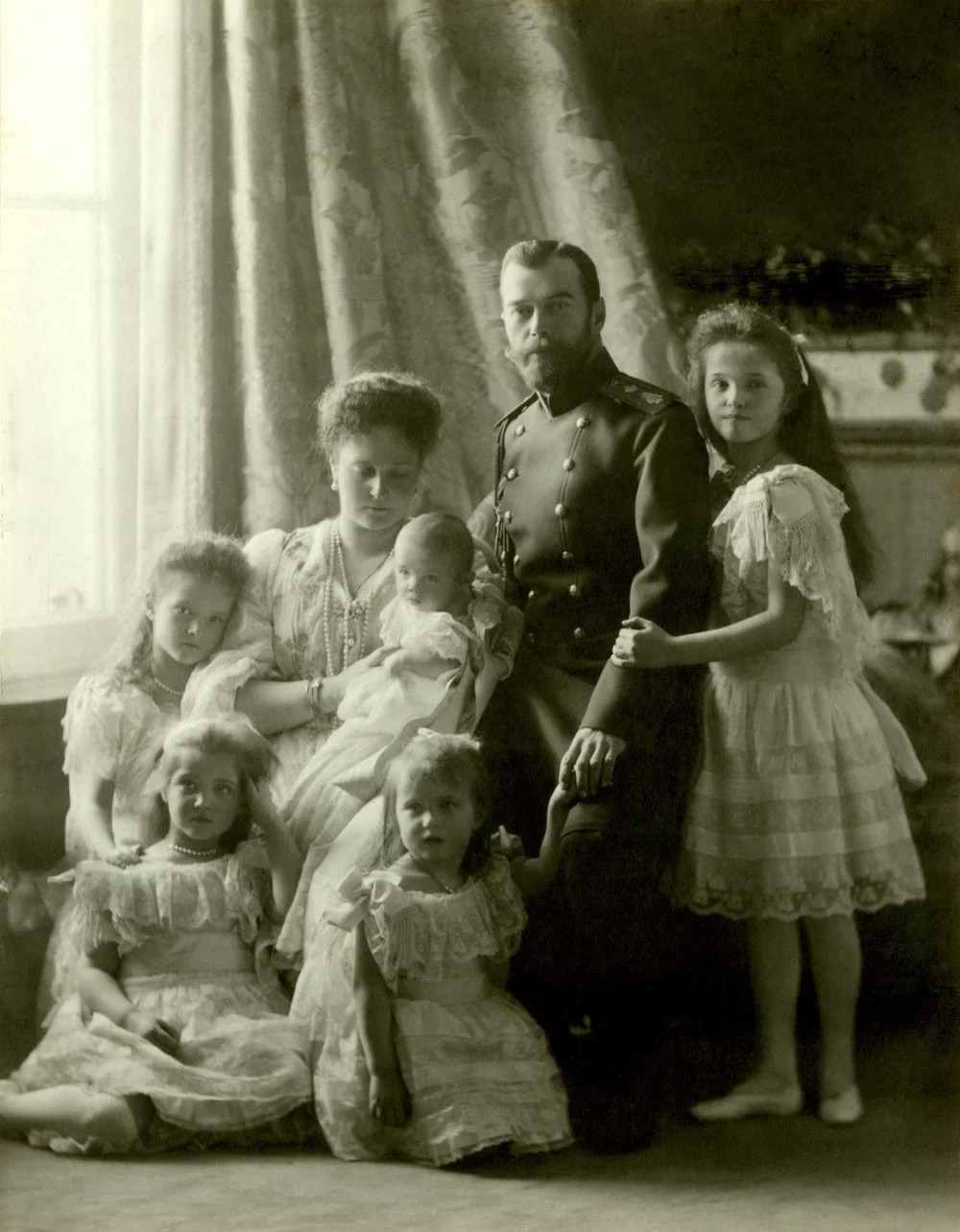
Nicholas II and family in a formal photograph, c. 1904. Source: Boasson and Eggler St. Petersburg Nevsky 24, available here.The Weak AutocratFor over a century Nicholas has been portrayed as a weak out of touch ruler who caused the collapse of the Russian Empire. A man who was too passive and indecisive. A Monarch who waited for divine intervention to act, this belief showed his conviction in his power being sacred and not political.Nicholas II was crowned Russia’s Tsar on the 26th May 1896 in Moscow’s Dormition Cathedral. During the ceremony the Tsar was blessed with holy oil and took communion. These acts symbolised that he was blessed by God to rule. In addition to this Nicholas also recited traditional catholic prayers that he would later reference as reasons why he could not concede to a constitutional and parliamentary government.Nicholas’s Orthodox faith served as his political compass by reinforcing his divine right to rule as an autocrat. In doing so he believed that any attempted to weaken his power was betrayal of his sacred obligation to God. This deep conviction was the core of his political ideology Orthodoxy, Autocracy, and Nationality. However, this belief would come at a cost during the 1905 revolution where he authorised the use of force to restore order, sanctioning repression which in turn cost the lives of hundreds of Russian people. Later that same year he was forced to concede to the October manifesto and create the Duma which he would consistently undermine and dissolve twice. These were not the actions of a ruler that was paralysed by doubt. They show a Monarch that acted decisively when he felt that the foundation of his autocracy was being threatened. His tragedy lay not in failing to choose but in repeatedly choosing to prese4rve an absolute system that could not survive. As a ruler the Tsar appeared to be detached from reality of modern governance to this around him, particularly those who within his political and diplomatic circles. The British Ambassador Sir George Buchanan would describe him as lovable man with good intentions but ultimately not born to set Russia right. — a judgement that would echo through later historical accounts. His ministers would claim that his decisions were too slow, consultations limited and crises were met with silence. His people would describe him as bloody Nicholas am a responsible for military failures and repression. This perception hardened into myth. Revolutionary propaganda transformed quiet conviction into incompetence. Later, Soviet histography framed Nicholas as a symbol of decaying autocracy. Yet modern historians would suggest that it was rigidity and refusal to change that led to the downfall of the tsar not weakness. Nicholas did not lose his throne because he lacked will power, he lost it because his will was anchored to the belief of Autocracy above everything and his unwillingness to change. His mistaking in a divine right to rule remained in a world that was changing and moving on without him.This rigid devotion, increasingly reinforced by those in court would soon find its most controversial expression in the figure of Grigori Yefimovich Rasputin Rasputin’s Puppet: The Tsar and the Romanovs The name Rasputin goes hand in hand with the downfall of the Romanov family. Rasputin a charismatic Siberian man with captivating hypnotic eyes was seen by many as healer especially when he rehabilitated Tsarevich Alexei's haemophilia with soothing prayers. However, to others he was deemed the manipulative mad monk who destroyed Russia’s royal family with his alleged heavy drinking, sexual exploits, and his influence over the Tsarina Alexandra Feodorovna. This negative portrayal has deemed him as a dark force behind the Romanov decline as they steered Russia towards ruin. In the popular imagination Tsar Nicholas’s image was eclipsed by a peasant holy man whose influence symbolised moral and political decay. Rasputin’s power was not in governance but in privacy with the royal family where his charisma and charm would gain him affection and admiration for the Tsarina and later on he would gain the respect of the Tsar. Though he never held any political position Rasputin occasionally offered his opinion on ministerial appointments, but it was Nicholas who had the final word. Surviving correspondence highlights that Nicholas would listen to Rasputin’s opinions and then later dismiss them in their entirety. Therefore, Rasputin’s influence was inconsistent and exaggerated by the liberal press and aristocratic opponents. The real damage caused by Rasputin was symbolic in terms of his assumed outrageous and occasionally devious behaviour that shocked the public and scandalised the court. During World War1 when Russia was suffering in every aspect of daily life, the image of the corrupt mystic whispering in the Tsarinas ear proved devastating when the monarchy stayed silent, allowing the myth to eclipse fact. When he was murdered in December 1916 by members of the aristocracy Rasputin’s image and legend was already solidified and eclipsed his reality. His death failed to secure the monarchy’s survival as the people’s belief in Rasputin’s power had become inseparable from their belief in the monarchy’s collapse. Therefore, Rasputin did not bring destroy the Romanovs but he did become a symbol through which enemies explained their fall. The Cold-Hearted Monarch Nicholas II is often remembered as an emotionally distant ruler who unmoved by the suffering of his people. His diaries are famously spare and restrained, he recorded moments of national crisis like weatherman reporting the weather. He famously described the execution of peaceful demonstrators on Bloody Sunday in 1905 as painful and sad but he did not show any outward grief or remorse. To many contemporises this highlight the Tsars lack of empathy. However, this detachment should not be excused for indifference. Nicholas believed deeply in his role as paternal ruler who was there to guide his people through his morals and spirituality. He saw himself as a father figure who preserved peace and stability not a distant tyrant who caused destruction at any cost. His world view helped shape his response to civil and global unrest.His inability to express emotions publicly, or respond to tragedy in ways expected by a modern ruler, proved disastrous. At a time when mass politics demanded visibility, compassion, and reform. Nicholas offered prayers and silence. Silence, restraint, and faith where his tools. In an age of upheaval these tools would prove fatal. The myth of the cold-hearted monarch soon evolved into something darker. Nicholas was no longer merely distant he became historically the architect of Russia’s ruin. The Architect of Collapse Nicholas II is described as the architect of Russia’s collapse, a man who had designed his empire ruin with intent. However, he inherited an empire strained by contradiction. During the 20th century Russia remained autocratic in form but modern in pressure: a diverse population was governed through personal authority over durable institutions. Land hunger, civil unrest and the absence of meaningful political participation created fault long before Nicholas’s reign. His tragedy was not that he created weaknesses, but that he trusted Russia’s fragile state to withstand an age of crisis.The First World War transformed Nicholas’s weakness into a catastrophe. Mobilisation of the Russian military strained an already fragile economy, and shortages turned hardship into anger. In 1915, Nicholas made the fateful decision to assume personal command of the Army, tying the monarchy’s fate to military success. Defeat at the front became failure at the throne. While Nicholas remained at headquarters, the capital endured inflation, hunger, and political paralysis. Authority, once rooted in ritual and belief, now competed with queues for bread.By February 1917, collapse arrived in the way of strikes and demonstrations. As a result, Nicholas abdicated not in the face of a victorious revolution, but because no one remained willing to defend him. His final act was framed as duty rather than defeat, a sacrifice for order rather than a concession to force. The monarchy fell less through overthrow than through abandonment.Furthermore, this highlights that Nicholas was not the architect of collapse, but its reluctant engineer. He did not build the conditions that destroyed his reign, but he refused to redesign them. The empire he inherited required transformation. The empire he governed received preservation instead. Between the two, the Romanov dynasty slipped quietly into history. By 1917, Collapse was no longer an act of revolution but a result of quiet consequences of belief, war, and abandonment. The Luxurious Last DaysIn popular memory, the Romanovs passed their final months cocooned in comfort while Russia starved. It is a compelling image, shaped by revolutionary propaganda and long resentment toward imperial privilege. The reality was plainer. After abdication, the family moved from palace to house arrest, from Tsarskoe Selo to Tobolsk and finally to the Ipatiev House in Yekaterinburg. With each move, splendour gave way to supervision, routine, and confinement.They were not destitute. They had books, warm clothing, and enough food when others did not. Yet in a nation ravaged by war and shortages, even modest security appeared obscene. The myth of luxury therefore served a purpose: it transformed execution into reckoning. Their final months became not simply a story of captivity, but a moral judgment on who they had once been. The Man Behind the Myth Not long after his execution Nicholas II had already been replaced by a plethora of myths that called him a weak autocrat, a tyrant, and the architect of Russia’s collapse. These myths endured because they offered clarity over historical contradiction. Stripped of his mythological caricature, Nicholas appears neither as a monster nor a martyr, but a ruler shaped by his underlying belief. A man devoted to duty and family, a man who was also fatally unsuited to the political age he ruled.His tragedy lay in the collision between conviction and change. Where his world demanded adaptation, he offered continuity; where it required compromise, he held to authority. To look beyond the myths is not to excuse his failures, but to understand them. Nicholas II did not lose his throne because he was uniquely cruel or foolish, but because the values that sustained him could not survive the century he inhabited. Was Nicholas II judged for what he was — or for what Russia needed him to be? The site has been offering a wide variety of high-quality, free history content since 2012. If you’d like to say ‘thank you’ and help us with site running costs, please consider donating here.








 New Posts (Home)
 ChatBox
 Popular Posts
  Game Zone
 Top PodCasts