www.thecollector.com
How the Eastern Roman Empire Outlived Rome’s Fall by a Thousand Years
The Roman Empire was a vast political organization that extended across Europe and into parts of Asia and Africa. Growing out of the Italian city of Rome, the fall of the Roman Empire is often dated to 476 CE, when the emperor in Rome, Romulus Augustulus, was ousted from power. However, at this time, the unwieldy Empire had already been split into two parts: the Eastern and Western Roman Empires. While the fall of Rome marked the fall of the Western Roman Empire, the Eastern Roman Empire continued to thrive for another millennium, during which time it was often referred to as the Byzantine Empire. This is the story of the Eastern Roman Empire.
Birth of the Roman Empire
Capitoline Wolf Suckling Romulus and Remus, unknown, c. 16th century. Source: National Gallery of Art, Washington
According to myth, Rome was founded by the twins Romulus and Remus in 753 BCE. Whether this story was history or legend, Rome began its life as a small village on the Tiber River in central Italy, no different than any number of other settlements in the region. Over the next few centuries, Rome’s warlike ways led to the expansion of Roman territory. At the height of Rome’s power, it controlled vast territories that stretched from the Atlantic Ocean in the west to what is now Iraq in the east. Expansion more or less ceased after the campaigns of Trajan at the beginning of the 2nd century CE, and his successor, Hadrian, consolidated Roman holdings.
Nevertheless, during the 3rd century CE, a crisis would strike as Rome saw a revolving door of emperors who ascended to the imperial throne through near constant civil wars. This chronic instability tore the empire apart, causing massive damage to Rome’s economy, military, and social structures. In 293, the emperor Diocletian implemented a new solution. Rather than one man attempting to run the massive empire, he split it into the western and eastern halves. Each was ruled over by an “Augustus,” with a subordinate “Caesar” as helper and heir apparent. Called the Tetrarchy, this solution worked for a while.
A New Eastern Capital & the Fall of Rome
Coin featuring Constantine and Sol Invictus, 316 CE. Source: British Museum
Political backstabbing and maneuvering caused the system to collapse, too, and soon the Empire was plunged into more civil wars. At the beginning of the 4th century, Constantine the Great managed to wrest control of both halves of the empire from his rivals, cementing himself as the sole ruler. Rather than stay in Rome, he moved east and established a new capital on the Bosporus at a town called Byzantium, renaming it Constantinople.
After more civil wars, economic crises, and barbarian invasions, both the eastern and western halves of the empire continued to drift apart politically and culturally. In 395, the emperor Theodosius I died. His sons, Arcadius and Honorius, each inherited the Eastern and Western halves of the Empire, respectively. Though they had already been divided for administrative purposes, they were now separate politically.
By this point, the Western Roman Empire was in decline due to relentless waves of barbarian invasions. They were forced to abandon Britain, and other bits of the empire were chewed off by migrations of Vandals, Goths, Huns, Alans, and other tribes. It became less and less powerful and relied heavily on mercenaries from these very barbarians to stay alive. In 476, the last Western Roman Emperor was forced from power by Odoacer, a Germanic chieftain, marking the end of the line of emperors that stretched back to Rome’s first emperor, Augustus, and is considered a pivotal moment in the decline of the Roman Empire.
Eastern Advantages
Reconstruction of Constantinople in the year 1200. Source: Vivid Maps
As the Western Roman Empire was crumbling, the Eastern half was able to survive, with Constantinople becoming the undisputed center of the Roman world. Unlike the West, the East had many advantages that made it more robust and able to deal with the tumultuous 5th century. Even at the height of its power, the richest Roman provinces were in the east, such as Syria. Egypt was the breadbasket of the Empire and was crucial for sustaining Rome’s urban population. When they split, the Western half lost these wealthy provinces and their tax revenues. Without that wealth, the West could not afford to pay armies or maintain its infrastructure.
The Eastern Roman Empire was also protected by geography. To the east, the Sassanids were always a threat, but could be kept in check, and the Sahara desert kept the south of the empire safe from large-scale invasions. In the heartland, the Dardanelles and the Bosporus Straits were natural choke points that made defending Constantinople much easier than defending Rome. When the West was being invaded by hordes of barbarians, the East was, for the most part, left alone. There were some incursions, but these were on a much smaller scale, and the government of the Eastern Empire was better suited to defend its territories. Rather than having the emperor deploy from crisis point to crisis point, he would generally stay in Constantinople and delegate generals to fight off threats, while he focused on overall administration.
The East’s wealthy provinces, more efficient government, and less threatened position meant that it was able to survive the turmoil of the 5th century. If invaded, it could gather enough troops to repel them, pay its soldiers without causing an economic crisis, or, if the situation called for it, simply pay the barbarians to go elsewhere.
The Eastern Empire Strikes Back
Electrotype coin of Justinian I, minted in Anatolia, c. 527-565 CE. Source: British Museum
In 527, the emperor Justinian I ascended to the imperial throne. During his long reign, he instituted numerous reforms, including the codification and overhaul of the legal system. Many of the old laws were sporadic and unevenly enforced, so Justinian streamlined the Roman laws into a single unified system. He also embarked on a massive public works program, which included the largest church at the time, the Hagia Sophia. He also reorganized the government and administration for more efficiency. While Justinian was an innovator, his focus on laws, building, and administration was very much in line with the tradition of the Roman Empire.
The Eastern Roman Empire at the death of Emperor Justinian I. Source: Britannica
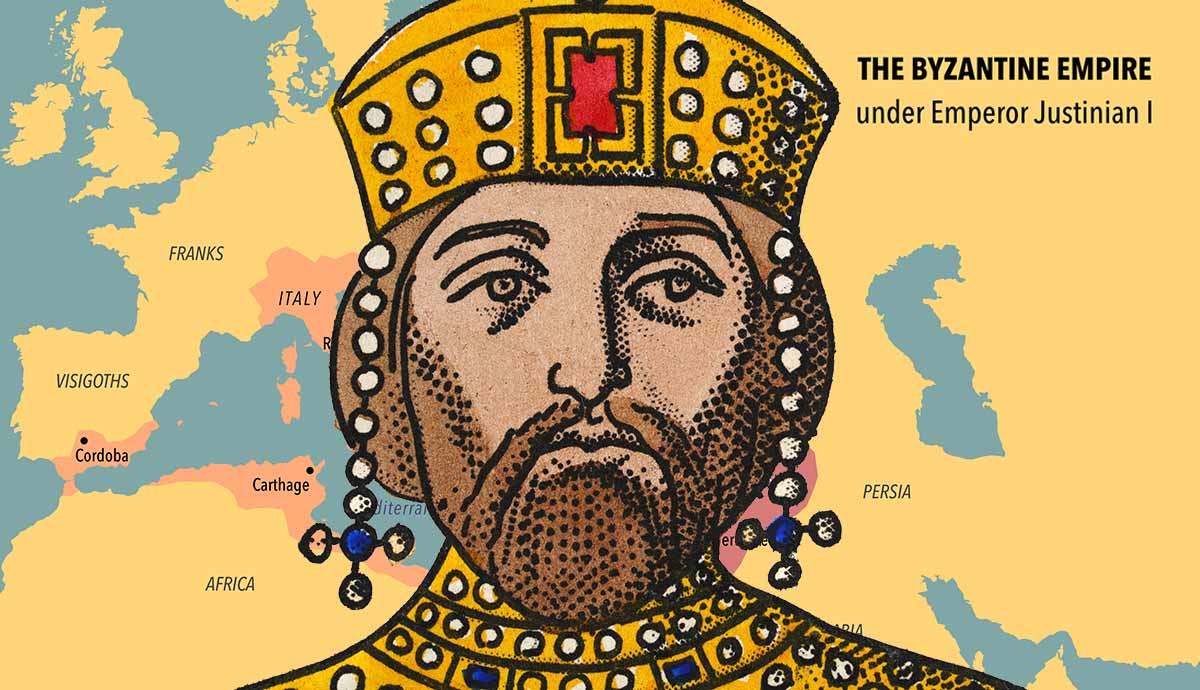
There was one policy in particular that directly connected the Eastern Roman Empire with ancient Rome. Rather than simply accept the loss of the Western Empire, Justinian, along with highly capable generals such as Belisarius, began a reconquest of the West. After securing peace with the Sassanids in 532, the eastern border was secure, and he could turn his attention to the west. The next year, Belisarius invaded and successfully captured Carthage in North Africa, driving out the Vandals. In 534, he landed and recaptured Sicily from the Ostrogoths. He then reconquered Italy, including Rome itself, as well as parts of Spain. While far from regaining all of the territory of the Western Roman Empire, Justinian managed to reclaim a significant chunk of former Roman territory. Due to several factors, these lands would be lost over the next few centuries, but for a brief moment in time, the empire regained some of its glory.
The Crusades & Decline of the East
The Siege of Constantinople, depicted on the external wall of Moldoviţa monastery, 1537. Source: istock
For nearly a millennium, the Eastern Roman Empire endured ups and downs. They repelled invasions from Persia and Bulgaria and raids by Vikings and the Rus. Their greatest challenge, however, would come from Arabia. After the birth of Islam in the 7th century CE, the Eastern Roman Empire would continually lose ground to Arab armies. The worst defeat occurred in 1071 at Manzikert, which saw the Byzantines lose control of Anatolia.
The Eastern Empire turned to the Pope in the West. Despite religious differences, the Catholic West formed a crusade to support the Orthodox East to drive back the Islamic incursions. Unfortunately for the Empire, this would also prove their downfall. In 1204, the Fourth Crusade was poorly led and financed, and the crusading army went rogue, and did the unthinkable: it captured Constantinople. The city was retaken in 1261, but it was never the same, limping on until the deathblow came in 1453 when the Ottoman Empire captured the city, finally ending the Roman Empire.
Byzantine or Eastern Roman Empire?
Gilt Plaque of St. Theodore, Byzantine, c. 11th century CE. Source: British Museum
Although the Eastern Roman Empire was Roman in every way, it causes some confusion among casual readers of history. The centerpiece of the Roman Empire, the city of Rome, was outside of its control for most of its history. Additionally, the Empire is often referred to as the Byzantine Empire, rather than the Eastern Roman Empire. And finally, when asked the question “when did Rome fall?” almost everyone, from serious scholars to internet search engines, responds 476.
The term Byzantine Empire was only applied to the Eastern Roman Empire after the fall of Constantinople. Western historians referred to it as such, and it soon entered the common lexicon and remains in use even today. The citizens of the Eastern Roman Empire simply referred to themselves as Romans. The term “Byzantine” would probably have meant nothing to them and would have simply reminded some of the more educated members of society of the original name of Constantinople. Every major government institution shared a continuity with the Empire of Augustus, and although it was reformed and evolved over the years due to changing circumstances, it remained the same empire. When Ottoman sultan Mehmed II captured Constantinople, he declared himself Kayser-i Rum, “Caesar of Rome.” The Eastern Romans spoke primarily Greek instead of Latin and labeled their institutions that way, but this was a superficial change.
Dardanelles Gun, of the same type used against Constantinople, 1453. Source: Wikimedia Commons
When Constantinople fell to Ottoman cannons, the last vestige of the Roman empire fell, absorbed by a much more powerful nation in an ever-changing world. When the city fell, the continuity from the small village on the Tiber was finally broken.








 New Posts (Home)
 ChatBox
 Popular Posts
  Game Zone
 Top PodCasts