www.thegospelcoalition.org
What Is the Biblical Way of Progress?
It’s the perfect symbol of progress. The United Nations headquarters was built in the aftermath of war and designed—appropriately enough—in the modernist style. Since work began in 1948, it has stood as a symbol for how the world can live as one. The UN charter preamble states,
We the peoples of the United Nations determined to save succeeding generations from the scourge of war, which twice in our lifetime has brought untold sorrow to mankind, and to reaffirm faith in fundamental human rights, in the dignity and worth of the human person, in the equal rights of men and women and of nations large and small, and . . . to promote social progress and better standards of life in larger freedom.
The UN charter perfectly captures how we feel. The past is dark. The future, we hope, can be better. That idea is baked into modern Western society.
You’ve probably heard somebody say “Get with the times,” “That was the Dark Ages,” “They need to update their thinking,” or “Those people are on the wrong side of history.” The progress story is so powerful nowadays that people try to win moral arguments by simply stating the date: “How can anyone believe that in 2026?”
In this way, even the most secular people believe in progress religiously. And we say religiously not just because of the force of this belief but because of its source: Progress is a biblical idea.
Biblical Vision of Progress
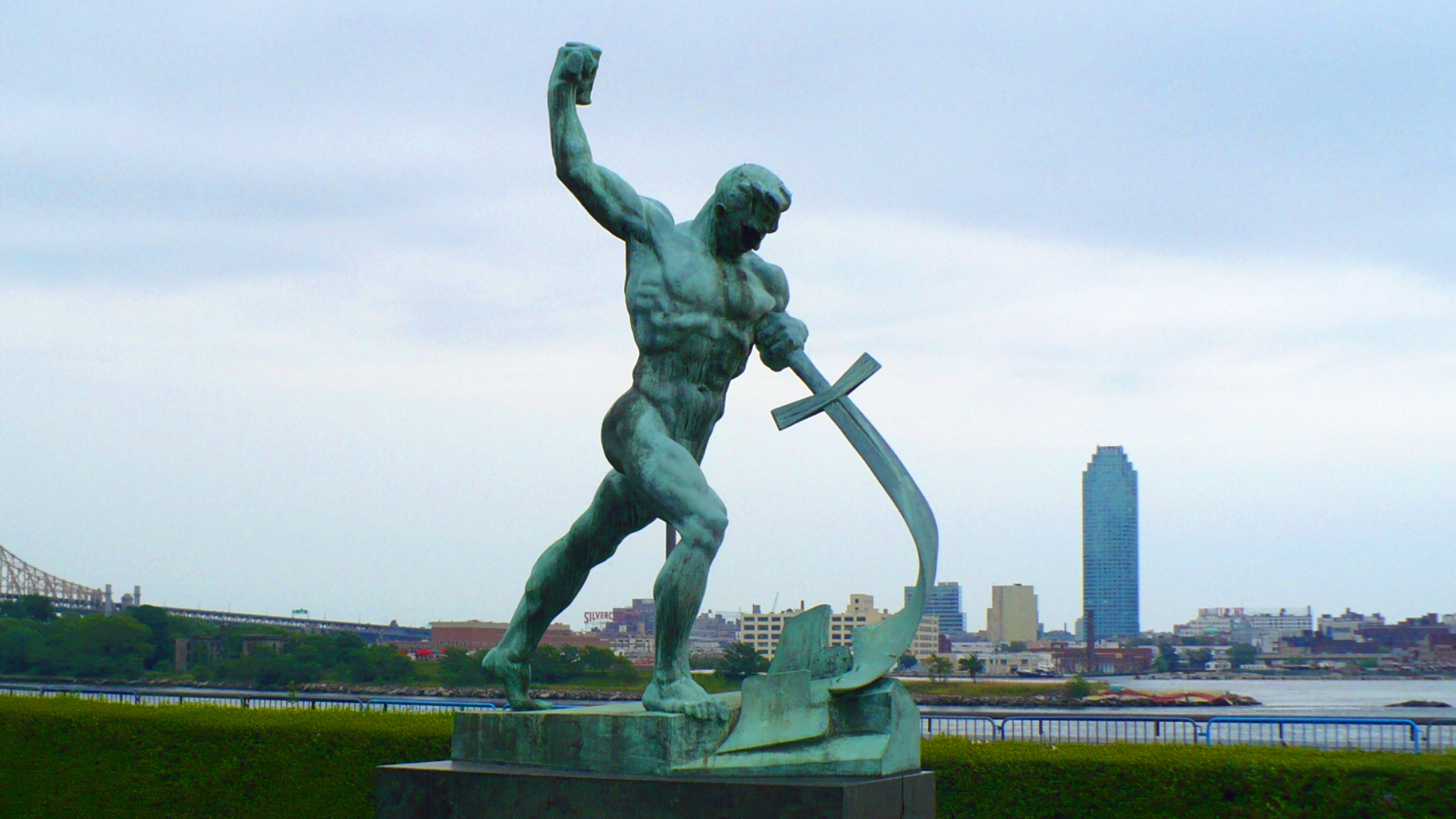
Consider a statue you can only see on the UN Headquarters garden tour. Unveiled in 1959, it’s called Let Us Beat Swords into Ploughshares, and it depicts a man beating a tool of violence into a tool of agriculture—moving from death to life. The statue is the perfect encapsulation of everything the UN is about, and it’s a profoundly biblical idea.
The image is taken straight out of Isaiah 2:3–4 (NIV, emphasis added):
Many peoples will come and say,
“Come, let us go up to the mountain of the LORD,
to the temple of the God of Jacob.
He will teach us his ways,
so that we may walk in his paths.”
The law will go out from Zion,
the word of the LORD from Jerusalem.
He will judge between the nations
and will settle disputes for many peoples.
They will beat their swords into plowshares
and their spears into pruning hooks.
Nation will not take up sword against nation,
nor will they train for war anymore.
This is part of the biblical vision for progress, and it begins on page 1 of the Bible: “And there was evening and there was morning, the first day” (Gen. 1:5). God sets everything in a direction, and then he methodically improves things day after day. He even gets humanity to methodically improve things by instructing them to work and keep the garden of Eden and to name its animals.
So we go from darkness to light. We go from simple to complex, from water to land, from seed to tree, from animal to man and woman, from nothing to good, to very good. It’s all progressing.
Read on in the Bible, and you see it in Israel’s story. First they’re slaves in Egypt and then they’re headed to the promised land (see Ex. 1–15). You later find them in exile, but they’re awaiting the Messiah, and when the Messiah comes, he first suffers and then is glorified. It’s cross and then it’s resurrection.
Some cultures think of time as a great circle: Round and round it goes with no progress. Other cultures have a decline narrative: We started with a golden age, but it’s all been downhill since then. But the Bible has an arrow: We’re going onward and upward. One day, God will wipe away all tears (Rev. 21:4), and we’ll beat our swords into plowshares.
The UN charter perfectly captures how we feel. The past is dark. The future, we hope, can be better.
Progress is profoundly biblical. The drafters of the UN’s Universal Declaration of Human Rights admitted as much in their more candid moments. John Humphrey, the Canadian law professor who first drafted the declaration, wrote in his diary that his intention was “something like the Christian morality without the tommyrot.” “Tommyrot” is a brilliant word. It’s like poppycock or balderdash. Humphrey thinks Christian theology is nonsense. He exemplifies the whole Western project after Christendom—to ditch Christian theology as tommyrot but somehow keep Christian morality.
That’s why the UN Declaration can speak of humanity with dignity and hope. These are Christian ideas with their biblical roots hidden. But what happens when you do more than hide the biblical roots of progress? What happens when you cut yourself off from them completely?
Downfall of Modern Progress
Let’s take a second look at where the Swords into Ploughshares statue came from. It was sculpted by Evgeniy Vuchetich as a gift from the Union of Soviet Socialist Republics, the USSR, to the United Nations in 1959.
Communism is one example of severing the progress narrative from its biblical roots, and maybe the shape of the statue you can see in the video or image above is starting to make sense to you now that you know its origin. Here’s a proletarian worker holding a mallet and a plowshare, or in other words, a hammer and a sickle. You don’t have to be an expert in Cold War politics to know trolling when you see it. Khrushchev likely couldn’t believe he pulled this off—a giant statue of a hammer and sickle installed in New York City during the height of the Cold War!
Karl Marx, who wrote the Communist Manifesto, was a prophet of progress in the 19th century, but there were all sorts of other prophets of progress. Marx wrote about political progress. Hegel wrote about historical progress. Darwin wrote about biological progress. And Freud wrote about psychological progress.
When those secular prophets of progress prophesied, evidence seemed to back up their claims. The Industrial Revolution was taking hold in the West, and there were unprecedented upticks in wealth, health, and life expectancy. Prosperity seemed to be advancing just as the secular prophets had said.
But if the 19th century was a century of progress, what were we progressing toward? The 20th century has been called the “murder century.” More people died violently in those hundred years than in every century before. We all believe in progress. The big question is, What kind of progress?
Hitler wanted a thousand-year Reich, and the death toll from World War II stretched to millions. In the USSR, the communists killed millions more in their revolution and reign. When the Swords into Ploughshares statue was being unveiled, Chairman Mao was launching his Great Leap Forward in China, an effort in which probably tens of millions died from being either beaten, worked to death, or starved to death in the name of progress.
We all believe in progress. The big question is, What kind of progress?
Discerning Biblical Progress
How do we discern the biblical idea of progress from all the counterfeits? Here are three questions you can ask.
1. What is the standard of progress?
When we say things are better now, what do we mean? Things have improved a lot by the standards of economics, technology, and health care. But have human beings improved? Is our moral fiber better? If we were to travel to the past, we might impress an ancient society with our iPhones, but we probably wouldn’t impress them with our moral character.
What’s the standard? In Isaiah 2, the standard is clear. It’s the Lord’s ways, his paths, his law, his Word, his light. He is the judge.
2. Who is the bringer of progress?
On the statue, they shifted Isaiah’s language from “they” to “us” or “we.” Let us beat our swords into plowshares. We will bring about this brave new world. That’s a big shift.
In Isaiah, the focus is on the Lord. He will teach us his ways. The Word of Yahweh will flow out from Jerusalem. He will judge between the nations. According to Isaiah, the Lord, through his Word, is the agent of progress. And that’s actually how history has worked out.
Think of the moral changes that have happened over the last 2,000 years—the birth of charities, hospitals, and hospices; education for all; the outlawing of blood sports, infanticide, and child sexual abuse. Think of the whole concept of human dignity, worth, and rights that the UN’s Universal Declaration is founded on. Think of the abolition of the transatlantic slave trade. These have been profoundly biblical movements—Christian movements. The Lord, through his Word and through his Spirit at work in his people, brings progress.
3. What is the way of progress?
In 1958, while Vuchetich was working on that statue and Mao was enforcing his Great Leap Forward, Martin Luther King Jr. wrote in a little magazine called The Gospel Messenger. For the first time, he used a line now remembered by millions: “The arc of the moral universe is long, but it bends towards justice.”
He got the line from a 19th-century abolitionist, a preacher named Theodore Parker. They both got it from the Bible. Parker and the abolitionists in the 19th century brought God’s Word to bear, and moral progress was made.
King and the civil rights movement in the 20th century said the arc of progress wasn’t done. The rights, dignity, and freedom that birthed abolitionism needed to be applied again in King’s day. So he proclaimed biblical truths and the arc continued to bend. But here’s a vital question: Which way does the arc bend?
We naturally imagine a rainbow-shaped arc rising up from the earth and soaring into the distance—an up and down trajectory. But that isn’t the biblical arc of progress—that’s a Babel arc. Remember Babel from Genesis 11? They built up a great tower by their own efforts to make a name for themselves, and in the Lord’s judgment, it all came down with a crash. Up then down—that’s the way of the flesh.
What’s the biblical way? Down, then up. In Isaiah 2, we see that nonviolence is at the heart of the Lord’s revolution. Swords turned into plowshares. The world brings progress by force, but the Lord brings progress by his Word. What’s it like to lay your weapons down and only use the Word of the Lord? It’s very costly, but King, like many others in the civil rights movement, embraced that way. He embraced the vulnerability of nonviolent, Word-based progress. It cost him his life. But that’s the way—down, then up.
That’s the way the Lord brings progress. Though he could’ve called 12 legions of angels, Jesus Christ refused to pick up his sword (Matt. 26:53). Instead, the weapons of violence were used on him, but he rose up to proclaim peace. That’s the way of his revolution, and it leaves all the others in the dust.
Jesus Christ refused to pick up his sword. Instead, the weapons of violence were used on him, but he rose up to proclaim peace.
When the Swords into Ploughshares statue was unveiled in 1959, Soviet propaganda seemed so cutting-edge, but now it’s the hammer and sickle that are on the wrong side of history. Progress is real, but it’s biblical. There is an arc, and it does bend, but it bends down and then up. It bends toward death then life. It’s cross and then resurrection, and in the end, all nations will see that it’s the Word of God that brings real progress. It’s the Word of God that will prevail.








 New Posts (Home)
 ChatBox
 Popular Posts
  Game Zone
 Top PodCasts