www.newsbusters.org
Editor’s Pick: Free Beacon DESTROYS NYT Reporter Over Iran War Hot Take
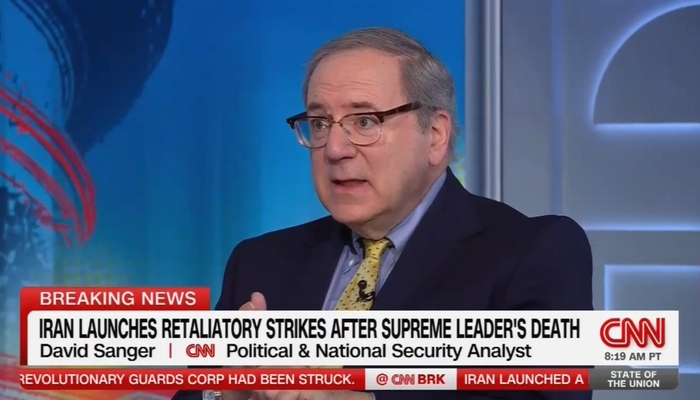
Writing Monday for our friends at the Washington Free Beacon, Ira Stoll took a blowtorch to longtime Deep State New York Times reporter David Sanger for his cartoonish “news analysis” story that ran in Sunday’s print edition under the headline “Trump’s War of Choice, With a Key Question: Why Now? Citing Grievances Like 1970s Crisis, Not an Imminent Threat.”
Stoll stated that Sanger was “playing a political role rather than functioning as an honest broker” in rather “breathtaking” fashion as he asserted the U.S. military undertook “the ultimate war of choice” as “[i]n international law, the difference between a war of necessity and a war of choice is huge.”
He went onto insist Iran was nowhere near capable of delivering dangerous blows to the U.S. “thanks largely to the success of the president’s previous strike on Iranian nuclear enrichment sites, in June.”
Here was where Stoll really dropped the hammer on Sanger by quoting back his own reporting from last summer and others from his Times colleagues that not only cast doubt on the success of Operation Midnight Hammer, but repeatedly covered the litany of threats Iran and its proxies have posed (click “expand”):
Now the Times wants to describe Trump’s previous strike as a "success." Yet back in June 2025, the Times marshaled six of its biggest star bylines—plus "David E. Sanger contributed reporting"—for a front-page story claiming, "A preliminary classified U.S. report says the American bombing of three nuclear sites in Iran set back the country’s nuclear program by only a few months, according to officials familiar with the findings. … The report also said that much of Iran’s stockpile of enriched uranium was moved before the strikes, which destroyed little of the nuclear material. Iran may have moved some of that to secret locations." The Times is going to attack Trump whatever he does. In June 2025, they were saying that the Iranian nuclear program hadn’t really been obliterated. Now, they are criticizing Trump for unnecessarily attacking Iran, because after all, he had essentially obliterated the nuclear program the last time around.
Sanger also writes, "While Mr. Trump claimed Tehran was ultimately aiming to reach to the United States with its array of missiles, even his own Defense Intelligence Agency concluded last year that it would be a decade before Iran could get past the technological and production hurdles to produce a significant arsenal." Yet Iran need not develop an intercontinental ballistic missile to hit America. It could send over a drone from Canada or Mexico or Cuba. It could launch a medium- or short-range missile from a boat or a submarine. Or it could use terrorists to deliver the blows.
Before the United States launched its preemptive attack, the New York Times was trying to panic readers about Iran’s capabilities against American targets. A Times article from February 22 was headlined, "Iran Could Direct Proxies to Attack U.S. Targets Abroad, Officials Warn." A June 2025 article in the Times said, "Carlos Fernandez, a former senior F.B.I. agent in charge of New York’s counterterrorism division, said the agents had to take seriously the possibility of sleeper cells in the United States, especially since Iran has been accused of plotting to kill President Trump before the election and a human-rights activist in Brooklyn. Indeed, the bureau has also uncovered members of Hezbollah, who trained in Lebanon but then moved to the United States, where they were eventually arrested in Michigan and New York and charged with terrorism. ‘It’s very real,’ he said. ‘It’s a legitimate concern.’" A July 2025 article in the Times quoted Bruce Hoffman, a terrorism expert at Georgetown University, who told the paper that, as the Times paraphrased him, "Iran and Hezbollah have long sought to position agents within the United States for potential terrorist attacks with at least some success."
Stoll even blasted Sanger for not conceding “these distinctions between wars of choice and necessary wars actually go far back in Jewish and Christian traditions,” specifically the Babylonian Talmud, the Mishneh Torah, a St. Augustine letter to Boniface, and a 1625 letter by Dutch scholar Hugo Grotius.
Having explained what each stated about wars of choice vs. necessary wars, Stoll observed the documents alone put Sanger’s partisan quackery to shame:
It does not seem to me as if it’s a war of choice in the sense of territorial expansion or enlarging borders. Neither Israel nor the United States is planning to capture Iranian territory on a permanent basis and colonize it. If this were a joint U.S.-Israeli operation to seize Greenland from Denmark, I might be in favor of it, but I wouldn’t be here defending it as a war of necessity rather than a war of choice. As to whether modern day Iran is Amalek, there are certainly ample parallels, and the timing with Shabbat Zachor is something. Yet I don’t even think one has to go there. There’s plenty of ground to place the U.S.-Israel action in the terrain of Maimonides—delivery from an enemy who has attacked. And Augustine—war waged in order that peace may be obtained. And Grotius—certainty that Iran "has not only Forces sufficient, but a full Intention to injure us."
Later, Stoll also trained his eye on Sanger’s fellow Deep State denizen Richard Haass, who insisted to The Times reporter the Trump administration has failed to give “diplomatic under military pressure, economic embargoes, [or] interceptions of Iranian ships” a chance before waging war.
Of course, Stoll stated in so many words that each of this had been tried before to little or no success.
To see Stoll’s full takedown, click here (or the link at the top of the post).








 New Posts (Home)
 ChatBox
 Popular Posts
  Game Zone
 Top PodCasts