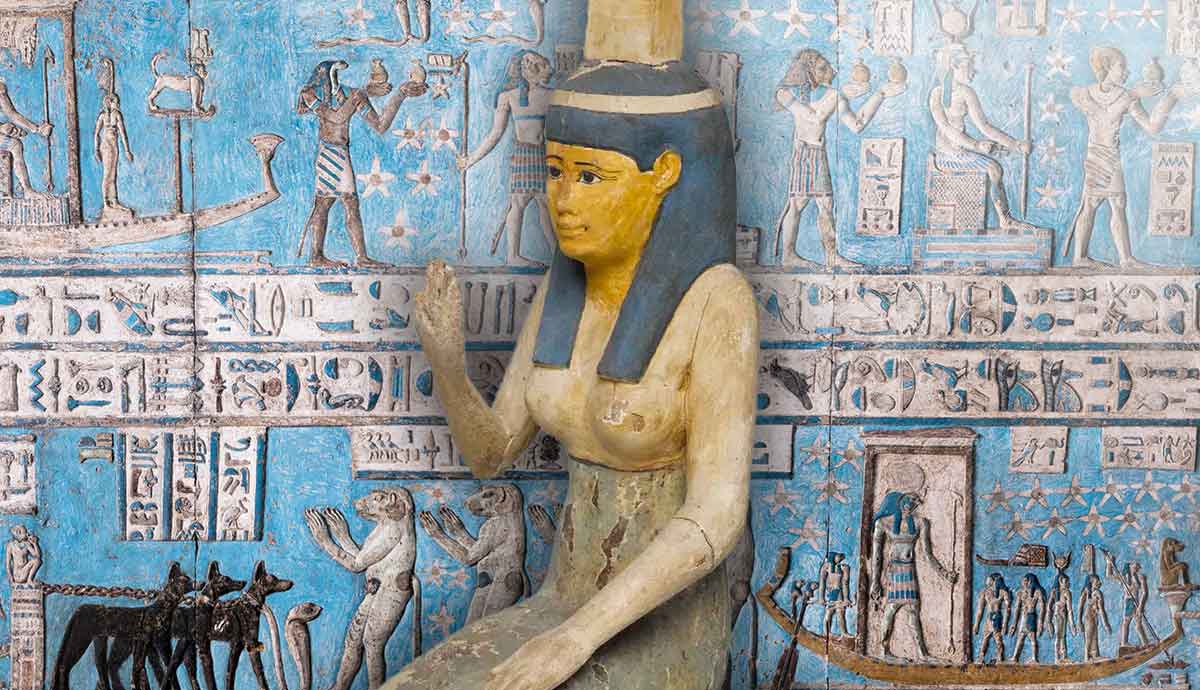
www.thecollector.com
Nephthys, the Dark Sister of Isis in the Egyptian Pantheon
Nephthys was one of the Egyptian deities in the Ennead of Heliopolis. While her siblings Isis and Osiris were married as the gods of light and life, Nephthys was married to the chaotic god Seth, forming a dark and dangerous couple. Nephthys was seen as the dark mirror image of her sister Isis, usually depicted together as two sides of the same coin. While Isis represented the transition into life through childbirth, Nephthys represented the transition into the afterlife. They were both necessary for the resurrection of Osiris and the nurturing of his son Horus, and his mortal incarnation, the pharaoh. Read on to learn more about this darkly fascinating and complex goddess.
Ennead of Heliopolis
Statuette of the goddess Nephthys, Late Period Egypt, c. 664-30 BCE. Source: Brooklyn Museum
While we often think of ancient Egyptian religion as a unified and coherent set of religious beliefs, that was far from the case. Egypt emerged as a group of independent settlements, each with its own gods. The country was unified into a single nation around 3100 BCE, though regions were still largely independent for centuries. Local religious practices continued, and the most important national gods belonged to whatever city was preeminent. As time passed, greater alignment emerged with lesser deities being absorbed into more important ones, and important gods being incorporated into local beliefs. But throughout Egyptian history, there continued to be a number of distinct pantheons with distinct mythologies.
Silver statuette of Nephthys, Late Period Egypt, c. 715-650 BCE. Source: Metropolitan Museum of Art
Nephthys belonged to what was known as the Ennead of Heliopolis. Heliopolis is the Greek name for a city called “The Pillars” by the Egyptians, which was located near modern Cairo. It was one of Egypt’s oldest cities and was particularly important during the Old and Middle Kingdoms. The sun god Ra was a member of the Ennead in his form as the god Atum. He was the creator deity who came into existence independently by emerging from Nun, the primordial waters. He then created Shu and Tefnut, personifications of air and moisture, who in turn gave birth to Geb and Nut, the earth and the night sky.
Geb and Nut had four children: Osiris, Isis, Seth, and Nephthys. The sibling spouses Osiris and Isis represented fertility and order and were given dominion over the world. Seth and Nephthys, also sibling spouses, represented the chaos necessary for balance.
Nephthys in the Osiris Myth
Nephthys with outspread falcon wings from the tomb of Tutankhamun, New Kingdom Egypt, c. 1323 BCE. Source: Egyptian Museum
Nephthys had an important role to play in the Osiris myth, which explains the origins of the Egyptian afterlife. The most complete version of the Osiris myth is told by the 1st-century CE Greek historian Plutarch. While his telling is consistent with earlier evidence, it is important to remember that this version of the story is told by an outsider at a time when Egypt was already incorporated into the Roman Empire for over a century.
According to the myth, Osiris’ parents made him the ruler of the earth and the netherworld of the gods, while his brother Seth was given rulership of liminal spaces, such as the dangerous desert. Jealous of his brother, Seth decided to kill Osiris and take his place. Some versions of the story suggest that Seth also set his brother up by convincing Nephthys to seduce Osiris and compromise his morals. This encounter left Enphthys pregnant with Anubis.
In one story, Seth invited Osiris to a party, during which he offered the prize of a beautiful chest to whoever could fit inside. Of course, it was perfectly sized for Osiris, and as soon as he lay down, Seth slammed down the lid and trapped him inside. He then threw the chest into the Nile, and Osiris drowned. In another version, Seth killed Osiris and then hacked his body to pieces and buried the pieces in different parts of Egypt.
Isis set about collecting the scattered pieces and found all of them except Osiris’s phallus, which had been swallowed by a fish. She then reassembled the body, and Isis and Nephthys turned themselves into kite birds, flapping their wings to breathe life back into the body. In some versions, Nephthys’ son Anubis, who was fostered by Isis, helped invent the mummification process for Osiris.
Nephthys, Horus, and Isis amulet, Late Period Egypt, c. 664-525 BCE. Source: Metropolitan Museum of Art
While Isis is the principal actor in the resurrection of Osiris, Nephthys is always cast alongside her sister in the story. In rituals carried out by the ancient Egyptians in imitation of Osiris’s resurrection, it is always both Isis and Nephthys who are represented as his mourners and call him back to life.
Osiris was sufficiently restored to life that Isis could become pregnant by him, but it was not enough to truly bring him back to life. Therefore, the underworld was created for him, allowing him to live on after death. Isis then gave birth to Horus, who would grow up and avenge his father, expelling his uncle Seth and taking up Osiris’s previous rulership.
While Isis was described as the birth mother of Horus, Nephthys was his “milk mother,” showing that she was considered to have an equally close relationship to the new ruler of the cosmos. As an extension of this, she was also seen as the divine nurse of the reigning pharaoh. In the New Kingdom, the Ramesside pharaohs often described her as Mother Nephthys. Ramesses II constructed a new temple for the goddess at Sepermeru, where two prophets delivered oracles.
Functions of the Goddess
Gold statue of Nephthys protecting Tutankhamun’s canopic chest, New Kingdom Egypt, c. 1323 BCE. Source: Cairo Museum
While Osiris and Isis together initially represented truth and light, Seth and Nephthys were their mirror opposites and represented the darker sides of life. As such, while Seth was associated with the dangers of the desert and foreign lands, Nephthys was associated with liminal spaces. Her domain was the darkness and the perilous edge of the desert, marking the line where order meets chaos. She was also associated with the sunset, when brightness fades into shadows, and had the power to illuminate that which is hidden when the moon reigns.
During the night, alongside her consort Seth, Nephthys protects the barge of the sun god Ra from the serpent Apophis, ensuring that the sun survives the night to light the world again. This gave her the attributes of a protective goddess. She was widely invoked as the “helpful goddess,” and many amulets in the shape of her likeness survive in the archaeological record, and she is summoned to aid mortals in many magical papyri. She was considered a benevolent but ferocious protector capable of incinerating enemies with her fiery breath, and she is one of the few beings that causes demons to tremble with fear. Nephthys is often represented with falcon wings outstretched in protection.
Canopic jar with head of Nephthys, Middle Kingdom (c. 1981-1802 BCE). Source: Metropolitan Museum of Art
Through her role in the resurrection of Osiris, Nephthys was also associated with the creation of the afterlife and the liminal space between the world of the living and the dead. As the mirror of her sister, Isis was associated with the transition into life, and Nephthys was associated with the transition into the afterlife. In this role, she is sometimes described as accompanying a person as they transition into the next life. As an extension of this, she was also the goddess of one of the canopic jars used in the mummification process.
While her chthonic duties might make Nephthys seem sombre, she was a festive goddess, particularly associated with the consumption of beer. She received lavish beer offerings, and in return, offered the joy of no hangover.
Lady of the Temple
Temple decoration at Dendera, depicting the goddesses Isis and Nephthys watching over the corpse of their brother Osiris, Ptolemaic Egypt, c. 305 BCE. Source: Wikimedia Commons
While Nephthys is the name most used for the goddess today, it is the Greek version of the name Nebet-hut. Her name means “Lady of the Temple.” She represents the pylons that guard the gateway of the temple, as she is also the goddess of thresholds and passageways, as liminal spaces. She often appears with a pylon on her head, and the hieroglyphs for her name, a combination of the symbol for sacred temple enclosures, hwt, and the symbol for nb “mistress.”
Relief from the temple of Hathor at Dendara showing Osiris on a sun barge, Nephthys sat behind him, and Isis in front, Ptolemaic Egypt, c. 305 BCE. Source: Wikimedia Commons
During certain rituals, Egyptian priestesses would assume the roles of Nephthys and Isis, the divine priestesses. The goddesses were particularly prominent in a ceremony known as the Lamentations of Isis and Nephthys, which reenacted the death and resurrection of Osiris with a significant focus on the mourning of the sisters. A text survives known as the Songs of Isis and Nephthys, which were reportedly used during rituals. It sees the sisters continually calling the murdered brother Osiris to return to them.
On temple walls, both Isis and Nephthys were usually depicted as a kite bird or a woman with falcon wings outstretched in protection.
Isis and Nephthys were seen as mirror images of one another, with Isis representing light and life, while Nephthys represented the darker side of existence; she was sometimes called the “Hidden One.” Nevertheless, Nephthys was not considered a dark goddess but was venerated as a nurturer and protector.








 New Posts (Home)
 ChatBox
 Popular Posts
  Game Zone
 Top PodCasts