www.theamericanconservative.com
Labour’s War on UK Pubs
UK Special Coverage
Labour’s War on UK Pubs
Safetyism and political correctness are destroying a British institution.
UK Special Coverage
“When you have lost your inns,” warned writer Hilaire Belloc over 100 years ago, “drown your empty selves. For you have lost the heart of England.” A century later, his message could not be more pertinent. Since the beginning of this year, roughly four pubs have permanently closed their doors every day. By the end of 2026, something like 540 pubs could shut for good.
For this British institution, no help can be expected to come from the current Labour government. In her Autumn Budget, Chancellor Rachel Reeves announced that Covid-era business rates relief will end in April this year, having previously been scaled back from 75 percent to 40 percent. Pubs unable to cope with the higher rates will be forced to close—something that has seen many Labour MPs being barred from their locals. Although Reeves did recently walk back the business rate increase and announce a temporary support package for struggling pubs, many landlords fear this will not be enough.
After all, this is not the only battle currently being fought by weary publicans across the country. Employer National Insurance contributions, alcohol duty, and minimum wage have all recently been increased, making the running of a pub prohibitively expensive. To make matters worse, the government recently announced that it was planning to cut the blood alcohol limit in half, from 80 milligrams of alcohol per 100 milliliters of blood to 50mg per 100ml. That would make having just one pint potentially criminal—and it would disproportionately impact rural pubs that rely on customers driving to and from them. None of this is to mention the fact that it’s becoming increasingly expensive to drink and eat out at all, with more and more customers, particularly young people, skipping after-work or weekend pints due to the extortionate cost of living.
It’s not just a financial war that’s being waged against the pub. Its very character, too, is under attack. As of October this year, pub landlords will also have to worry about the so-called ‘banter ban’ being implemented by the Employment Rights Act of 2025. This makes employers liable for harassment by third parties (in this case, customers) while working. Unsurprisingly for any piece of legislation cooked up by Keir Starmer’s Labour government, “harassment” can essentially boil down to nothing more than overhearing an “offensive” conversation or banter between patrons. As such, landlords would effectively be forced to police customers’ speech, in case it crosses that line.
Turning the pub into a kind of panopticon, where punters and publicans alike are constantly afraid that an off-color joke might land them in legal trouble, undermines its nature and purpose. It violates the spirit of the pub—a place that ought to be the natural home of free assembly and free speech of all kinds.
It is for perhaps this reason that the pub so regularly draws the ire of the political classes. Those who would consider themselves our “betters” are horrified at the vulgarity and commonness of this British institution. Historically, taverns, inns, and alehouses acted as meeting places for radicals and anti-government conspirators. From the planning of election campaigns and revolts to being the target of the anti-alcohol temperance movement of the 19th century, pubs were often deeply political. Indeed, the infamous November 5 Gunpowder Plot—the failed attempt by English Catholics to blow up King James I and Parliament in 1605—was hatched and finalized in various taverns across London.
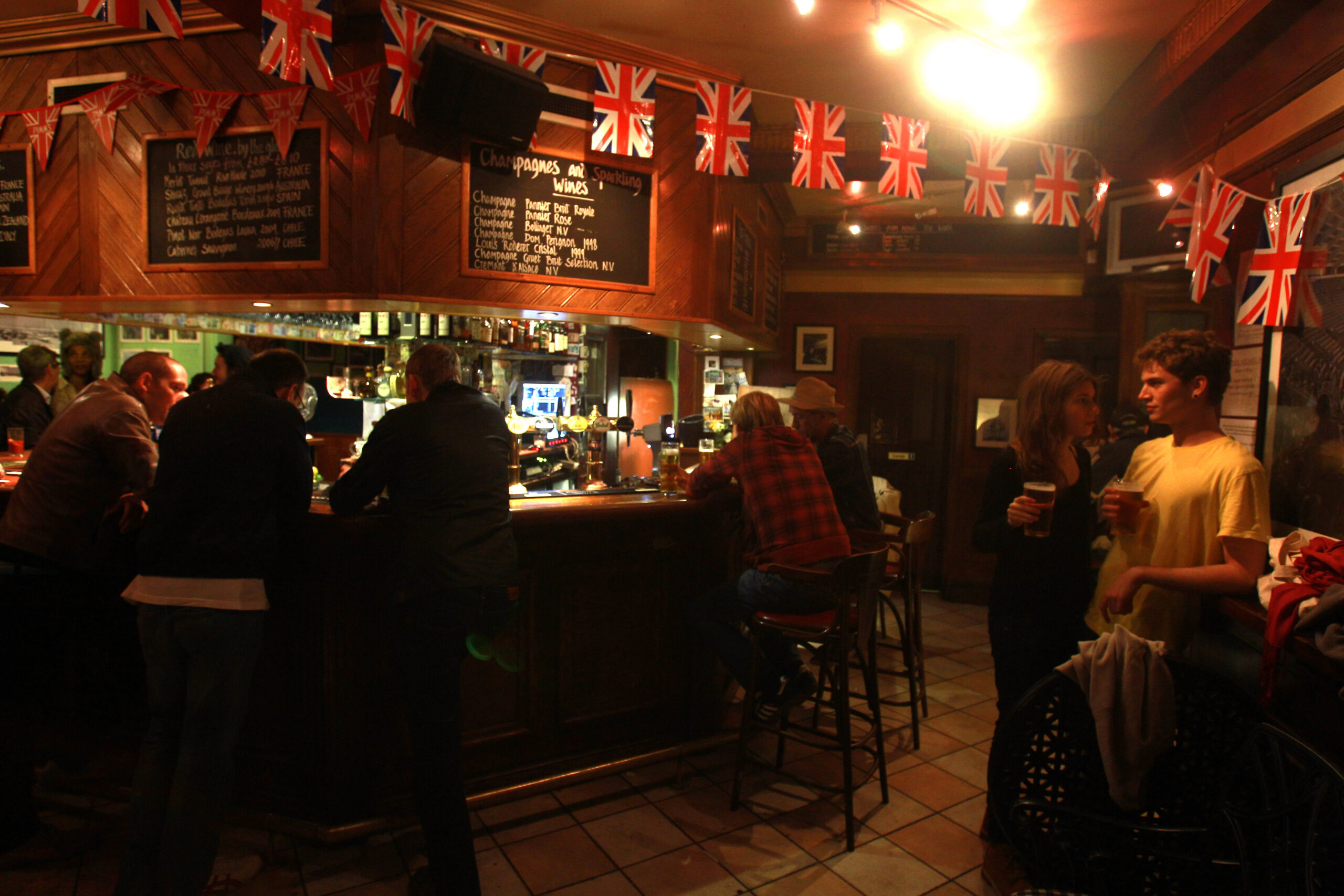
Even today, the pub remains central to the British way of life, no matter how much our politicians may look down their noses at it. It might be difficult for non-British readers (or at least, those who have not spent a great deal of time in the UK) to understand how central the pub is to our cultural fabric and our identity. They are not simply places to buy food and drink; they are a fundamental part of many communities, and act as centers to bring people together. Whether your tipple of choice is a trendy craft beer, a traditional stout, or—Heaven forbid—an Aperol spritz, the pub offers a place of refuge for people from all walks of life. A good pub has less in common with a bar, club, or restaurant and more with a sitting room. It is somewhere comfortable, informal, and familiar.
The long shadow of the temperance movement still hovers over the pub today. It now adopts the language of wellbeing and “self-care” rather than that of religion, with measures like minimum unit pricing, already in place in Scotland and Wales and mooted in England under the guise of concern for public health and shielding the NHS from mass alcoholism. Moderate drinkers, therefore, are punished for a problem they have no part in.
If not an obsession over health, then the modern “teetotalitarian” impulse comes from good old-fashioned killjoyism. At any moment, pubs can have their licenses revoked over noise complaints. This is particularly a problem in London, where pubs are closing at a faster rate than most other cities in the country, and landlords are at the mercy of local residents—even in busy areas like Soho and Shoreditch, which are renowned for their nightlife. Pubs can be closed due to a few angry letters, if word gets out that punters dared to raise their voices past 10pm on a Saturday. This is the fate that almost befell George Orwell’s favorite pub, the Compton Arms in Islington, which was threatened in 2022 by the local council that it must quiet down or close its doors. It was apparently irrelevant that the pub has been operating since 1800, hundreds of years before any of the current residents were even born, and offers a very civilized-sounding “seasonally led” “small-plates menu”—hardly a wild nightclub. Nonetheless, the Compton Arms was considered simply too rowdy for some puritanical locals. Thankfully, the pub ultimately survived its brush with death.
The Labour Party may not be all that bothered by the death of one of Britain’s most beloved institutions, but Reform UK is. Earlier this month, party leader Nigel Farage and Reform MP Lee Anderson launched the party’s Save Our Pubs campaign. At its core is a five-point plan to ease the tax and regulatory burden on landlords and cut costs across the hospitality sector. Crucially, Reform’s plan treats pubs as something more than just businesses. Rather, they are the beating hearts of many communities and a part of our national heritage. That is exactly the right instinct. Each pub that permanently closes its doors is a blow to a uniquely British institution.
Belloc was right. When Britain loses a pub, it loses a piece of itself. If politicians refuse to stop taxing, regulating, and moralizing our locals out of existence, voters will back those who will. It’s high time that we called last orders on those destroying our pubs.
The post Labour’s War on UK Pubs appeared first on The American Conservative.








 New Posts (Home)
 ChatBox
 Popular Posts
  Game Zone
 Top PodCasts