www.newsbusters.org
MEET THE IRANIAN PRESS: NBC’s Welker Takes Iran’s Foreign Minister to Softball City
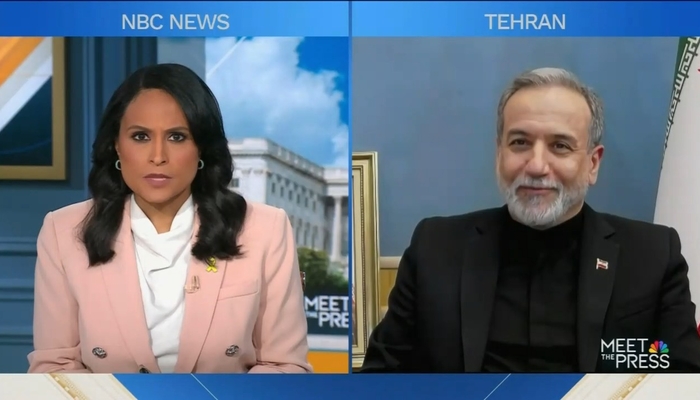
Another Sunday, another softball interview for Iranian Foreign Minister Abbas Araghchi. With it, more proof that the Elitist Media appear to have sided with Iran in this latest engagement within a conflict that was started by Iran 47 years ago.
Watch as NBC’s Kristen Welker opens her interview of Araghchi quite collegially, with horserace speculation on who the next Supreme Leader of Iran might be:
TERRIBLE: his exchange between NBC's Kristen Welker and Iranian FM Abbas Araghchi on Supreme Leader succession is indistinguishable from the usual Sunday show horserace patter. They might as well be talking about a Senate vacancy. pic.twitter.com/Uu2AmxcUH9
— Jorge Bonilla (@BonillaJL) March 8, 2026
KRISTEN WELKER: Welcome back. Joining me now is the Foreign Minister of Iran, Abbas Araghchi, Mr. Foreign Minister, welcome to Meet the Press.
ABBAS ARAGHCHI: Well, thank you so much. Thank you for having me.
WELKER: Thank you very much for being here. I have to ask you the big question on everyone's mind: who is in charge in Iran right now?
ARAGHCHI: Well, it is already known. The council of- the interim leadership council is now in charge. And they are doing their act in absence of the leader while a new Supreme Leader is going to be elected soon by the Assembly of Experts. And the president and the cabinet are also in there- are doing their duties, the parliament there, everything is in its place.
WELKER: Well, there are reports this morning that the Iranian Assembly of Experts has come to a decision on a new Supreme Leader for Iran, many have suggested it would be the son of the late Supreme Leader, Mojtaba Khamenei. Will he be the next leader of Iran?
ARAGHCHI: Well, nobody knows, actually. There are lots of rumors around, but we know we have to wait for the Assembly of Experts to convene and vote for the new Supreme Leader and- the one who is elected by them.
WELKER: Do you think he should be the next leader of Iran?
ARAGHCHI: Anybody who is elected by the Assembly of Experts will be the next Supreme Leader of Iran. As you know, the members of the assembly of- the members of the Assembly are already elected by- elected directly by the people.
WELKER: All right, well President Trump says he should pick the new leader of Iran. Will Iran allow President Trump to have any role in picking its new leader?
ARAGHCHI: We allow nobody to interfere in our domestic affairs. This is up to the Iranian people to elect their new leader. They have already elected the Assembly of Experts and the Assembly of Experts will do the job. It is only the business of the Iranian people and nobody else business.
The interview goes downhill from there. Welker went on to ask about what terms might Iran accept in order to enter into some form of ceasefire, Iran’s aggression against neighboring countries, the disputed strike against a girls’ school located just 650 yards from an IRGC base, and Iran’s missile capabilities.
At no time did Welker seriously push Aragchi. At no time did she cut him off mid-answer or point her pen at him as she routinely does when interviewing GOP officials. It’s not unreasonable to say that Aragchi got far better treatment than Senator Lindsey Graham, a frequent Meet the Press guest.
In tone and tenor, Araghchi came in with the benefit of the doubt and with all deference. For the most part, he was allowed to speak freely. The follow-up questions were not particularly thorny, and he was never in a situation where he was pressed on anything.
It is not unreasonable to say that Iranian officials appearing on Elitist Media are drawing the same deference that was given to Ukrainian officials at the outset of the Russian invasion. To be clear, this is to say that the Elitist Media consider America to be the hostile aggressor, and Iran the victim of hostile aggression. This interview is just the latest instance of an ongoing and irrefutable trend.
Click “expand” to view the full transcript of the aforementioned interview as aired on NBC’s Meet the Press on Sunday, March 8th, 2026:
KRISTEN WELKER: Welcome back. Joining me now is the Foreign Minister of Iran, Abbas Araghchi, Mr. Foreign Minister, welcome to Meet the Press.
ABBAS ARAGHCHI: Well, thank you so much. Thank you for having me.
WELKER: Thank you very much for being here. I have to ask you the big question on everyone's mind: who is in charge in Iran right now?
ARAGHCHI: Well, it is already known. The council of- the interim leadership council is now in charge. And they are doing their act in absence of the leader while a new Supreme Leader is going to be elected soon by the Assembly of Experts. And the president and the cabinet are also in there- are doing their duties, the parliament there, everything is in its place.
WELKER: Well, there are reports this morning that the Iranian Assembly of Experts has come to a decision on a new Supreme Leader for Iran, many have suggested it would be the son of the late Supreme Leader, Mojtaba Khamenei. Will he be the next leader of Iran?
ARAGHCHI: Well, nobody knows, actually. There are lots of rumors around, but we know we have to wait for the Assembly of Experts to convene and vote for the new Supreme Leader and- the one who is elected by them.
WELKER: Do you think he should be the next leader of Iran?
ARAGHCHI: Anybody who is elected by the Assembly of Experts will be the next Supreme Leader of Iran. As you know, the members of the assembly of- the members of the Assembly are already elected by- elected directly by the people.
WELKER: All right, well President Trump says he should pick the new leader of Iran. Will Iran allow President Trump to have any role in picking its new leader?
ARAGHCHI: We allow nobody to interfere in our domestic affairs. This is up to the Iranian people to elect their new leader. They have already elected the Assembly of Experts and the Assembly of Experts will do the job. It is only the business of the Iranian people and nobody else business.
WELKER: President Trump says there will be no deal with Iran, except for, quote, “unconditional surrender.” Will Iran agree to unconditional surrender for the sake of bringing this war to an end, Mr. Foreign Minister?
ARAGHCHI: Well, this is what he asked a previous time, last year in June, that when Israel started to attack us, we know, President Trump used the same phrase, “unconditional surrender,” that was the tweet he made- and that didn't happen. We resisted, and after 12 days, Israelis asked for unconditional cease-fire. So, we never gave up, we never surrendered and we continue to resist as long as it takes. We continue to defend ourselves and we are defending our territory, our people, and our dignity. And our dignity is not for sale.
WELKER: Well, let me ask you, because what conditions would Iran accept to bring this war to an end?
ARAGHCHI: Well, actually, we are not at that point yet. Obviously, this time is different from the previous time. Last time, we accepted the cease-fire. But you know, this time is quite different. And the reason is obvious, you know, last time they attacked us, they made aggression against us, they killed our people, they destroyed our places and then asked for a cease-fire and we accepted it out of good faith because we were only exercising the, you know, the act of self-defense and when the aggression was stopped, we stopped, too. But, you know, it didn't brought- it didn’t bring about peace, and now this year, they again started to attack us and again they have, you know, they are killing our people, they are killing, you know, girl students, you know, they are attacking hospitals, freshwater desalinations, refineries you know, everywhere, people have been killed.
Places have been destroyed, and now, they want to ask for a cease-fire again? well, this doesn't work like this. So there should be a permanent end of the war and unless we get to that, I think we need to, you know, continue fighting for the sake of our people and our security.
WELKER: We are going to get to the reports about some of the deaths in just a moment. But just to stay on this topic: would Iran ever agree to a cease-fire to get back to the negotiating table- to end all of this military conflict?
ARAGHCHI: Well, they have to explain why they started this aggression before we come to the point to even consider a cease-fire. Of course, nobody wants to continue this war, this is not our war, this is not our- you know, the war of our choice. This is imposed on us by the United States, by the Israelis. They have, you know, started this war, unprovoked, un- warranted, illegally, and what we are doing is an illegal- is legal act of self- defense and we have every right to do that. So it is not fair that if only it stops the aggression and asks us to stop, too. You know- as I said, this time is different.
WELKER: Let me ask you about some of what Iran has been doing. Iran has launched hundreds of missiles at 13 other nations in the region. On Saturday, the Iranian president apologized for those strikes on neighboring Gulf states. Was it a mistake for Iran to attack its neighbors?
ARAGHCHI: Well, it is a mistake if you consider that Iran is attacking its neighbors. No, we are not attacking our neighbors. We are attacking American bases, American installations, American assets which are unfortunately located in the soils of our neighbors. So we are not attacking our neighbors, we are attacking Americans who are attacking us. We are retaliating. We have not started this war. It's Americans who started this war against us, attacking us, and we are defending ourselves. So our- it is obvious that our missiles cannot reach the U.S. soil. What we can do is to attack American bases and American installations around us which are unfortunately in the soil of our neighborly countries.
WELKER: But Mr. Foreign Minister, if you're not attacking your neighbors, why did the Iranian president apologize?
ARAGHCHI: First off, apology in our culture is a sign of dignity and strength. Secondly, he apologized for the people of the region for the inconveniences that they have faced because of this aggression by the United States and retaliation by us. So as a matter of fact, it is in fact, the President of the United States who should apologize to the people of the region and the Iranian people for the killings and distractions they have done against us.
WELKER: Let me ask you, because NBC News is reporting that Iran is receiving help from Russia to help locate U.S. forces. Are you receiving any help from Russia?
ARAGHCHI: Well, we have a strategy partnership with Russia --
WELKER: So that's a yes?
ARAGHCHI: Well, military cooperation between Iran and Russia is nothing new. It's not a secret. It has been in the past, and it's still there and will continue in the future.
WELKER: Is Russia helping you locate U.S. forces, I just want to be very clear here.
ARAGHCHI: Well, I don't have exact military information. As far as I know, we have a very good partnership with Russia.
WELKER: So they are helping you, they are providing intelligence?
ARAGHCHI: Well, they are helping us in many different directions. I don't have any detailed information.
WELKER: Okay, let's move to the strike on the elementary school in southern Iran. It killed more than 170 people, including many children. President Trump said Iran is responsible for that strike. What is your response to what the president said?
ARAGHCHI: Well, it is you know, funny. It is our school, these are our students, our girls, and they are attacked by an American fighter- jet fighter, and they have been killed. Why Iran is responsible? Have we started this war? Have we attacked our own people? No, we've been negotiating with the United States, and in the middle of negotiations, in the middle of diplomacy, they decided to attack us. And they have attacked so many places, including the schools and hospitals. And there are all evidences that this school was attacked by an American, you know, jet fighter.
WELKER: Where is the Iranian evidence that this was a U.S. attack, a jet fighter as you say? Will you provide --
ARAGHCHI: If it was not U.S., then who was it? Maybe Israelis, but it's obvious. Who else is attacking us?
WELKER: Well, let me move on to this question about potential ground troops. You said earlier this week on U.S. ground troops to my colleague Tom Llamas, quote, “we are waiting for them.” But President Trump says the condition for sending troops to Iran would be that Iran would be quote, “so decimated that they wouldn't be able to fight at the ground level.” Is the president right, would you not be able to fight at the ground level Mr. Foreign Minister?
ARAGHCHI: Well, at least it is not the case right now, for the time being, we are capable enough, we have very brave soldiers who are waiting for any enemy who enters into our soil to fight with them and to kill them and destroy them. So, and that would be the case in the coming days and the coming years, and always in our, you know, in Iran. We are brave people, we have a great civilization, we have defended our land for thousands of years and we will continue to do that as much as it takes.
WELKER: Let me ask you, because you have said that this was a war of choice. President Trump said one of the reasons for launching this war was that Iran, quote, “already had missiles capable of hitting Europe and our bases, and would soon have missiles capable of reaching America.” Was Iran planning to directly attack the United States?
ARAGHCHI: Well, this is not true. This is in fact, misinformation. You know, we have capability to produce missiles but we have intentionally limited ourselves to below 2000 kilometers of range because we don't want to be felt as a threat by anybody else in the world. We have not started any plan to increase the range of our missiles more than what it is right now. So, there is no evidence, there's no intelligence, nothing to indicate that Iran is going to long-range missiles, let alone missiles that can reach the United States soil.
WELKER: All right, and of course U.S. officials say that negotiations over this came to a halt and that is part of why they moved forward with this action. Minister Araghchi, thank you very much. We will obviously be tracking everything that unfolds very closely. We appreciate you being here.
ARAGHCHI: Thank you so much. Thank you for having me.








 New Posts (Home)
 ChatBox
 Popular Posts
  Game Zone
 Top PodCasts