www.dailywire.com
Trump’s Hormuz Moment: The Only Way Out Is Through
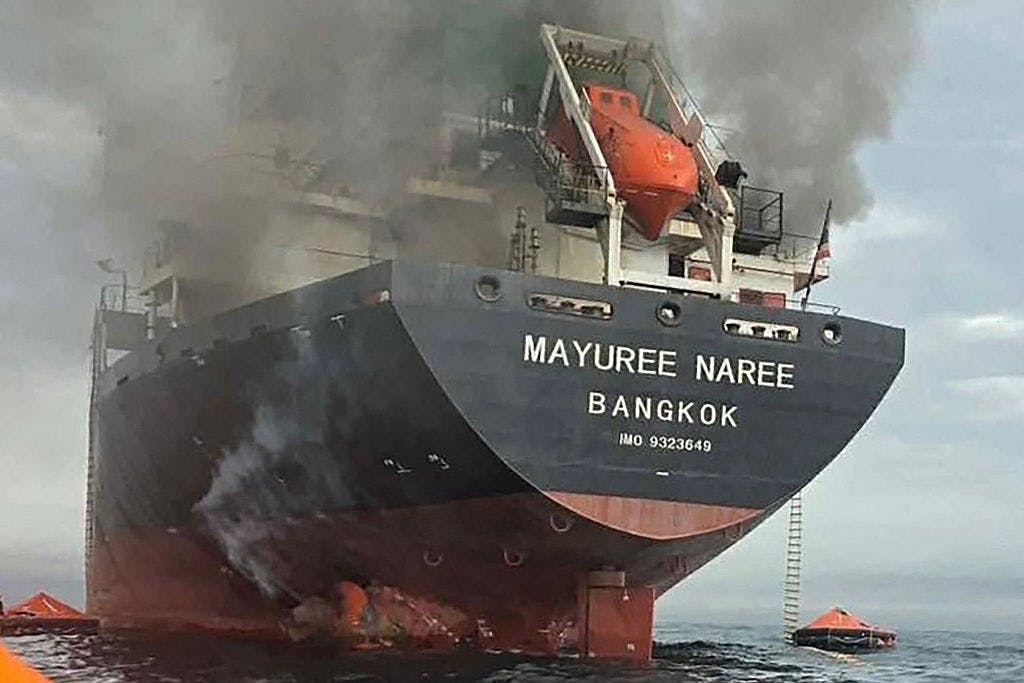
This week Iran claimed to have formally closed the Strait of Hormuz, the 21-mile-wide chokepoint through which roughly 20% of the world’s oil flows every single day. Three more ships – the Thai-flagged Mayuree Naree, the Japanese ONE Majesty, and the Marshall Islands-flagged Star Gwyneth – were struck by “unknown projectiles,” which is almost certainly reporter-speak for Iranian missiles and drones on Wednesday. This brings the total number of vessels attacked since February 28 to at least 14.
Welcome back to the Persian Gulf, circa 1987. Back then, Iran targeted tankers carrying oil from countries supplying Saddam’s Iraq during the Iran-Iraq War, forcing the Reagan Administration to escort re-flagged Kuwaiti vessels under U.S. Navy protection — a confrontation that ended with American warships sinking a significant chunk of Iran’s fleet in a single day.
This, then, is our “Back to the Future” moment. The Islamic Republic’s dusty playbook from almost 40 years ago dictates if Tehran can’t export oil freely, no one can. Iran’s most important security official now, Ali Larijani, put it plainly this week. The strait “will either be a strait of peace and prosperity for all, or a strait of defeat and suffering for warmongers.” Iranian military elites went further, vowing not to allow “a single liter of oil” to pass for the benefit of America or its allies.
Since 2019, the IRGC Navy has been methodically re-upping its threats to freedom of navigation, using limpet mines against commercial vessels, seizing tankers, and harassing ships throughout the Persian Gulf. It also exported this threat to its Houthi proxies in the Red Sea, impeding maritime trade in yet another critical waterway after October 7, 2023.
The mining threat we’re now confronting was incubated during the Iran-Iraq War. The last time Iran tried this, in 1988, the U.S. Navy responded with Operation Praying Mantis, destroying nearly half of Iran’s operational fleet in a single day, the largest American naval surface engagement since World War II. Tehran blinked, accepted a ceasefire, and then Supreme Leader Ruhollah Khomeini famously compared it to “drinking a poisoned chalice.” The lesson was partially written on the wreckage of Iran’s vessels.
U.S. Central Command moved fast this week, destroying 16 Iranian minelayers near the strait on Tuesday. By Wednesday, Trump told reporters the number was up to 28. That’s real progress but it’s not enough to change the risk calculus for ship owners and neighboring Arab states. Yet the Iranian maritime threat here isn’t its conventional fleet, most of which is now, as Trump put it, “at the bottom of the sea.” It’s the hundreds of speedboats and fast attack craft that the IRGC possesses, capable of laying mines faster than they can be hunted down. Destroying a frigate is a photo op. Neutralizing a swarm of cigarette boats is a campaign.
That’s the hard truth Trump must reckon with. Threatening “death, fire and fury” is great for the Truth Social feed. But rhetoric doesn’t sweep mines or open shipping lanes. Trump says the escort option is on the table. Ship owners are watching to see if he means it.
He should.
The Reagan administration faced a strikingly similar moment in 1987, when Iran was targeting tankers in the Persian Gulf during the “Tanker War.” Reagan’s answer was Operation Earnest Will which involved re-flagging Kuwaiti tankers under the American flag and providing them with U.S. Navy escorts through the Persian Gulf. It was a direct challenge to Iranian maritime aggression, and it worked. The message was clear: the free flow of commerce is a vital American interest, and the United States will back that interest with force. Iran stood down.
Trump is now facing his version of that moment, and it is arguably a harder one, given the scale of the current conflict, the mining threat, and the IRGC’s asymmetric capabilities. The only way out of this crisis is through it. That means not just destroying minelayers after the fact but going after the IRGC Navy comprehensively including its fast attack craft, its shore-based missile batteries, and its port infrastructure.
It also means considering convoy operations to restore confidence among ship owners and allied regional states, who right now see little reason to risk their vessels in a waterway the United States has not yet secured. And it means making clear to Iran’s current leadership that the Strait of Hormuz is not a bargaining chip.
This is Trump’s Reagan moment. He’s already scored a significant security win: Ali Khamenei is gone, Iran’s conventional navy is decimated, and the regime is staggering. But the war for the global economy is still being fought on a battlefield 21 miles wide, between Iran and Oman. Winning it would deliver something Reagan never quite achieved: a decisive, lasting blow to the IRGC’s ability to hold the world’s oil supply hostage.
The question is whether Trump will pull the trigger not just on Iran’s military, but on reopening the artery that keeps the global economy alive. The Strait is where the real test of Trump’s resolve against the Islamic Republic begins.
* * *
Behnam Ben Taleblu is a senior fellow and Senior Director of the Iran program at the Foundation for Defense of Democracies.
The views expressed in this piece are those of the author and do not necessarily represent those of The Daily Wire.








 New Posts (Home)
 ChatBox
 Popular Posts
  Game Zone
 Top PodCasts