www.upworthy.com
Delightful clip from 1955 shows how globes were once painstakingly made by hand
For more than 2,000 years, humankind has known that the Earth is round. That fact was widely demonstrated in 1522, when the Magellan-Elcano expedition sailed around the planet without falling off its nonexistent edge. So for more than 2,000 years, people have made globes to help them navigate the planet and hone their geographic knowledge.
In the second century AD, a major step in globe-making came when Claudius Ptolemy developed a scientific method for locating places using coordinates known as latitude and longitude. Initially, elites exchanged globes with one another. You might also find one in a classroom. But globes began to be mass-produced in the early 19th century, giving more people a way to understand the world from their own homes.
Video shows how globes were made in London in 1955
A charming video by British Pathé, created in 1955, offers an inside look at what it was like to manufacture a globe by hand before machines took over much of the process. British Pathé was a newsreel producer that covered world events from 1896 to 1978, and today its entire archive is available to view for free.
Globe construction in the 1950s was a painstaking process. It began with covering a solid wooden ball with papier-mâché, which was then coated with plaster. Nine separate layers of plaster were applied to the sphere, bringing it to a thickness of 1/8 inch; the entire molding process took more than six hours.
Once dried, the globe was sent to the covering room, where the map was pasted on in small portions, “like restoring the skin to a peeled orange,” the narrator said. After the map was added to the globe’s surface, workers painstakingly smoothed out any lumps and removed excess glue. It was then attached to an axis for display. The entire process took around 15 hours.
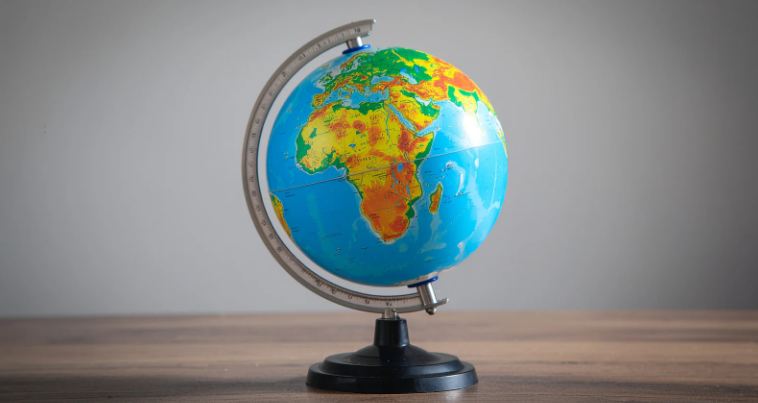
A globe. Photo credit: Canva
In 1955, globes were available in sizes ranging from one inch (£0.60) to six feet (£1,000), which would cost roughly $24 to $35,000 in today’s dollars.
How are globes made today?
Replogle Globes, one of the world’s largest globe manufacturers, shared a video offering a behind-the-scenes look at how globes are made today and how modern machines have made the process much faster.
One big difference from how globes were made in the ’50s is that the maps are printed directly onto chipboard, which is then precisely cut with a hydraulic press and formed into half a sphere. During the pressing process, three-dimensional mountains are embossed into the globe’s surface. After the northern and southern hemispheres are pressed together, they are attached to a central hoop, creating a complete replica of planet Earth.
Globes have been around for more than 2,000 years, and they remain one of the few educational tools that we still use today. You can put a child in front of a computer and show them a representation of the Earth, which they will probably understand. Still, nothing beats running your fingers across a globe and spinning it in your hands to realize what an incredible planet we live on.
The post Delightful clip from 1955 shows how globes were once painstakingly made by hand appeared first on Upworthy.








 New Posts (Home)
 ChatBox
 Popular Posts
  Game Zone
 Top PodCasts