www.dailywire.com
Why Iran’s Long-Range Missile Attack On Diego Garcia Proves It Was Lying The Whole Time
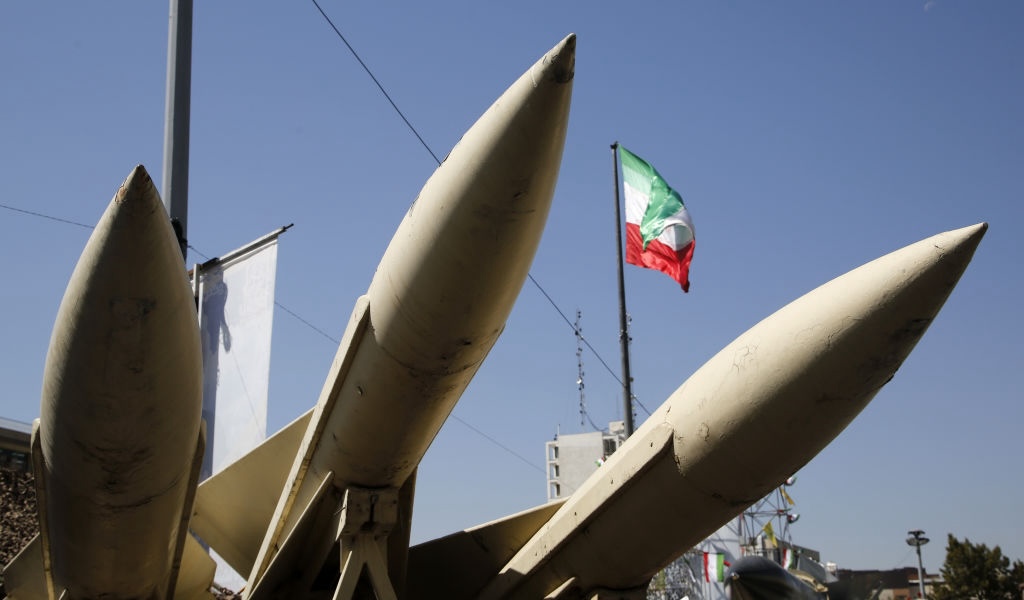
Iran launched missiles on Thursday at a U.S. and U.K. base in the Indian ocean, far beyond the range its leaders have long claimed to maintain, revealing that Tehran has been lying about its ballistic missile capabilities for quite some time.
According to the Wall Street Journal, multiple U.S. officials have said Iran fired two intermediate-range ballistic missiles at Diego Garcia, a remote but highly strategic joint U.S.-U.K. base in the Indian Ocean. Neither missile struck the base, one reportedly failed mid-flight, while the other was engaged by a U.S. interceptor.
The strike marked Iran’s first operational use of an intermediate-range ballistic missile and a clear attempt to project power well beyond the Middle East. The launch directly contradicts recent public statements from Iranian officials.
Just weeks earlier on “Meet the Press,” Iranian Foreign Minister Abbas Araghchi dismissed concerns about Iran’s missile range, calling them “misinformation” after President Trump announced that the development of longer-range missiles was one of the primary factors for U.S. intervention in the country. “We have intentionally limited ourselves to below 2,000 kilometers of range because we don’t want to be felt as a threat by anybody else in the world,” Araghchi said.
Located roughly 2,500 miles (or 4,000 kilometers) from Iran, Diego Garcia sits well beyond the range Tehran has publicly claimed. Diego Garcia serves as a critical hub for U.S. military operations, hosting strategic bombers, nuclear submarines, and naval assets central to projecting power across the Middle East and Indo-Pacific.
Farzin Nadimi, an Iran expert with the Washington Institute, noted that while Iran’s missile development is often framed around threats to Europe, the ability to strike Diego Garcia is likely the more immediate strategic goal. “If they have sufficient range to reach Europe, they have sufficient range to reach Diego Garcia,” Nadimi said. “But I think Diego Garcia is more critical because of the location.”
Iran may have achieved the longer range by modifying existing missile systems most likely by reducing payload weight to increase distance. That kind of engineering is complex and typically requires extensive preparation, suggesting the capability may have been in development long before the current conflict. “Iran likely prepared long in advance,” Nadimi said, noting that such modifications would be difficult to execute under sustained military pressure.
Groups like the Wisconsin Project on Nuclear Arms Control’s Iran Watch have speculated Iran may have already possessed missiles capable of reaching up to 2,500 miles, far beyond its stated limits.
Following the strike, the United Kingdom moved to expand U.S. access to its regional military bases, particularly for operations tied to the Strait of Hormuz, signaling concern that the conflict could widen. “The UK remains committed to defending our people, our interests and our allies,” the government said in a statement.
For now, the missiles did not hit their target, but the message appears to have landed. For years, Iran has framed its missile program as limited, defensive, and regionally contained, but through the undisclosed development, Tehran has now demonstrated a willingness, and an ability, to reach far beyond its stated boundaries, and in doing so, it has shifted the strategic calculus for both Washington and its allies.








 New Posts (Home)
 ChatBox
 Popular Posts
  Game Zone
 Top PodCasts