www.upworthy.com
British teacher flawlessly translates everyday sayings into Victorian English, and people are hooked
It’s hard to believe now, but communicating via the written word used to be a gigantic deal. Long before texting, social media, quick emails, or even short postcards, one of the only ways people could communicate across space and time was by writing long letters.
The 18th century is considered by some to be the peak of the Golden Age of letter writing. It was a key element of education for people wealthy enough to receive one, and it was incredibly important: business was conducted via handwritten letters, love was declared, and new introductions were made.
It was crucial, then, to choose your words extremely carefully. This was especially true in and around the Victorian Era in England, roughly between 1820 and 1914.
Victorian-era translations of everyday sayings
An English teacher from the United Kingdom has been delighting followers with Victorian-era translations of everyday sayings.
Abram Elenin runs Berber English, where he says, “I help professionals master British English… and communicate more effectively.”
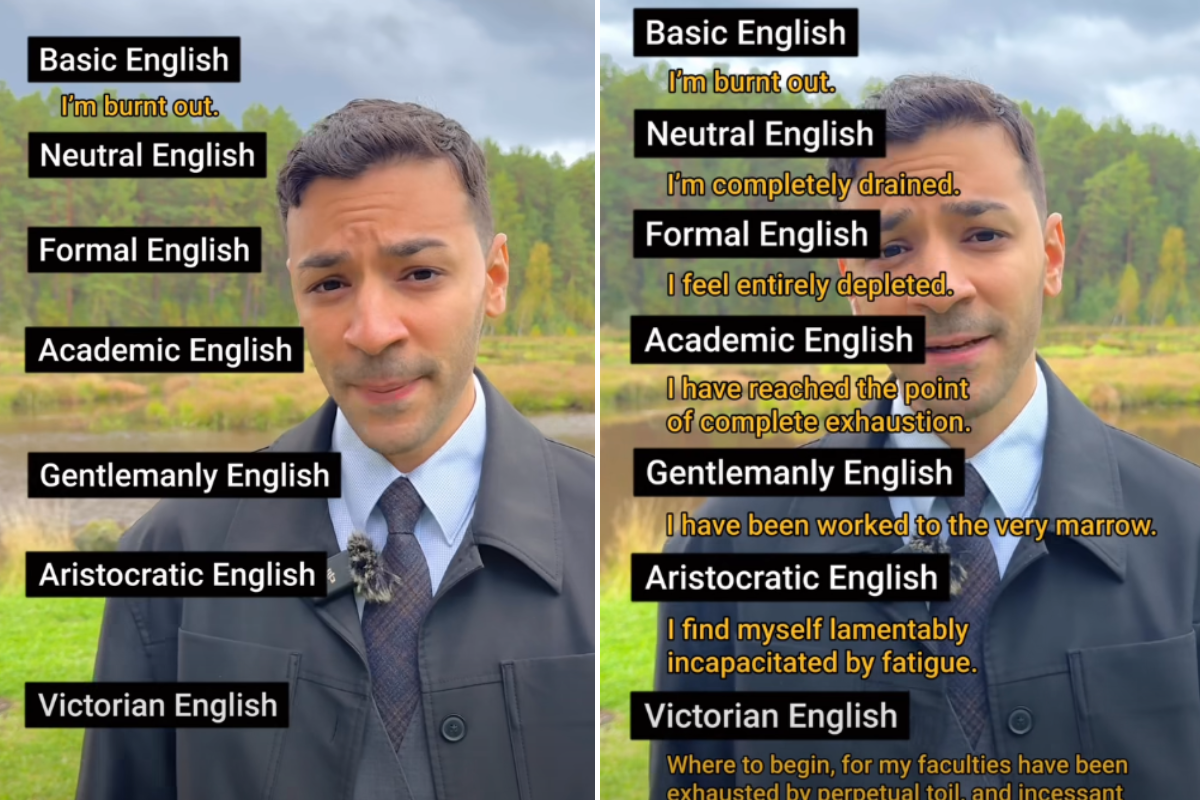
He also likes to have a little fun with his work as a linguistics expert and accent coach. In a wildly popular series of Instagram Reels, he performs “tiered” translations of common phrases, transforming them into increasingly formal variations. Victorian English is usually the final resting point and comedic punchline.
In one popular video, “I’m burnt out” becomes “I’m entirely depleted” in formal English, and “I have been worked to the very marrow” in gentlemanly English.
But Victorian English, the age of beautiful if long-winded novels like Great Expectations and Jane Eyre, takes the cake: “Where to begin, for my faculties have been exhausted by perpetual toil, and incessant application has so stripped me of vitality that I am scarcely able to summon the strength requisite for the smallest effort.”
View this post on Instagram
In another Reel, “I’m poor” becomes “I find myself in a precarious financial position,” and finally:
“It is with no small measure of affliction that I acknowledge my fortunes to be sadly diminished, my purse exhausted, and my station reduced to one of grievous penury, such that I find myself abandoned to the stern tutelage of want, the harshest master to which mankind is ever subject.”
It just sounds so much better that way. Can’t you just hear Moira Rose from Schitt’s Creek saying that?
View this post on Instagram
Videos go viral
Elenin’s videos have reached millions of viewers worldwide, helping them gain a greater appreciation for Victorian-era English and language more broadly.
“‘My faculties have been exhausted by perpetual toil’ goes hard,” one Facebook commenter notes.
“Gonna use Victorian for my essays now,” someone says on Instagram.
“I just love listening to you saying these things,” adds another.
A few brave commenters tried writing their own Victorian-style passages, but it’s really a job best left to the pros, like Elenin.
Why the language died out
This gorgeous, verbose style of language unfortunately faded as literacy rates climbed and the written word became more commonplace.
However, letter writing was still commonly practiced until the telephone became a major part of everyday life in the early 1900s.
Early phonograph recordings from the late 1800s offer some of our only glimpses into what people in the Victorian era actually sounded like. Though their conversations are less flowery and long-winded than their writing, they still stand in stark contrast to casual conversation today.
While it’s a little sad for those who appreciate language that this kind of prose is mostly extinct, there is some good news: letter writing is making a comeback. As people grow weary of screens and impersonal digital communication, the trusty pen and paper are experiencing a much-needed revival.
Maybe now is the perfect time to brush up on your Victorian English, or at least take some inspiration from the way they could make anything sound interesting or profound.
The post British teacher flawlessly translates everyday sayings into Victorian English, and people are hooked appeared first on Upworthy.








 New Posts (Home)
 ChatBox
 Popular Posts
  Game Zone
 Top PodCasts