www.dailywire.com
We Replaced Community With Content. Here’s How To Fix That.
This article is part of Upstream, The Daily Wire’s new home for culture and lifestyle. Real human insight and human stories — from our featured writers to you.
***
The Levin family Seder was a throw-the-gates-wide-open sort of affair. There was something different about crossing the threshold of the house in Ann Arbor on days like that — kicking your shoes into the pile of Sambas and hanging your jacket among the others steeping in lived-in smells of the day: brisket, soft wood, chicken baked in parchment paper, and the faint, sweet perspiration of college kids in spring.
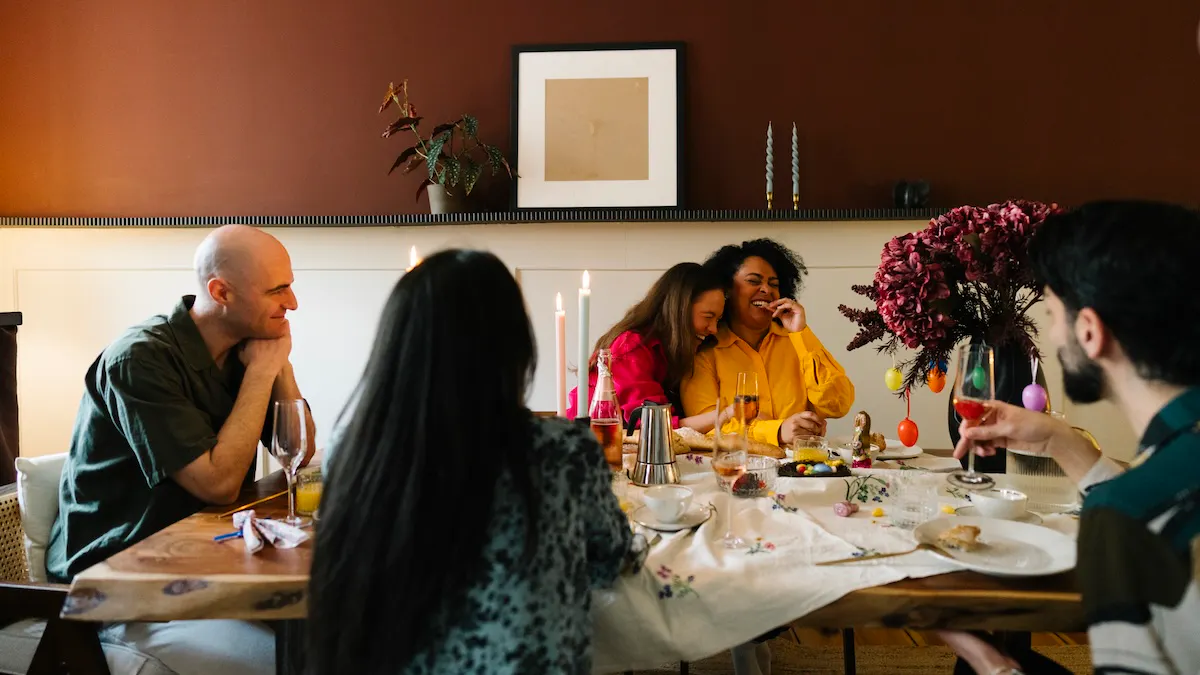
Tables stretched diagonally through the living and dining rooms, pushed together to accommodate 20, 30 people, sometimes more, and empty plates were set out for latecomers, stragglers, strangers, and Elijah, the long-awaited prophet.
Dan, the family patriarch and kibbutz cook-turned-scientist, would be standing over a pot of broth or pulling a Pyrex, brown with age, from the oven. “Stir,” he’d say when I’d peer in (he liked to communicate in declarative sentences and smiles), handing me an olive wood spoon. I’d watch him mix the matzo balls from a packet and roll them between his hands.
People giggled and drank wine and played music until it was time to sit. Matriarch Aviva handed out worn copies of the Haggadah, and led us in her favorite prayers. We passed the food and ate our fill. Aviva and Dan ate, too, looking at each other softly across the table. They served and talked but never worried, that I can remember.
And then came Aviva’s favorite part: the poetry. “There is a beautiful hum,” she once said, describing that time of night, when papers were passed and we were given time to write our pieces for the group. I would pause to listen to the whir of thinking people, the soft graphite wearing down, the candles snuffing themselves out. We’d go to sleep full that night, thinking of next morning’s bagels and lox and coffee with real cream.
Even years later, after I’d moved to New York, I wanted my home to feel like that. I wanted to invite people in and to have them show up. I summoned the courage to invite 11 friends to a Friday night dinner party for which I cooked all day, making brussels sprouts, crispy potatoes, and Ina Garten’s roast chicken from scratch. I spent more money than I’d made all week.
Turns out, I wasn’t the only one trying my hand. The art of “gathering” is surging, perhaps as a response to the disconnection of what’s been called the “loneliest generation.” According to Pinterest’s 2024 Summer Trends report, searches for “dinner party” rose 6,000% year over year.
Riding that resurgence, Martha Stewart re-released her 1982 classic, Entertaining, extending her “reign of relevancy.” In it, she looks backward to the banquet scenes of Sir Walter Scott, the Roman punch dinners of Edith Wharton, and the country weekends of Leo Tolstoy’s Anna Karenina. These are not casual meals; they are worlds unto themselves — ordered, aesthetic, and exacting.
And if Stewart walked, it was so Instagram accounts and Substacks such as Isabel Heikens and Bright Moment Co. could run, adding paper menus, homemade garlands, and handwritten letters to elaborate, multi-course meals.
Just watching these reels makes me nostalgic for a simple Shabbat at the Levins’ house. With content like this filling our feeds, the expectation our work-worn mothers pushed against is seeping in again, more polished, more visible, and harder to ignore. If the dinner party is back, so too is the tacit requirement that we know how to host one. We are left with big shoes to fill, leaving us to feel as though we have failed an unspoken class in the domestic arts.
My first attempt was an abject disaster. Only two people came. A tense few hours later, after everyone had left and the heaping piles of leftover food were packed into plastic bags, I lay in bed staring at the ceiling. I was exhausted, overextended, and embarrassed. Mostly, I was hurt.
What had I done wrong? Where was the warmth I remembered, that glimpse of heaven Dan and Aviva had created in their living room?
Looking back, the problem was what it almost always is: a skewed motive of the heart. If I’d read Entertaining more closely, I might have seen it. The word entertain comes from the Old French entretenir, from the Latin tenere: to hold. To hold together. To maintain. To keep appearances intact — as if I could keep the evening from coming undone. What I called hosting had become a performance, and I was a one-woman show.
Our Lord of hosts offers a different vision of hospitality. The word host comes from the Latin hostis, which means the stranger, even the enemy, the one outside the circle. And yet from that same root comes hospes: a word that means both guest and host. They are not opposites. The stranger is brought near, received, and honored. Our job then is to share who we are and what we have with whomever God sends.
In her 1986 book Hospitality with Confidence, Grace Pittman writes about “opening your home and heart.” She writes, “From a biblical perspective, hospitality recognizes that God is more interested in caring relationships than the mold behind the shower curtain. It need not matter whether we live in a single-room apartment or a split-level ranch. The only real requirement is allowing God to use our lives and our possessions. Our homes and our lives are, together, the most powerful ministry we have to offer the world.”
When we approach hospitality this way, it helps us to serve and talk, but never worry. The questions we ask change profoundly. “Will I have enough?” becomes, “Lord, how can I use what you’ve given me?” “What will they think of me?” becomes, “Lord, what might they see of you?” “How will I stay relevant?” becomes, “Lord, how might I be of use to you today?”
Like all kingdom work, hosting is an opportunity to be a collaborator, a co-conspirator, and a co-creator with God in bringing about heaven on earth. “Hospitality is not to change people,” wrote theologian Henri Nouwen, “but to offer them space where change can take place.” In other words, set the table and open a bottle of wine. God will do the rest.
We are called to hospitality not just to bless others, but for the posture it cultivates in the host herself. It shapes her heart, loosening the inward knots of self-preservation, self-reliance, and the familiar resistance to being known. It loosens the death grip on her possessions, guards against stinginess and grumbling, and teaches her by experience the truth about herself and her role in the world: She was made to do what God has done without reservation — to give herself away.
Though it took me several years after my home-cooked fiasco to host again, once I began, I couldn’t stop. I’ve spoken a liturgy from Every Moment Holy, Vol. III over birthday book exchanges, going-away parties, wine nights, bagel breakfasts, and baby showers. Now I offer its final lines to you with the hope that, by God’s grace, you too might bring a glimpse of heaven into your living room: “Let the simple gift of a seat in this house, and the experience of hospitable fellowship, long remain with our guests as a small reflection of your welcome, and as a reminder that with you there is no leaving.”
***
Grace Salvatore is the senior editor of media, arts, and culture at Ayaan Hirsi Ali’s Restoring the West and a contributor to Independent Women’s Voice.








 New Posts (Home)
 ChatBox
 Popular Posts
  Game Zone
 Top PodCasts