www.newsbusters.org
PBS Ready To Declare Defeat In Iran: 'We're Losing Every Day He Continues'
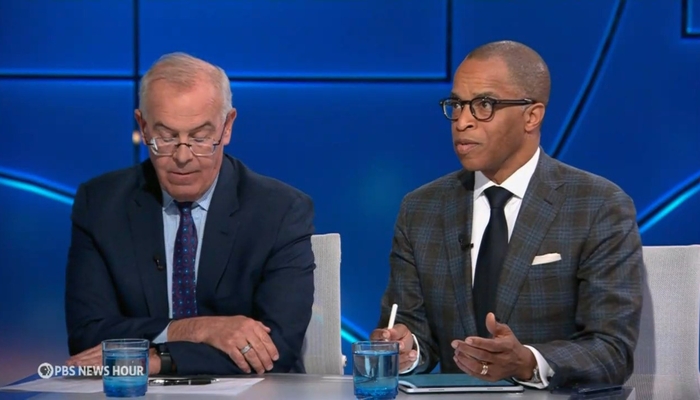
The trio of PBS News Hour anchor Amna Nawaz, The Atlantic staff writer David Brooks, and MS NOW host Jonathan Capehart appeared ready to pronounce defeat on Friday as they juxtaposed President Trump’s Iran speech earlier in the week to the day’s news that saw an American F-15 and Black Hawk helicopter go down in Iran.
Nawaz began with Brooks and suggested there was a contradiction between Friday’s news and Trump’s speech, “David, all of this is just two days after the president said in an address to the nation that the U.S. had crippled the Iranian military and the war was nearly over. What's your reaction to all of this?”
PBS is ready to declare defeat in Iran with host Amna Nawaz asking David Brooks about Friday's F-15 and Black Hawk shoot downs "All of this is just two days after the president said in an address to the nation that the U.S. had crippled the Iranian military and the war was nearly… pic.twitter.com/SNtPomWlpa
— Alex Christy (@alexchristy17) April 4, 2026
The correct answer for the conservative half of this segment would have been to point out that the reason why this is such a big news story is because it is so rare. It took Iran over a month to get its first confirmed shoot down, but instead, Brooks took Nawaz’s framing and ran with it, “Yeah, that's one of the disadvantages of having a huckster for president, that he does just—he can't tell the American people that, when you're going to war, it's horrible, and that Iran is a serious country that's been preparing for this for nearly half-a-century.”
Brooks claimed that while he was initially somewhat supportive of the decision to attack, the benefits no longer outweigh the costs, “To me, what happened—I have been somewhat, moderately hoping there'd be some positive outcome. And I think there has been some. We have had to go to the Middle East for almost every decade for the last 50 years because of radical Islam, which the Iranian regime typifies. But this is clearly the week when the costs of the war are so exponentially larger than the benefits of what we're getting in these marginal weeks.”
With references to how high oil prices enrich Iran and Russia, the state of the world economy, and of NATO, Brooks concluded, “The costs are just exorbitant now, not to mention the human suffering. And so, if Trump doesn't see that we're losing every day he continues this thing, he's going to just face more and more political problems, military problems, and all sorts of problems. And so he just needs to admit that—what's going on. And I doubt he has the mental ability to do that.”
As for Capehart, he pulled out an interesting analogy to try to paint a dire picture, “I mean, this is a war of choice. We didn't need to do—take this action now. What's funny, but not funny, playing on cable right now on a loop is Top Gun: Maverick. And if anyone has seen that movie, the whole plot is about a U.S. military operation deep inside Iran, and two fighter pilots have to eject out of their planes.”
According to Capehart, “There was more of a plan in the fictional plot of Top Gun: Maverick than there appears to be in this very real, very live situation in the United States' war with Iran.”
Jonathan Capehart then claimed "There was more of a plan in the fictional plot of Top Gun: Maverick then there appears to be in this very real, very live situation in the United States' war with Iran."
As for Trump's speech, "What he should have done was told the American… pic.twitter.com/Xyuq1pDFc9
— Alex Christy (@alexchristy17) April 4, 2026
The plot of that movie revolved around an unnamed country—which was clearly meant to be Iran—and its nuclear program. It was more analogous to the single mission in June’s Operation Midnight Hammer than the wider campaign of Epic Fury. The U.S. lost no aircraft in Midnight Hammer because while Top Gun: Maverick was a good and entertaining movie, the point of the climatic bombing run was meant to develop characters and themes, not to show realistic combat tactics.
Nevertheless, Capehart returned to Trump’s speech, “Look, I applaud the president for finally addressing the American people, but he is a month too late, and told us nothing we had not already heard from him, from his administration through—in various ways. What he should have done was told the American people really why we went, how we're getting out, and then spend more than half-a-phrase on the 13 service members who lost their lives in this war of choice, his choice.”
Friday featured tragic events and reminded the country why we admire those who serve, but we should also keep things in perspective and be appreciative that these events have been so rare. Brooks and Capehart can have their own opinions about the costs and benefits of this war, but they can’t apply a standard to Trump that has never been applied to previous wartime presidents.
Here is a transcript for the April 3 show:
PBS News Hour
4/3/2026
7:36 PM ET
AMNA NAWAZ: So, as we sit here and speak now, as we reported at the top of the show, there's still a U.S. crew member from that downed fighter jet missing, a search-and-rescue operation under way. We know Iranians were also able to shoot down another aircraft over the Gulf, shot at a Black Hawk helicopter that returned to base safely. Iranian leaders are looking for that missing crew member on the ground.
David, all of this is just two days after the president said in an address to the nation that the U.S. had crippled the Iranian military and the war was nearly over. What's your reaction to all of this?
DAVID BROOKS: Yeah, that's one of the disadvantages of having a huckster for president, that he does just—he can't tell the American people that, when you're going to war, it's horrible, and that Iran is a serious country that's been preparing for this for nearly half-a-century.
And they're going to fight back and they're going to make countermoves like this or like the Straits of Hormuz. To me, what happened—I have been somewhat, moderately hoping there'd be some positive outcome. And I think there has been some. We have had to go to the Middle East for almost every decade for the last 50 years because of radical Islam, which the Iranian regime typifies.
But this is clearly the week when the costs of the war are so exponentially larger than the benefits of what we're getting in these marginal weeks. The cost to Russia is now getting all this revenue. Iran is getting all this revenue. The European economy and the world economies are in crisis. NATO is in shreds.
And so the costs are just exorbitant now, not to mention the human suffering. And so, if Trump doesn't see that we're losing every day he continues this thing, he's going to just face more and more political problems, military problems, and all sorts of problems. And so he just needs to admit that—what's going on. And I doubt he has the mental ability to do that.
NAWAZ: Jonathan?
JONATHAN CAPEHART: I mean, this is a war of choice. We didn't need to do—take this action now.
What's funny, but not funny, playing on cable right now on a loop is Top Gun: Maverick. And if anyone has seen that movie, the whole plot is about a U.S. military operation deep inside Iran, and two fighter pilots have to eject out of their planes.
I bring that up because there was more of a plan in the fictional plot of Top Gun: Maverick than there appears to be in this very real, very live situation in the United States' war with Iran.
Look, I applaud the president for finally addressing the American people, but he is a month too late, and told us nothing we had not already heard from him, from his administration through—in various ways. What he should have done was told the American people really why we went, how we're getting out, and then spend more than half-a-phrase on the 13 service members who lost their lives in this war of choice, his choice.








 New Posts (Home)
 ChatBox
 Popular Posts
  Game Zone
 Top PodCasts