www.newsbusters.org
CNN Taps Lefty-Activist General to Warn Trump Iran Strikes Could Be ‘War Crimes’
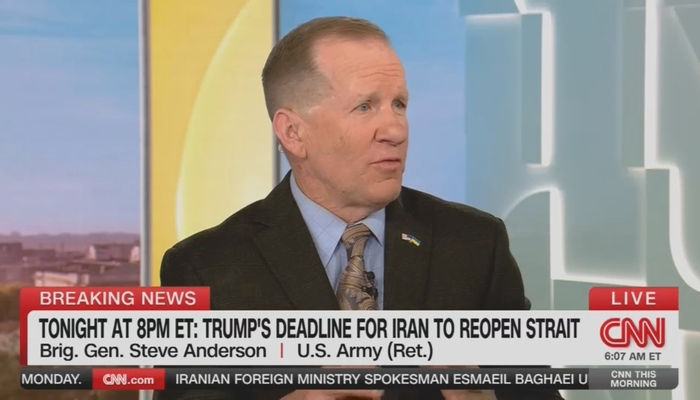
On Tuesday's CNN This Morning, host Audie Cornish turned to retired Brigadier General Steven M. Anderson to assess President Trump’s potential expansion of military strikes on Iran.
Anderson repeatedly warned that targeting infrastructure such as bridges, power plants, and water facilities could amount to “war crimes,” even suggesting U.S. troops could be put in the position of refusing “illegal” orders.
Cornish failed to disclose that Anderson sits on the board of VoteVets, a progressive PAC that backs Democrat candidates. Nor did she note his record of sweeping, alarmist claims, including warning in a Washington Post op-ed of a potential military coup, and, in a recent MS NOW appearance, calling the Iran conflict ‘the greatest geopolitical disaster in the history of our country.”
Cornish reinforced the theme by playing a clip of a United Nations spokesman declaring that attacks on civilian infrastructure would violate international law. CNN senior reporter Edward-Isaac Dovere then pointed to Trump’s statements about targeting such sites, and said “there is a pretty clear line,” effectively backing the same argument.
Anderson doubled down, insisting the line was “very clear” and reiterating that such strikes would be criminal.
There was no meaningful pushback.
WATCH: CNN Stacks Panel to Call Trump Strikes ‘War Crimes’ pic.twitter.com/5KuPBNpuW9
— Mark Finkelstein (@markfinkelstein) April 7, 2026
Ashley Davis, the panel’s nominal Republican voice, did not contest the charge, offering only that Trump could run up against a 180-day limit to secure congressional authorization—raising a procedural point while leaving the central allegation untouched.
Anderson closed on a strikingly downbeat note, arguing
ANDERSON: The political will to continue to fight. I mean that's the other issue here. You know, I mean, the Iranians have it in spades, okay? They're fighting for their lives there. It's an existential threat to them. And this whole war was essentially predicated on a miscalculation of their will to fight. Oh, by the way, they also have the card, which is the Strait of Hormuz. And they also have perhaps 1,000 pounds of highly-enriched uranium that we haven't found. So the Iranians have the cards. We don't. America's stocks seem to go down every single day. Iran's seems to go up.
By the end of the segment, CNN had constructed a consensus that the U.S. risks “war crimes”—against an adversary that, viewers were told, already “has the cards”—with no pushback from the panel’s lone Republican.
Here's the transcript.
CNN This Morning
4/7/26
6:02 am EDT
AUDIE CORNISH: Today in the group chat, Isaac Dovere, CNN senior reporter, Steve Anderson, retired U.S. Army Brigadier General, Chuck Rocha, Democratic strategist and former senior advisor to Bernie Sanders' presidential campaigns, and Ashley Davis, former White House official under President George W. Bush.
Okay, so serious business to start. I have heard that overnight the IDF issued an urgent warning for Iranians to stay away from trains and railways. CNN reporting showing that Israel has approved an updated list of energy and infrastructure targets and that basically they're waiting on Trump's decision on the next steps.
And we also heard Trump talking about a plan about bridges. Is this part of the war games, meaning did people sort of model out what it would mean to go after Iran more broadly?
STEVE ANDERSON: Well, we would not be going after bridges that had civilian applications; only if they had military connections somehow because otherwise it would be a war crime. Water desalination plants, civilian target, a war crime. Power plants, probably civilian targets unless they supported some kind of a military installation, probably a war crime.
So it would be a very, very difficult thing for American soldiers to be faced, to try to obey what would be essentially an illegal order, as Senator Kelly and his colleagues did a couple months ago.
CORNISH: Yeah, I'm glad you're bringing this up, because we have heard it so much. I want to play the U.S. Secretary General, I'm sorry, the Secretary General of the U.N., who was asked about the potential for violations of international law, and I'll have you guys react when we come out of it.
STEPHANE DUJARRIC: I think whether something is a crime or not a crime would have to be decided by a court, but they, any attack on civilian infrastructure is a violation of international law and a very clear one.
CORNISH: So, a spokesperson for the Secretary General. Is it too soon to be talking this way?
EDWARD-ISAAC DOVERE: The president keeps saying it, right? So that's why we're talking about it. He said over and over again yesterday at that press conference that power plants, bridges are on the target list. He said destroy the whole country, that the Iranian people would be willing to suffer for it. Those are the things that, look, I'm not a lawyer, certainly not an international lawyer, but there is a pretty clear line.
CORNISH: Yeah, that's your cue. Is the line that clear?
ANDERSON: Very clear. I mean, you cannot attack those kind of targets. But every target needs to be evaluated, and that's one of the things that we have legal opinions. We have staff, judge advocate lawyers that are a part of every decision, and they have to first look at and make a recommendation to the commander, the actual authority that makes a decision.
Every single target gets evaluated whether or not it's an appropriate military target. If it's not an appropriate military target, to attack it would be a war crime.
DOVERE: You mentioned that video that had Senator Kelly and the others in it. They, that video was people who had served in various capacities saying, just repeating what was in the military code, right? That you are not required to file an illegal order. And for that, the Secretary of Defense tried to strip Senator Kelly of his pension and his rank, this ongoing legal stuff about it, right?
And saying this would never happen. The president is talking about it happening.
ANDERSON: The political will to continue to fight. I mean that's the other issue here. You know, I mean, the Iranians have it in spades, okay? They're fighting for their lives there. It's an existential threat to them. And this whole war was essentially predicated on a miscalculation of their will to fight. Oh, by the way, they also have the card, which is the Strait of Hormuz. And they also have perhaps 1,000 pounds of highly-enriched uranium that we haven't found.
So the Iranians have the cards. We don't. America's stocks seem to go down every single day. Iran's seems to go up.








 New Posts (Home)
 ChatBox
 Popular Posts
  Game Zone
 Top PodCasts