www.newsbusters.org
CBS Details SHOCKING New Example of Possible Fraud in California Hospice System
On Tuesday’s CBS Mornings, CBS continued its commitment to actual, enterprise, public service journalism under editor-in-chief Bari Weiss that appeals to all Americans with part two of its CBS News Investigation into rampant fraud in dark blue California’s hospice system. Following on part one from March 11, correspondent Adam Yamaguchi chose to spotlight one doctor who submitted over $70 million of claims in 2024 allegedly caring for nearly 2,800 patients at 126 hospice facilities.
NEW: Tuesday's 'CBS Mornings' aired part two of the CBS News Investigation on hospice and Medicare fraud in California.
Correspondent Adam Yamaguchi found one man -- Dr. Rajiv Bhuva -- has submitted claims alleging to have cared for nearly *2,800* patients at *126* hospices pic.twitter.com/wx9MD6J1Er
— Curtis Houck (@CurtisHouck) April 7, 2026
The only criticism here would be there was no connection between the level of fraud taking place in California versus the rest of the country, floating the possibility it’s happening there for a reason and allowed to fester under Democrat Governor Gavin Newsom’s nose (though his team, in an X post, blamed the federal government).
Following two teases, Norah O’Donnell — a former longtime co-host filling in this week — tossed to Yamaguchi with the revelation that “[o]ur investigative unit found some potential red flags” with “[o]ne hospice doctor [having] submitted claims for more than 20 times the number of patients the average California doctor cares for in a year.”
Yamaguchi hit the ground running with a simple but important reality to keep in mind as he investigated the curious case of Dr. Rajiv Bhuva in the greater Los Angeles area: “The state of California says that if a doctor is involved with any more than, like, even just a few hospices, it is a sign of potential fraud.”
“At the heart of the industry are doctors who are trusted to sign off on care, but in records for the active physicians caring for terminal patients one stands out, a man whose name appeared on claims from 126 hospices and had 60 percent more in Medicare reimbursements than the next closest doctor in 2024 – the last full year of available data – Dr. Rajiv Bhuva,” he added.
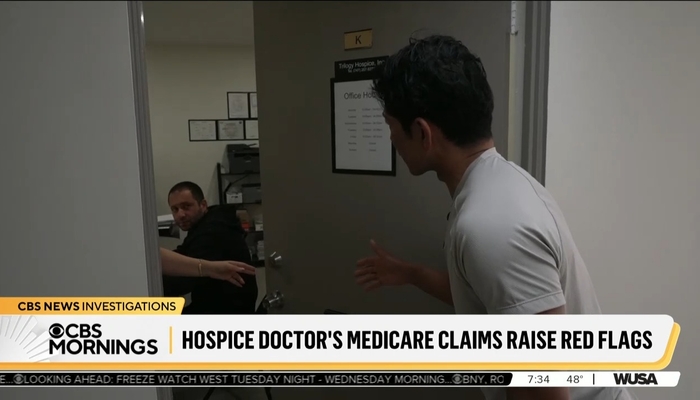
He then showed his visit to one such facility in which he introduced himself to two purported staff members, saying “we’re doing a story about hospice, and we’re just trying to understand how often [Bhuva] is here.”
In broken English, one of them replied, “I didn’t [sic] see him in a long time.”
Yamaguchi had the door shut on his face at another stop (click “expand”):
YAMAGUCHI: [TO NUSRSE] We understand that Dr. Rajiv Bhuva is the medical director here, and we’re trying to get some information about him.
RECEPTIONIST [OFF-CAMERA]: He’s not.
YAMAGUCHI [TO STAFF]: He’s not?
RECEPTIONIST: No.
YAMAGUCHI [TO NURSE]: Was he at some point?
NURSE: Yes, he was.
YAMAGUCHI [TO STAFF]: But you’re telling me he’s longer associated with you guys?
NURSE: No, close the door.
YAMAGUCHI [TO STAFF]: Was he at some point?
NURSE: No, close the door, thank you.
RECEPTIONIST: Thank you.
The CBS reporter said the response was the same at each “of the hospices we visited” because “[w]e wanted to find Dr. Bhuva to ask how he managed to work for so many different providers, so we followed a trail of hospice offices linked to his name and Medicare claims totaling $71 million in 2024 across the LA basin.”
Then came the stunning find: “On average in California, a hospice doctor claims for about 140 patients in a year. In 2024, claims with Bhuva’s name were submitted for nearly 2,800 terminally ill patients.”
To recap, we have boots-on-the-ground reporting, attempts at interviews with relevant parties, and a probe of what was likely a trove of documents. Yamaguchi added another key component: interviewing an expert.
He found one in Penn State Health Milton S. Hershey Medical Center Dr. Kristina Newport (click “expand”):
NEWPORT: There’s no reason to think it is legitimate.
YAMAGUCHI: Dr. Kristina Newport has been in the hospice field for 18 years. There are a range of reasons why one physician might be identified in connection with the care for so many patients, including stolen identity.
NEWPORT: If someone is really effectively evaluating the plan of care for every patient that they admit to the hospice, which is their job and their responsibility, they, you know, would have a superhuman schedule to do that in a meaningful way.
Unsurprisingly, Yamaguchi said “several hospices” Bhuva’s claims cited have since “lost their Medicare certification for what regulators called an abuse of billing, a pattern of submitting improper claims.”
The taped portion appropriately wrapped with Yamaguchi’s attempts to track down Bhuva himself:
We reached out to him on the phone and e-mail, but couldn’t connect, so we headed to Dr. Bhuva’s home address. Dr. Bhuva came out. He said that being affiliated with dozens of hospices is not illegal. And I – and I said you’re correct. There’s nothing in the law that prevents someone from being affiliated with many, but, again, it raises flags, and that’s what I have questions about. Bhuva said he wanted to see our information. Until then, he said he wouldn’t talk any further.
Of course, the CBS crew did return and Bhuva hilariously refused to hold up his end of the deal, down to the fact that Yamaguchi called Bhuva out from his front door: “We were able to hear you through the door!”
Back live, O’Donnell praised Yamaguchi for this “really important investigation raising these questions” while co-host Gayle King predicted “more people will be asking questions after that story today.”
Yamaguchi replied to O’Donnell that “[o]ne of the things that’s so shocking about all of this is that it appears to be hiding in plain sight” and CBS has been “the only ones asking these questions.”
Granted, Nick Shirley has also joined the case and been covering it (as has Fox News), but Yamaguchi was indeed the first on the case as part one went live on March 10 at CBSNews.com
O’Donnell wrapped it all up with an important takeaway about why fraud in health care is so damaging (in addition to it being criminal and morally wrong): “I think the question that many people have is, why is my health care so expensive? And is it because of fraud that exists out there?”
“Ultimately, we, the taxpayers, end up paying,” Yamaguchi concluded.
To see the relevant CBS transcript from April 7, click here.








 New Posts (Home)
 ChatBox
 Popular Posts
  Game Zone
 Top PodCasts