www.thegospelcoalition.org
James K. A. Smith’s Case for an Uncertain Faith
A sprawling river system runs through four counties in West Tennessee, but it’s the pronunciation that reveals a local every time.
Nonlocals say “forked” in one syllable; locals say “fork-ed.”
“The Fork-ed Deer River.”
In my sophomore year, I took a “Gibson County History” elective taught by a local historian. I still remember him describing how the Fork-ed Deer once carried small barges between counties, some even drifting to the Mississippi and on toward New Orleans. From above, the river resembles leaf veins—tributaries branching, curling, and gathering westward into the Mississippi. It’s easier to find your way downstream to the larger body of water, but in trying to return home it’s easy to lose track of which tributary you’re supposed to follow.
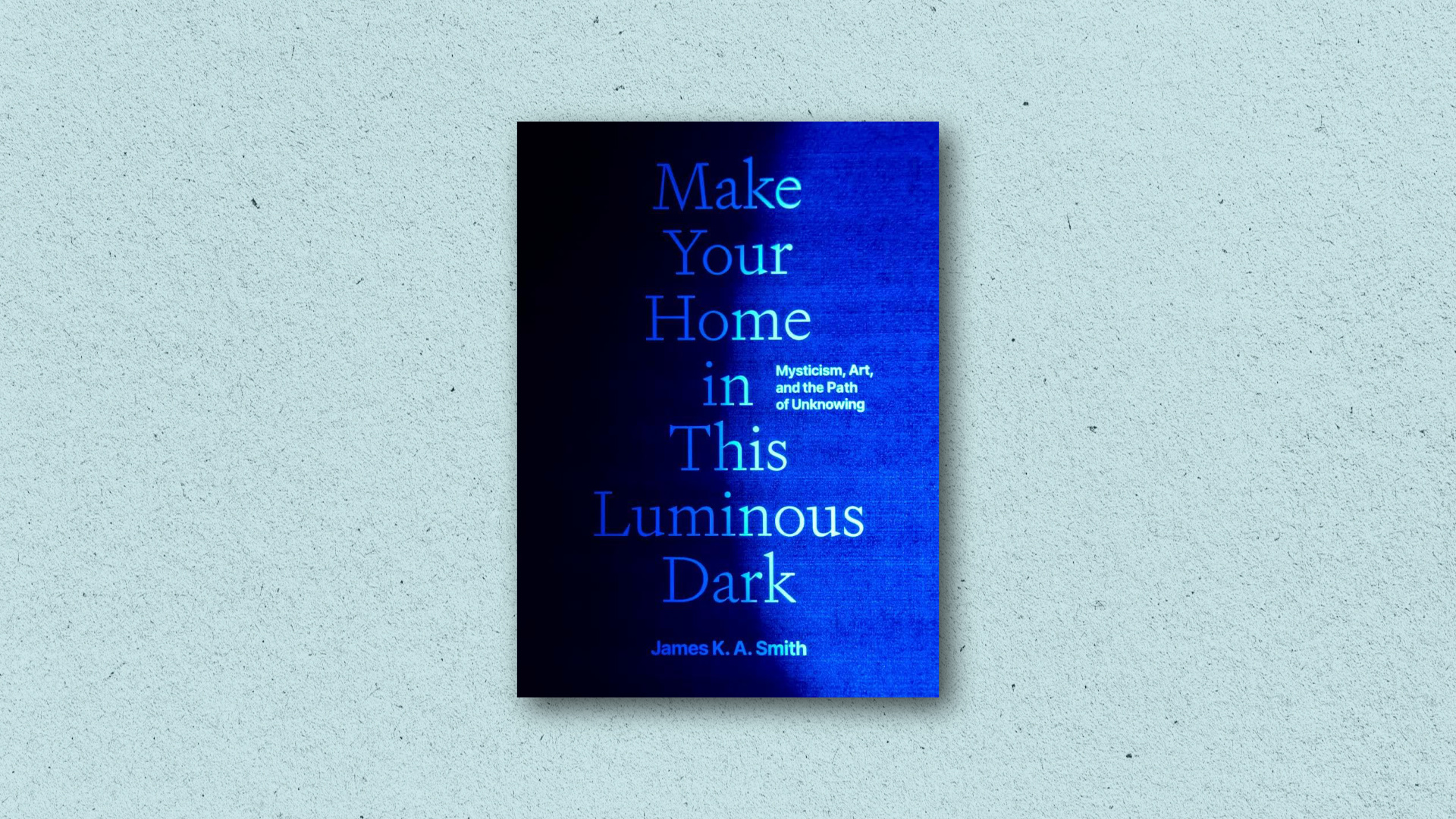
In Make Your Home in This Luminous Dark: Mysticism, Art, and the Path of Unknowing, James K. A. Smith, professor of philosophy at Calvin University, argues that true knowledge of God comes not through mastery and certainty but through mystical “unknowing” in the darkness. That perspective helped Smith through a dark season of the soul, but it’s less clear how his version of mysticism can serve the broader church.
Tributary Project
By my reading, Smith’s book is a tributary project—branching beyond yet curling back to his earlier works, such as How to Inhabit Time and his 2002 project, Speech and Theology.
The former work invites an extended meditation on time and human finitude, surveying how cultural liturgies and shared stories shape our presence in the world. The latter book is a bedrock of Smith’s ongoing theological-philosophical concern: the relationship between transcendence and immanence and the distinctiveness of a Christian epistemology. There, he reflects on how God condescends to meet humanity, speaking and revealing himself as “Other” within the “This-ness” of our creational conditions.
In Smith’s literary library (from his Cultural Liturgies trilogy to How (Not) to Be Secular) he warns his readers of the influence of our past—especially modernity and its subversive, epistemic sway in our daily lives. How we see our world draws from this history, this deep genealogy with forebears who have influenced how we know.
Mystical Knowledge
Modernity’s main actors like René Descartes wrestled with doubt while craving indubitability. Descartes’s experiment of discovering indisputable truth and escaping the fears of uncertainty and darkness has primed Western imaginations for centuries. While most Americans have never read Descartes, they instinctively live by the same epistemic rule: Uncertainty makes us uneasy, while certainty feels safe and desirable.
Uncertainty makes us uneasy, while certainty feels safe and desirable.
Smith offers an alternative account, and he hopes readers will consider a contrarian history and an epistemic paradigm of the Christian mystic traditions of St. Teresa of Ávila, St. John of the Cross, Meister Eckhart, Brother Lawrence, Thomas Merton, the unnamed author of The Cloud of Unknowing. Where Descartes wants to rescue us from epistemic darkness, Smith, drawing from these mystics, wants us to make our home in the darkness.
This is the underlying question for the reader throughout the book: When we’ve reached the place of not knowing, where do we go? Insecure in this dark, we’re beckoned by Cartesian epistemology to find answers through logic, syllogisms, and our own rational powers. But what if these methods can’t deliver us? What if we’re too rationally feeble to make our way out on our own? Or maybe we’re meant to dwell in the dark?
Smith invites readers “to be when [we] don’t know” (xi). His work is an approachable yet raw philosophical memoir exploring that phrase. In places of real uncertainties, like at a father’s deathbed, or the abysmal pangs of postpartum depression, or the discovery of marital disloyalty, we’ve imbibed a way of knowing that tries to “analyze, dissect, quantify, and instrumentalize” our situations so we can get out and move on (99). He urges the reader not to rush past the darkness but to remain within it—waiting, attending, and learning to wonder.
Mystical Practices for the Dark
The Christian mystics offer four key practices for the dark: anachoresis (a movement of withdrawal, a retreat to solitude), hesychia (achieving stillness to dwell in silence), docta ignorantia (the cloud of unknowing, the dark night of the soul), and mysterion (emergence to wonder, a new form of attention).
Smith is careful here. This fourfold path isn’t our salvation or some therapeutic method to follow so we can escape our wounds and worries. To do so would be to reintroduce Cartesian promises of method and mastery. Yet the mystical fourfold path is an epistemological “re-storying” and remediation of our imaginations to consider an alternative awareness while dwelling in the dark (11).
What Smith retrieves from the mystics isn’t confined to monasteries or spiritual elites; it quietly persists today in practices we rarely name as contemplative—particularly in the arts. Painting, sculpture, films, novels, and music train us in a form of attention that seeks not to solve or conquer but to receive a gift from the Giver. One doesn’t stand before a canvas, a carved figure, or a requiem to master it but to dwell with it, to be addressed by it, often without clear resolution or conceptual payoff.
Smith argues that no argument for God’s existence lifts us out of our lonely, distressed trenches.
We exert our mastery by knowing; the mystics lose themselves in a cloud of unknowing. We assert our singularity and self-sovereignty; the mystics find themselves in union. Our default is suspicion; the mystics claim we float in a Love that is before all things. (156)
When despondence sets in—if I may be vulnerable for a moment—the theological insights of Augustine, Aquinas, Luther, Edwards, and Barth don’t do much to steady me. This is precisely the point Smith presses: When we’re plunged into uncertainty, what we want most isn’t logical rebuttals but the assurance that we’re seen and that Someone is searching for us.
When we’re insecure and afraid in our unknowing, like Descartes, we’ve been taught to ask questions like “Why?” or “How can I know?” (168). But the singular question Smith poses is “Who’s there?” (168). As we carry our anxieties and uncertainties to the precipices of what we can know, Smith dares us to yell into the dark, “Is someone with me?”
Two Hermeneutical Tributaries
In the epilogue, Smith charts what he calls a “mystical” path forward. Resisting what he describes as the “binary mode” of analytical dogmatism, he advocates instead for an episteme of mystical wondering—a “disciplined attention to the complexity, plentitude, and mystery of things” (197–98). This move, however, will likely give many evangelical readers pause, as it redirects the flow of interpretation into two competing tributaries.
One tributary reads the book as a critique of evangelicalism—portraying certain conservative camps as dwelling in “darkness” while elevating mysticism as a form of illumination beyond their dogmatisms, a potential reading based on Smith’s discussion in the epilogue. Along this stream, the project may appear to advance an apologetic for a more deconstructive Christianity—likely in light of Smith’s public support for the acceptance of LGBT+ behavior in the church and at Calvin University.
Another tributary flows in a different channel. Here, the book reads less like a critique of conservative evangelicalism and more like confession—a phenomenological memoir of human limitation, where “darkness” names our fragility and God meets us in the depths of despair. Following this current, readers may see the work as a deepening of Smith’s ongoing phenomenological projects, shaped by an Augustinian sensibility and his own acknowledged struggles with depression captured in his interview with Publishers Weekly. Those who appreciated much of his other work in that vein will likely also appreciate this volume.
Smith argues that no argument for God’s existence lifts us out of our lonely, distressed trenches.
Both tributaries lead into the the same riverbed; the question is which tributary the reader will trace as they read Smith’s book.
My primary critique concerns the book’s vision for the future of Christianity—specifically, its cultural embodiment. Citing Karl Rahner, Smith writes, “The Christian of the future will be a mystic, or will not exist at all” (200). Aside from brief references to contemplative practices—such as meditating on the mysteries of God—the reader isn’t given a clear explanation of why or how this “mystical mode” meaningfully shapes the church’s future or why it should be considered the mode for the future (202).
This lack of clarity is significant, especially given the complexity of the mystical tradition itself. Some mystics, such as Eckhart, employed language about union with God that seemed to blur the distinction between Creator and creature. Others, like George Fox, elevated personal spiritual experience in ways that appeared to minimize Scripture, sacraments, or ecclesial authority.
While often intended to express deep communion with God, such tendencies can drift toward subjectivism and theological ambiguity if not properly flowing from the kephalē—authority, source, origin—of Christ and his Word (Eph. 5:23).
Make Your Home in This Luminous Dark is reflective and evocative, but it underdevelops the case for how a mystical Christianity might alter the spirit and structure of the church of the future.








 New Posts (Home)
 ChatBox
 Popular Posts
  Game Zone
 Top PodCasts