www.upworthy.com
13 years ago, an astronaut sang live from space with singers on Earth. It’s a must-watch.
Canadian astronaut Chris Hadfield hasn’t seen Earth from as far away as the Artemis II astronauts who circled the Moon, but after completing three space missions, including a six-month stint as commander of the International Space Station (ISS), he is familiar with the “overview effect” in a way few humans ever experience.
In 2013, Hadfield captured what it feels like to see our home from space in a song he performed with Barenaked Ladies. While he played guitar and sang from the ISS, the band and the Wexford Collegiate School for the Arts Glee Club (aka “Wexford Gleeks”) performed alongside him from Earth.
The song is called “(I.S.S.) Is Somebody Singing,” and it’s all the more moving in light of the images from Artemis II.
Here’s a sampling of the lyrics:
Pushed back in my seat
Look out my window
There goes home
That ball of shiny blue
Houses everybody anybody ever knew
The song takes us on a journey: we fly out to space, around the Earth, and return home again, all while looking out the window at our beautiful planet. The visual of people singing from Earth, their “voices bouncing off the Moon,” takes on even greater significance now that we’ve returned there.
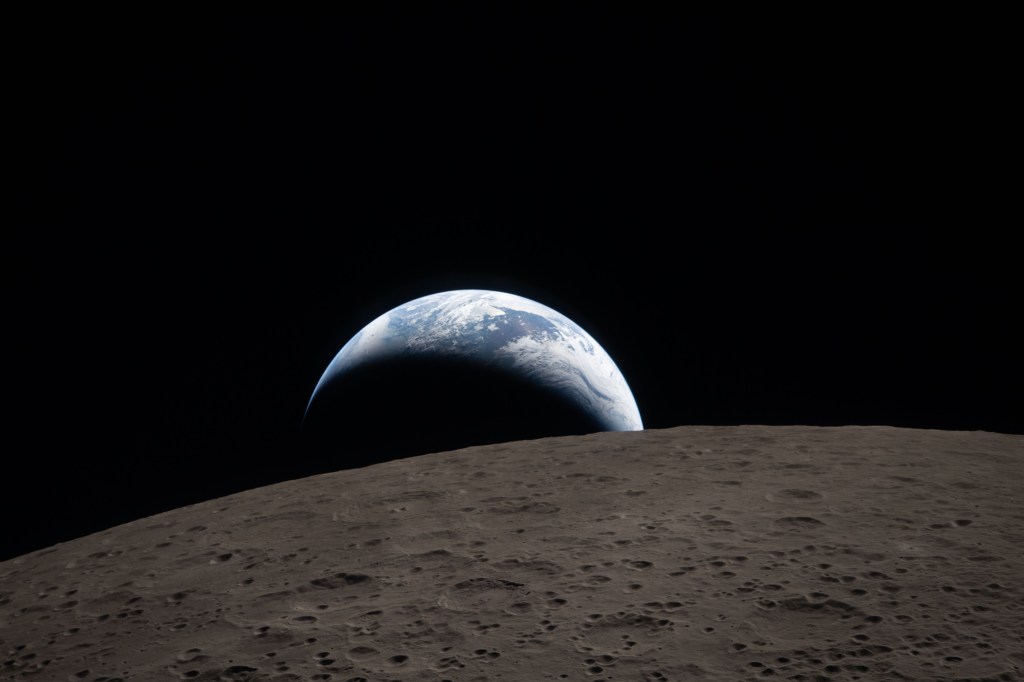
A view of Earth from near the Moon, taken during the Artemis II mission. Photo credit: NASA
Even though the video is 13 years old, people are revisiting it now with new appreciation:
“I keep coming back to this everytime there’s a significant step forward in space exploration! and it’s the perfect time to watch this for Artemis II!”
“Coming back to this after watching the Artemis II launch, and it feels so magical knowing they’re going back to the moon for all of us. These launches really make me feel connected to all of humanity.”
“Cried to this as the Artemis crew returned to earth. Watching the earth grow larger through the window, seeing the glow of reentry, the clouds passing by and the big red and white parachutes.”
Commander Reid Wiseman looks out at Earth from the Orion spacecraft. Photo credit: NASA
Some people have asked how it was possible for the musicians to play live together without a delay. In interviews with astronauts on the ISS, there is often a lag in communications. But that’s less of an issue for a song like this than one might expect. Most likely, Hadfield played and sang live from the ISS, while the band and choir followed along with the transmission as they heard it.
As someone explained in a Quora inquiry:
“I actually know some performers who have performed with Chris Hadfield (not Hatfield) while he was on the ISS—Trent-Severn, three women from Ontario. It’s actually quite easy. He plays his guitar and sings. It’s beamed down from the ISS to a ground station, then transmitted by whatever method works (internet, phone lines, satellite link) to get to the destination, where it goes into the sound board. The sound man or woman sends it to the main PA speakers and to the stage monitors so that the performers can hear it. And they just play along with it as they hear it. It doesn’t matter that he actually played it a second or two before. They just play in time with it as it arrives where they are.”
What is challenging, apparently, is the singing itself in space. Hadfield explained that it’s “like singing with a head cold” because of the way the fluids in your body drain—or rather don’t drain—without the assistance of gravity.
The singing astronaut had another musical performance go viral in 2013. In fact, he made a whole music video from the ISS, covering “Space Oddity” by David Bowie. Hadfield said he always felt the song should be sung aboard a spaceship. (He added that if Bowie had been there, he would have done a better job.)
Thanks to Chris Hadfield for giving us these wonderful musical connections to human space exploration.
The post 13 years ago, an astronaut sang live from space with singers on Earth. It’s a must-watch. appeared first on Upworthy.








 New Posts (Home)
 ChatBox
 Popular Posts
  Game Zone
 Top PodCasts