www.upworthy.com
Columbia shuttle astronaut shared a moving take on humanity shortly before reentry tragedy
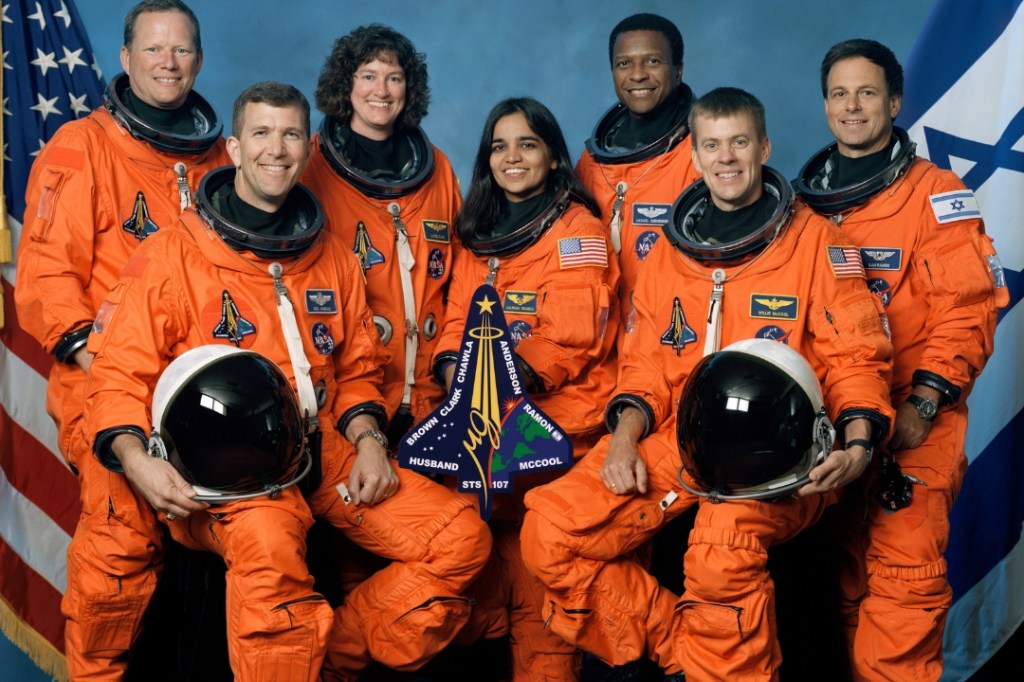
On February 1, 2003, a tragic reminder of how delicate life is struck those watching the landing of Space Shuttle Columbia (STS-107). Commander Rick D. Husband, Pilot William C. “Willie” McCool, and mission specialists David M. Brown, Kalpana Chawla, Michael P. Anderson, Laurel B. Clark, and Ilan Ramon were selected for Columbia’s 28th mission. The mission involved orbiting Earth while conducting experimental research.
What they didn’t know was that, during liftoff, a piece of insulation foam had compromised one of the shuttle’s heat shields. Upon reentry, with just 16 minutes remaining before they were expected to touch down, the shuttle met its fatal end.
Crew of the STS-107. Photo credit: NASA
Giant leaps
Many have recently taken a renewed interest in astrophysics, inspired by the awe of the Artemis II mission. Astronauts who devote their lives to space exploration are nothing short of magnificent. It’s a pursuit defined by equal parts devotion, incredible bravery, and the ability to see the big picture, quite literally. As astronaut Neil Armstrong famously put it, even “small steps” in this realm are “giant leaps for mankind,” a reminder of the importance of perspective within the smallest scientific details.
Letter from space
Mission specialist Brown had sent an email just one day before the crew was set to land, and his aerial view of our tiny blue marble of a planet clearly gave him perspective.
A Reddit user who said they were related to Brown shared the email and wrote, “I had a family member on Columbia, Dave Brown. We were at the launch and the disaster was put in a very different perspective for us, even though I didn’t know him that well. He emailed the family regularly and the day before reentry sent a very impactful email to us that became much more so after the incident.”
The email read:
“Friends,It’s hard to believe but I’m coming up on 16 days in space and we land tomorrow.
I can tell you a few things:
Floating is great – at two weeks it really started to become natural. I move much more slowly as there really isn’t a hurry. If you go too fast then stopping can be quite awkward. At first, we were still handing each other things, but now we pass them with just a little push.
We lose stuff all the time. I’m kind of prone to this on Earth, but it’s much worse here as I can now put things on the walls and ceiling too. It’s hard to remember that you have to look everywhere when you lose something, not just down.
The views of the Earth are really beautiful. If you’ve ever seen a space IMAX movie that’s really what it looks like. What really amazes me is to see large geographic features with my own eyes. Today, I saw all of Northern Libya, the Sinai Peninsula, the whole country of Israel, and then the Red Sea. I wish I’d had more time just to sit and look out the window with a map but our science program kept us very busy in the lab most of the time.
The science has been great and we’ve accomplished a lot. I could write more about it but that would take hours.
My crewmates are like my family – it will be hard to leave them after being so close for 2 1/2 years.
My most moving moment was reading a letter Ilan brought from a Holocaust survivor talking about his seven-year-old daughter who did not survive. I was stunned such a beautiful planet could harbor such bad things. It makes me want to enjoy every bit of the Earth for how great it really is.
I will make one more observation – if I’d been born in space I know I would desire to visit the beautiful Earth more than I’ve ever yearned to visit space. It is a wonderful planet.
Dave”
Data from the mission
While these precious lives were ended far too soon, their work was not in vain. NASA was able to salvage much of the data collected during the mission.
One of many examples was video footage that appeared to show a new, unexplained lightning-like phenomenon. In an article for New Scientist, Maggie McKee explains that researchers who pored over the footage saw a reddish glow unlike anything astrophysicists had seen at the time: “The glow occurred about 150 kilometres above the ocean near Madagascar and does not appear to be linked with thunderstorms.”
View this post on Instagram A post shared by rocket enthusiast (@rocket.enthusiast)
Similar to the tragic end of the Space Shuttle Challenger (STS-51L) mission, astrophysicists, as all good scientists do, find a way to carry on. They use these experiences to deepen their understanding and to advance science beyond what once seemed possible. In the words of Isaac Newton, “If I have seen further, it is by standing on the shoulders of giants.”
The post Columbia shuttle astronaut shared a moving take on humanity shortly before reentry tragedy appeared first on Upworthy.








 New Posts (Home)
 ChatBox
 Popular Posts
  Game Zone
 Top PodCasts