www.bikernet.com
Hidden Camera Detection Techniques?
A review of methods by Wayfarer@Bikernet.com
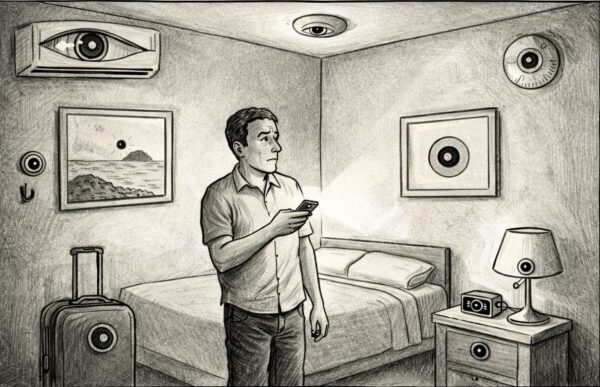
If you travel and stay at different accommodations, you may have questions and concerns regarding safety, security, privacy and their possibilities.
One such concern brought to light, thanks to cinematic thrillers, are hidden cameras that record things inside your room. Cameras, just like all other gadgets have now shrunk in size good enough to fit inside a sunglass or a ballpen.
So how to know if you or your loved ones are safe from unwanted attention? After all, if you get threats and ransom calls or other forms of extortion, you are at least aware of someone having some recordings—audio, video or both. However, if you only have a lingering doubt and never receive any threats—maybe someone has a collection of such videos for whatever reasons–including for illegal content on portals such as PornHub.
Deal with what you can—and pay for better quality and branded, well-rated services instead of booking the cheapest, nearest accommodations should be your first line of defence.
Once you are inside your room, if you feel insecure, you can look for hints and signs.
The most effective “light-based” methods use white light (flashlights) or infrared (IR) detection for hidden cameras.
1. The Flashlight Test (Finding the Lens)
Instead of a black light, use a standard bright flashlight or your phone’s flash.
How it works: Camera lenses are made of glass and naturally reflect light. In a dark room, if you shine a light at a camera, it will reflect a tiny, sharp glint back at you.
The Technique: Turn off all the lights and close the curtains. Hold the flashlight at eye level (near your temple) and scan the room slowly. Look for a small “pinprick” of blue or purple reflection.
2. The Smartphone IR Scan (Finding Night Vision)
Many hidden cameras use Infrared (IR) light to see in the dark. While invisible to the human eye, your phone’s camera can often “see” it.
How to do it:Turn off all lights so the room is pitch black.Open your smartphone’s front-facing camera (most rear cameras have IR filters that block this).
Slowly pan the room while looking at your screen. If you see a glowing purple or white dot, you’ve likely found an IR source.
Test it first: Point a TV remote at your phone camera and press a button; if you see a light flash on your screen, your phone can detect IR.
3. Dedicated Lens Finders
If you want a professional tool, look for a lens finder. These use high-powered flashing red LEDs. When you look through the specialized viewing port, any camera lens—even a tiny pinhole—will light up like a bright, blinking beacon.
Summary of Better Tools
ToolWhy Use ItBest ForPhone FlashlightFree and easy.Finding reflections from the glass lens.Front Phone CameraFinds “invisible” light.Spotting night-vision IR emitters.RF DetectorPicks up wireless signals.Finding cameras that stream over Wi-Fi.Lens FinderTargeted optical search.Confirming lenses hidden behind smoke detectors or clocks.
Let us know by email if you have ever faced uneasiness or suspicion or intuition of such voyeurism in your State or anywhere else. We would be following this up with legal remedies and limitations of the law itself. Email to WAYFARER@BIKERNET.COM
The post Hidden Camera Detection Techniques? appeared first on Bikernet.com - Online Biker Magazine.








 New Posts (Home)
 ChatBox
 Popular Posts
  Game Zone
 Top PodCasts