www.theorganicprepper.com
How to Use Super Glue for First Aid
by Chuck Hudson
The last time we visited I wrote an article for Daisy about my different first aid kits that I created built on my experience as an Army medic. And she let me know an important item I forgot.
How to use some of the less common items.
There are a lot of items in the kits. Not all may be things everyone is used to. So Daisy asked me to do a series of articles that cover:
When do you need to use this item?
How do you use this item?
What are some warnings about using this item?
In the basic kit, you see basic items. One that stands out is Super Glue. Let’s start with that one.
Note from Daisy: The information provided here is for entertainment purposes. You should always seek appropriate medical care. This does not take the place of medical advice nor are any of the writers or editors doctors.
When do you use that super glue from your first aid kit?
Super glue is one of the greatest inventions. It will bond almost anything. Army Medics and Navy Corpsman were the first to ever use it in the field, during the Vietnam War. They glued more patients back together than they sewed. Placing a standard interrupted suture for every stitch you make two new wounds – two new avenues of infection. Super glues eliminated that route of infection
You can use super glue when you have a cut. Deep or shallow, it doesn’t matter – you need to protect it from infection. Sealing the wound is your best bet. Why should you worry about a tiny cut? In the SHTF world, more people will die of infection than major trauma. Why? Because no matter how much people like me preach about diet and washing hands, its human nature to find 5000 more important things to do when you’re trying to survive.
How to use super glue on a cut
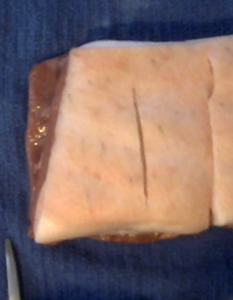
Using super glue is pretty easy. Just follow a few simple directions. Included are some screen captures from a first aid video I made on how I used medical glue to close a wound in a piece of pork. Meet our victim:
First, make sure the wound is not bleeding and is dry and CLEAN. Notice how clean is in bold type. If you seal a wound and it is not clean you are making an incubator. Warm, wet, dark, and chock full of goodness for bacteria to eat. Blood poisoning or as we say in the biz, Septicemia, is fatal. Even with 21st-century medication and care. You do not want someone to experience that type of death.
Once the wound is clean and dry, you’ll start to apply the super glue. Whoa! Hold up there, cowboy! Don’t just dump it in there! A very close and dear friend of mine closed a deep wound on his arm once it healed there was almost no scar. He had cut it on a piece of metal roofing. Deep and long. He cleaned it perfectly got it dry. And closed it. But he closed both the muscle and the skin and discovered a new meaning to the word. ITCH. When you apply super glue below the skin level, the body thinks it’s being invaded and attacks it. My friend had a knot under his skin and a deep itch for months.
Then you’ll close the wound while applying the super glue. To close, start at either edge. Pinch the wound closed, and apply a drop or 2 along the first 1/4 inch.
Hold until its completely dry. Move up and repeat this process until the wound is completely closed.
Then dress with a band-aid. What? A band-aid? Yep, it will give your repair an extra layer of protection. Here’s what the wound looks like when it’s closed and you’re ready for duty.
What super glue should you use?
I recommend you get the Loctite ultra gel super glue. It’s fairly flexible and lasts much longer than the standard super glues.
There is also a much more expensive medical grade glue called 3M Vet Bond Tissue Adhesive. It carries similar properties to Dermabond Skin Adhesive by Johnson and Johnson, but each bottle can be used multiple times, while Dermabond is single-use. This makes Vet Bond a better buy!
DO NOT USE the cheap 4-tubes-for-a-dollar super glue or those thin liquid glues. They will run deep into the wound, then turn white and flake off in minutes to maybe an hour, leaving the wound unprotected.
What are some of the hazards of using super glue?
Everything in medicine has a risk/benefit, even something like super glue. So some of the risks of using it are:
Infection.
Allergic reaction
Tissue necrosis (Tissue the glue binds to dies)
When you should NOT use super glue
Remember this: super glue does not work well on joints. It is not very flexible. (Except for the Locktite brand mentioned above, and still, this isn’t ideal for a joint like an elbow or knee.)
Never use super glue on animal bites (including human bites.) The risk of infection is very high with any bites, and that’s the main reason why most are not closed.
Now you know how to use that super glue in your first aid kit.
Do you have questions or anything to add? Use the comments section below.
The post How to Use Super Glue for First Aid appeared first on The Organic Prepper.








 New Posts (Home)
 ChatBox
 Popular Posts
  Game Zone
 Top PodCasts