www.newsbusters.org
Morning Joe Admits: ‘Noose’ Now Around Iran, Trump Strategy ‘Working’
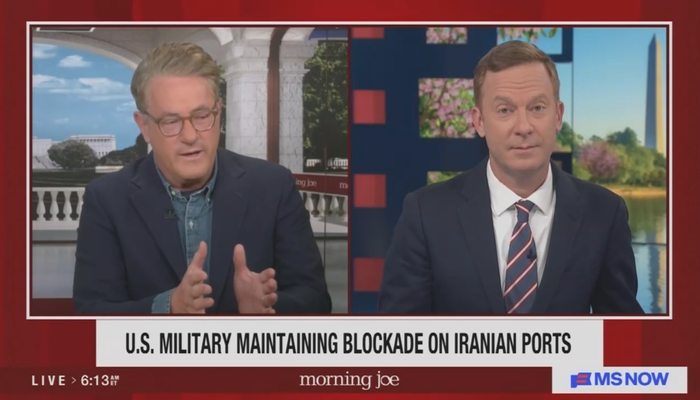
In a hell-freezes-over moment, Thursday’s Morning Joe featured something all but unheard of: Joe Scarborough making the case for Trump’s Iran strategy.
Discussing the U.S. blockade of Iranian ports along the Strait of Hormuz, Scarborough described what he’s hearing from regional and Trump administration sources as a “growing sense of optimism.”
Citing a Gulf ally, Scarborough said that where “the noose was around our neck,” the blockade has now “put it on Iran.”
That assessment was reinforced by David Ignatius, who pointed to the unexpectedly muted market response. Oil prices, he noted, have failed to spike as Iran had hoped, while the stock market continues to hit record highs—blunting Tehran’s leverage.
“Iran was thinking… the effect on markets would be enormous,” Ignatius said. “Instead, the stock market is setting records… and that, in effect, devalues Iran’s biggest weapon.”
Scarborough underscored the point, noting that economic resilience at home is strengthening the White House’s hand.
Even so, Scarborough couldn’t resist inserting his customary anti-Trump barbs—complaining about “blasphemous” behavior and references to “AI images of Jesus Christ.” But the bottom line was unmistakable.
“When he’s not being blasphemous… he’s running a war,” Scarborough said. “And right now, that seems to be working fairly well.”
WATCH: Scarborough Says ‘Noose’ Now Around Iran—Trump Strategy ‘Working’ pic.twitter.com/2YegJ3t53c
— Mark Finkelstein (@markfinkelstein) April 16, 2026
Former Obama administration advisor Hagar Chemali took the argument even further. Noting that Iran “doesn’t have an economic leg to stand on,” she predicted that “in a matter of months, the regime is not going to be able to pay their soldiers”—a scenario that could trigger military defections.
Chemali added an ominous warning: “A military can only be so loyal when it’s not getting paid.”
Here's the transcript.
MS NOWMorning Joe
4/16/26
6:03 am EDT
MIKA BRZEZINSKI: There are also signs of optimism from the White House. Press Secretary Caroline Leavitt told reporters in a briefing yesterday, quote, we feel good about the prospects of a deal.
That comes as U.S. Central Command says its blockade of Iranian ports along the Strait of Hormuz is holding firm. According to CENTCOM, no ships have passed through since the operation began Monday morning. Officials say nine vessels turned around in the first 48 hours after being warned.
. . .
JOE SCARBOROUGH: David Ignatius, from talking to people in the region, in the Gulf region, talking to people inside the White House connected to the negotiations, I'm hearing a growing sense of optimism, something that wasn't really there a week ago. A growing sense of optimism that moving forward with the blockade actually is a low-risk high-reward alternative to what was going on before that began.
And they believe you know, I have passed by members of the administration your observation a week ago: we needed to get into a position where time was on our side instead of time being on the Iranian side. They feel like this has gotten them into that position. What do you think? What are you hearing?
DAVID IGNATIUS: So, Joe, I think you described the sense of optimism of the White House team correctly.
SCARBOROUGH: What impact has the market's continued resiliency had on actually putting the White House in a stronger position? Because the markets are not responding quite as dramatically as many people thought at the beginning. They were expecting $125 dollars per barrel, maybe $150. It's hovering at or below 100, and the S&P up to record highs. That gives the White House, that gives negotiators a lot more latitude with Iran, doesn't it?
IGNATIUS: It does. I think Iran was thinking that as it continued to hold the Strait of Hormuz hostage, and again, Joe, I see this as a hostage-taking, that the effect on markets would be enormous, and the level of pain for Donald Trump would be enormous.
Instead, the stock market is setting records, the oil markets seem to be kind of sloughing this off, and that, in effect, devalues Iran's biggest weapon.
And in fact, by blockading the blockade, it's Iran that now has a problem. It's only got a few weeks left. It needs the revenue badly to be able to, as one part of the U.S. team put it, Iran has been living in a military version of COVID. There's no economic activity, nothing going on in Tehran. They need this to end soon.
So I think you're right to describe the optimism that the White House feels as it looks at the markets, and undoubtedly the disappointment the Iranians feel that their weapon isn't drawing much blood.
SCARBOROUGH: Most of the military targets they wanted to hit, they hit, so they've considered a military operation. But right alongside of that has been the fact that it's been a political failure.
This has seemingly shifted that equation, at least talking to our allies in the Gulf region, one of whom told me a few days ago that they had been discussing this with Jared Kushner and actually saying a blockade would choke off Iran's support, financial support, and they would be left with no option other than deal with the United States.
And my reporting, at least, from this Gulf ally, is that Kushner went to the White House, went to the president, and lobbied for this very hard to get that blockade.
And now that the blockade's in there, you and I were talking yesterday about it. Our sources inside the White House suggest that when the president's not being blasphemous. When the president's not doing AI images of Jesus Christ, Jesus of Nazareth, they're actually feeling fairly optimistic on Iran and feel like this blockade has completely changed the dynamics.
This Gulf leader inartfully said, the noose was around our neck. This move has taken it off of us and put it on Iran, and now they have to act.
. . .
When he's not being blasphemous, when he's not attacking God's representative on Earth, when he's not mocking Jesus Christ, he's running a war. And right now, that seems to be working fairly well, this blockade.
HAGAR CHEMALI: And when you look at the economics of it, the Iranian regime has been in an economic collapse since last year. And Iran's own central bank highlighted that, alerting that their own banks, each one was about to explode, all of their major ones. One of their major ones exploded, Bank Ayandeh in the fall of last year. And that's what precipitated the protests, because of the regime's economic mismanagement.
So when it comes to how long they can hang on, this is a question of how long they can pay their soldiers for. And the fact is that in a matter of months, the regime is not going to be able to pay their soldiers.
But I don't think the blockade will last that long. I think you're talking more matter of weeks, days. But as a regime, economically, it doesn't have an economic leg to stand on.
And that's when you're going to see a problem. Military defections. A military can only be so loyal when it's not getting paid.








 New Posts (Home)
 ChatBox
 Popular Posts
  Game Zone
 Top PodCasts