www.upworthy.com
Why don’t space photos ever show stars? NASA’s explanation is simpler than you’d think and a photo from Artemis II proves it.
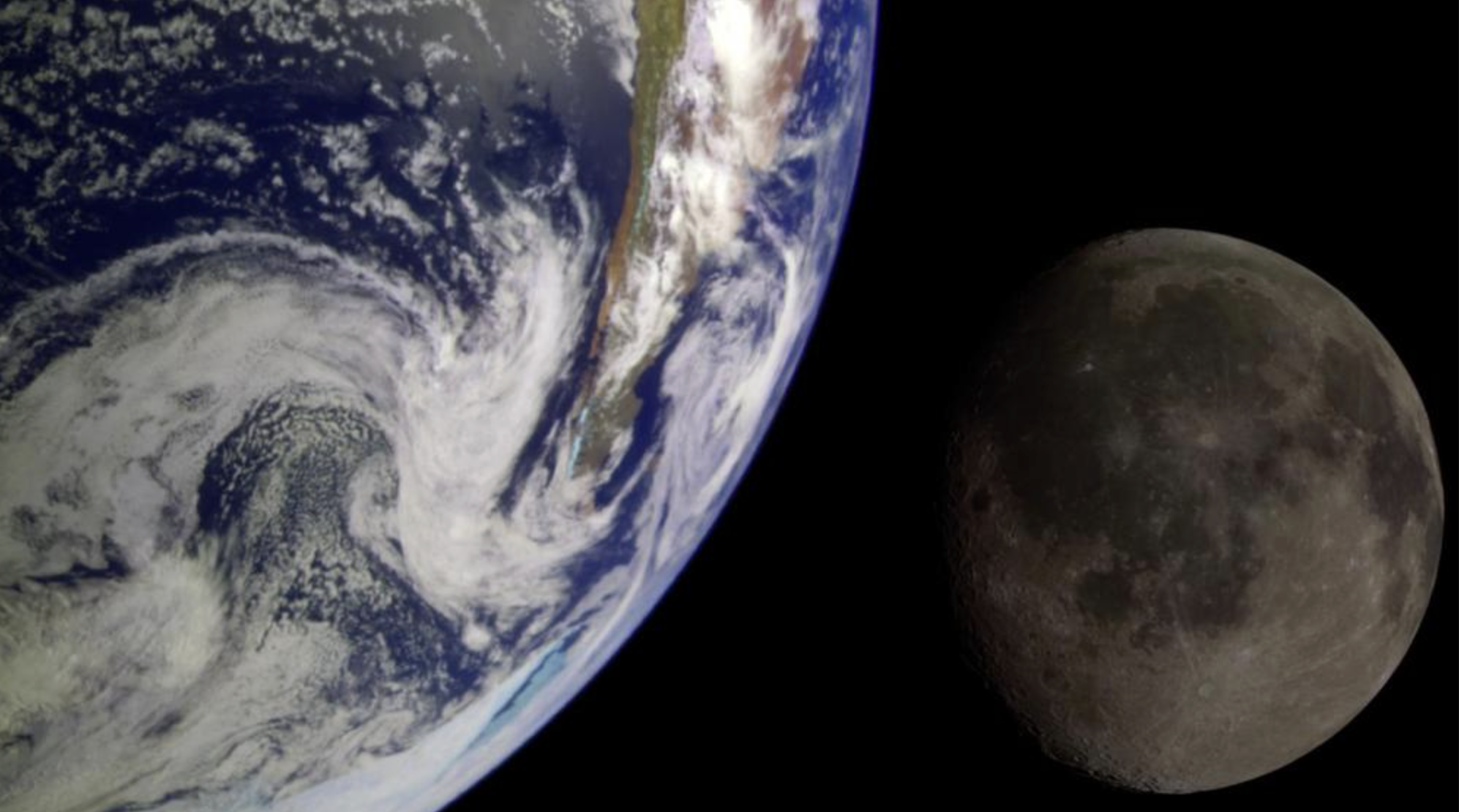
Every time NASA releases a stunning image from space of something like the Earth glowing against blackness, or the Moon’s cratered surface in sharp detail, the same question follows: where are the stars?
It happened again when NASA’s Artemis II crew, which launched April 1, 2026 and flew around the Moon before splashing down in the Pacific on April 10, began beaming back photos from their historic 10-day mission. The images were breathtaking. The backgrounds were pitch black. And the conspiracy theories started almost immediately.
The camera can only do so much
NASA’s answer, as explained in an Instagram post, is straightforward: it’s just how cameras work.
View this post on Instagram
A camera captures a limited range between the brightest and darkest parts of a scene. When you’re photographing the Moon or the Earth from space, you’re dealing with an enormous difference in brightness. The sunlit surface of the Moon is extraordinarily bright, while stars are extraordinarily dim. To expose correctly for the bright object in the foreground, the camera’s settings have to be adjusted in a way that makes the faint stars in the background vanish into black.
Three settings control this. Shutter speed determines how long the camera’s sensor is exposed to light. ISO controls how sensitive that sensor is to light. And aperture determines how wide the lens opens. Getting the Moon in sharp, detailed focus means tuning all three for brightness, which is the opposite of what you’d need to pick up the faint glow of distant stars. You could technically try to capture both, but the result would be a blurry, overexposed mess where neither looks right.
The same thing happens on Earth. Try taking a photo of the night sky next to a bright streetlight. The stars disappear. The light itself isn’t unusual. It’s physics.
The photo that proves both sides
The most remarkable image from the Artemis II mission accidentally became the perfect illustration of exactly this phenomenon. On April 6, during their seven-hour flyby of the Moon’s far side, the crew captured a total solar eclipse. The Moon completely blocked the Sun for nearly 54 minutes of totality, far longer than any eclipse visible from Earth’s surface.
In that image, stars are clearly visible. Dozens of them, scattered across the frame around the dark disk of the Moon with its glowing halo of light. Venus appears as a bright silver glint on the edge. It’s one of the most striking photographs ever taken by humans in deep space.
The reason the stars appear is the same reason they normally don’t: the object in the foreground is dark. With the Moon blocking the Sun, there’s no blinding bright surface to expose for. The camera settings could be adjusted to capture the dim light of distant stars, and they showed up exactly as they should.
As NASA noted in the image description, stars are “typically too faint to see when imaging the Moon, but with the Moon in darkness stars are readily imaged.”
A historic mission
The Artemis II mission marked humanity’s return to the Moon’s vicinity for the first time since Apollo 17 in 1972. The crew included commander Reid Wiseman, pilot Victor Glover, and mission specialists Christina Koch and Jeremy Hansen of the Canadian Space Agency. They set multiple records. Koch became the first woman to travel beyond low Earth orbit. Glover became the first person of color to witness the lunar far side. Hansen became the first person from a nation other than the United States to go to the Moon. And the mission broke the all-time crewed distance record, reaching 406,771 kilometers from Earth, surpassing the mark set by Apollo 13 in 1970.
The crew also captured an Earthset, with Earth sinking below the Moon’s horizon, that deliberately echoed the iconic Earthrise photo from Apollo 8 in 1968. They photographed ancient lava flows, impact craters, and surface fractures on the far side. They witnessed six meteoroid impact flashes on the darkened lunar surface.
Koch described the experience with characteristic simplicity: “The Moon really is its own unique body in the Universe. It’s not just a poster in the sky that goes by. It’s a real place.”
And it turns out space is full of stars. You just need the right conditions and the right camera settings to see them.
The post Why don’t space photos ever show stars? NASA’s explanation is simpler than you’d think and a photo from Artemis II proves it. appeared first on Upworthy.








 New Posts (Home)
 ChatBox
 Popular Posts
  Game Zone
 Top PodCasts