www.dailywire.com
Who’s Taking The Prime Cut Of America’s Beef Prices?
According to the Wall Street Journal, the antitrust division of the U.S. Department of Justice is investigating whether meatpackers engaged in criminal antitrust conduct. Last November, as consumer beef prices continued climbing, President Trump called upon the DOJ to investigate the practices of meatpackers.
Beef is among America’s most important protein sources, and understanding how beef makes its way to the grocery store reveals why consumers at the end of the beef supply chain and farmers and ranchers at its beginning are highly susceptible to foul play.
Think of the beef supply chain as a sand-filled hourglass. The sand-filled top represents the start of the beef supply chain, with the sand itself representing hundreds of thousands of widely dispersed, independent, family-scale cattle farmers and ranchers scattered across America. Now cattle grow slowly, and from the time they are born until they reach their optimal slaughter weight takes upwards of two years.
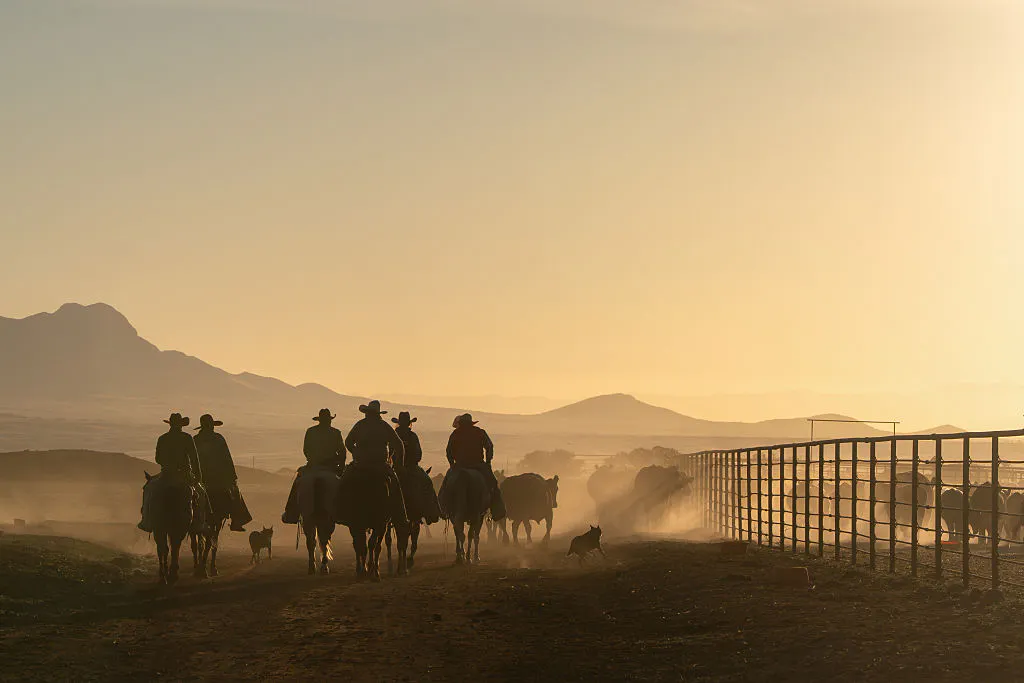
As the cattle grow, they flow downstream in the hourglass and are eventually transported from their distant, wide-open grassy birthplaces to large pens called feedlots, where they are congregated. Most feedlots are in the central and southern plains regions of the United States, and when cattle arrive, they are fed a highly concentrated diet that fattens them to slaughter weight.
Ty Wright/Bloomberg via Getty Images
When fed to their optimal weight, these slaughter-ready cattle are offered for sale to the beef packers at the choke point of the hourglass, as here there are just four dominant beef packers who purchase and control 80% of the 25 million or so slaughter cattle entering the choke point each year. Of course, these same dominant packers also control 80% of the resultant beef that passes on through the choke point, which they then sell to grocery stores scattered across America for ultimate purchase by consumers.
It is at this highly concentrated and centralized choke point — the point at which the dominant beef packers purchase cattle from the feedlots and convert them into consumable beef — that foul play can cause harm to the cattle farmers and ranchers above the pinch point and consumers below.
For example, if the concentrated beef packers unlawfully collude by agreeing to reduce the number of cattle they will collectively slaughter, cattle will back up in the supply chain above the choke point, effectively reducing demand for cattle and lowering their prices paid to cattle farmers and ranchers. Because slaughtering fewer cattle will result in less beef, reducing the number of cattle the beef packers will collectively slaughter will reduce the available beef supply below the choke point, causing beef prices to increase.
Now it could be argued that colluding to lower cattle prices could result in lower consumer beef prices if the dominant beef packers were to pass their cost savings on to retailers, and ultimately consumers. But history shows otherwise.
Going back for more than four decades, the spread between the prices that farmers and ranchers receive for their cattle and the retail prices that consumers pay for beef has grown increasingly wider. This suggests that firms standing between America’s cattle ranchers and America’s consumers are somehow capturing artificially high profits along the beef supply chain.
How these supra-competitive profits are being extracted from the beef supply chain and by whom is likely a central focus of the DOJ’s ongoing antitrust investigation.
Justin Sullivan/Getty Images
During the past six years, several private class action antitrust lawsuits have been filed against the four largest beef packers operating in the United States – Tyson, JBS, Cargill, and National Beef Packing Company, alleging they had colluded to suppress cattle prices while simultaneously inflating beef prices. These civil antitrust lawsuits have alleged harm to virtually every segment of the beef supply chain, from cattle farmers and ranchers who sold cattle to the beef packers to consumers, distributors, and retailers who directly or indirectly purchased beef from the dominant beef packers. These private civil actions are still working their way through the court system and have so far resulted in settlements of over $170 million.
In at least one of these civil lawsuits, it is alleged that the dominant packers unlawfully colluded to suppress cattle prices from mid-2015 through early 2020. During that period, retail beef prices trended markedly upward while cattle prices trended downward, an anomaly signaling market failure in the beef supply chain, particularly since the only source of beef is cattle.
The question of whether beef packers engaged in unlawful antitrust conduct will be answered upon the completion of the numerous civil lawsuits pending against them and the result of the DOJ investigation. The outcome of the DOJ investigation alone will determine if principals representing the beef packers also engaged in criminal antitrust conduct.
* * *
Bill Bullard is the CEO of R-CALF USA in Billings, Montana.








 New Posts (Home)
 ChatBox
 Popular Posts
  Game Zone
 Top PodCasts