www.newsbusters.org
PBS News Hour's Simona Foltyn Strikes Again with Softball Interview with Hezbollah
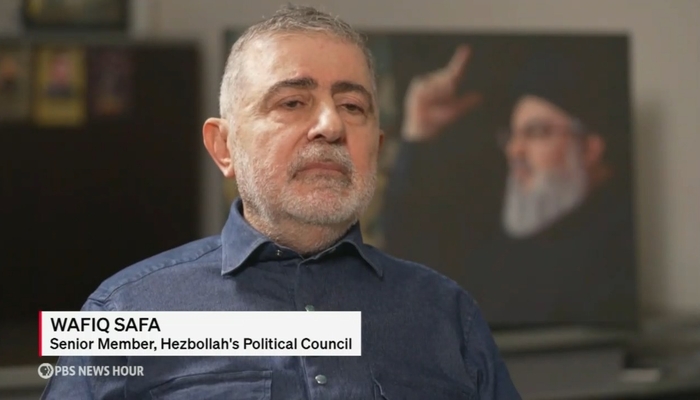
Simona Foltyn, a Middle East-based “special correspondent” for the PBS News Hour, conducted a shamefully soft interview of a senior official of the Iran-backed anti-Israel terrorist group Hezbollah for Tuesday, after previously fawning over the terrorist group while interviewing figures less directly related to Hezbollah.
Foltyn worked for the Arab news network Al-Jazeera English from 2019 to 2021 (on the Iraq beat) and maintains a virulently anti-Israel X feed. Hezbollah PR knew what they were doing when they agreed to let Foltyn, an expert at peddling anti-Israel propaganda, meet secretly with Wafiq Safa, a senior official in Hezbollah`s political wing.
Anchor Amna Nawaz teased “….in a rare interview, a top Hezbollah official tells special correspondent Simona Foltyn they will never give up all of their weapons.”
SIMONA FOLTYN: We are at an undisclosed location in Beirut's southern suburbs, a residential area where Hezbollah enjoys widespread support. Israeli bombardment has left a trail of destruction here. Despite the cease-fire, the buzz of Israeli drones is constant. Safa has little confidence in the Trump administration's ability to restrain Israel.
WAFIQ SAFA (through translator): We don`t believe that there are any guarantees with the Israelis, but for the weapons that we possess.
SIMONA FOLTYN: It`s a lesson learned from the previous U.S.-backed cease-fire that was supposed to end the 2024 war. Israel had reserved a right to strike what it said were Hezbollah targets, violating the agreement more than 10,000 times in 15 months. Hezbollah held back until the U.S. and Israel attacked Iran….
PBS's Simona Foltyn in Beirut: "Israeli bombardment has left a trail of destruction here. Despite the cease-fire, the buzz of Israeli drones is constant. [Hezbollah's Wafic] Safa has little confidence in the Trump administration`s ability to restrain Israel." pic.twitter.com/x2GbQQ8s2u
— Clay Waters (@claywaters44) April 23, 2026
Her idea of a challenging question came off sounding like a well-meaning ally in Hezbollah’s war against Israel:
SIMONA FOLTYN: On March 2, Hezbollah fired six rockets into Northern Israel. In response, Israel sharply escalated its attacks, killing more than 2,000 Lebanese. But if Israel was preparing for another war, why attack first and give them the justification on a silver platter for what you knew would be a disproportionate response that would claim a many civilian lives?
SAFA: The Israelis don't need a pretext. The six rockets that we fired, why didn't they speak to the cease-fire monitoring mechanism? They bypassed the mechanism and they went straight to the war they had been threatening us.
Foltyn hit the left-wing talking points of Israel as a colonial occupier, not a small country trying to establish some security in a region out for their blood.
FOLTYN: Israel says it now wants to take care of Hezbollah itself. Its troops have pushed several miles into Southern Lebanon, establishing a yellow line similar to Gaza in what looks like an annexation of land. Hezbollah has vowed to resist the occupation.
….
FOLTYN: Israel says its so-called buffer zone is necessary to protect residents in the north. At least 35 Israelis have been killed by Iranian and Hezbollah missiles, though Safa denies that the group is deliberately targeting civilians.
Did Foltyn provide Israel the same understanding? She certainly didn’t challenge Safa’s bizarre claim that Hezbollah doesn’t kill civilians.
SAFA: Let us be clear and honest. Hezbollah's ethics and religion prohibits it from killing civilians. But what happens when we fire at soldiers, there may be what is called collateral damage….
She strove to make the anti-Israel terrorist group the sane party next to Israel. You’ll hear nothing here about Hezbollah running roughshod over Lebanon’s official government through threats of violence, a fact even the anti-Israel New York Times concedes.
FOLTYN: Hezbollah’s demands are clear.
SAFA: We want complete and permanent adherence to the cease-fire, withdrawal from all occupied Lebanese territory, the release of the prisoners, and the return of the displaced.
In November 2023, Foltyn questioned Gen. Abbas Ibrahim, a former Lebanese intelligence official with close ties to Hezbollah, the Iranian-backed militant group designated as a terrorist group by the United States. In February 2025 Foltyn reported from a funeral service celebrating Hassan Nasrallah, who led Hezbollah.
A transcript is available, click “Expand.”
PBS News Hour
April 21, 2026
7:28:25 p.m.
AMNA NAWAZ: The Lebanese militant group Hezbollah attacked an Israeli army position in Northern Israel today, saying it was in response to several Israeli cease-fire violations. It's the first time the Iran-backed group has claimed responsibility for an attack during the tenuous truce that started last week.
Representatives from the government of Lebanon and Israel will meet again this Thursday in Washington for peace talks. Hezbollah is not involved. The full disarmament of the group is a central part of the discussions.
But, in a rare interview, a top Hezbollah official tells special correspondent Simona Foltyn they will never give up all of their weapons.
SIMONA FOLTYN: We're about to meet a high-ranking Hezbollah official to understand the group's position on the cease-fire. He is one of the few senior leaders to have survived Israel's relentless assassination campaign, and he`s still considered a high-value target.
Wafiq Safa is a senior official in Hezbollah's political wing. He narrowly escaped a targeted Israeli strike in 2024. This is his first interview on American television.
There have already been several violations in the first days of the cease- fire. Is Hezbollah committed to abiding by it?
WAFIQ SAFA, Senior Member, Hezbollah Political Council (through translator): Hezbollah is committed to the cease-fire, but we have seen during the last two days that the Israelis have continuously violated it, be it the destruction and bulldozing of houses or the bombardment of villages or even the killing of civilians.
There can`t be a one-sided cease-fire from Hezbollah only. So Hezbollah will respond to these attacks, but in a way that we deem appropriate.
SIMONA FOLTYN: We are at an undisclosed location in Beirut`s southern suburbs, a residential area where Hezbollah enjoys widespread support. Israeli bombardment has left a trail of destruction here. Despite the cease-fire, the buzz of Israeli drones is constant.
Safa has little confidence in the Trump administration`s ability to restrain Israel.
WAFIQ SAFA (through translator): We don`t believe that there are any guarantees with the Israelis, but for the weapons that we possess.
SIMONA FOLTYN: It`s a lesson learned from the previous U.S.-backed cease- fire that was supposed to end the 2024 war. Israel had reserved a right to strike what it said were Hezbollah targets, violating the agreement more than 10,000 times in 15 months. Hezbollah held back until the U.S. and Israel attacked Iran.
It reentered the war to avenge the killing of Iran`s Supreme Leader Ali Khamenei.
Many Lebanese blamed Hezbollah for this decision to drag Lebanon back into a war, and it looked as though you were defending Iran`s interests and not Lebanon`s interests.
WAFIQ SAFA (through translator): In reality, there`s a delusion. And this delusion stems from the fact that Israel never stopped the war. Diplomacy was tried, and it failed.
Therefore, it was necessary to take the right decision under the right circumstances and at the right time to defend Lebanon and to defend the Lebanese people, to deter Israel and to force it to stop the attacks.
SIMONA FOLTYN: The decision to reenter this war, was that an Iranian decision or a Lebanese decision?
WAFIQ SAFA (through translator): We chose the right time, when the Israeli enemy was busy with its war on Iran. We benefited from the ongoing war. And we don`t deny that Iran also benefited from this war that we took to the Israeli enemy.
We are in a permanent alliance with the Islamic Republic, and it`s natural that we support each other. Israel was preparing for another war on us, and Hezbollah made the first move.
SIMONA FOLTYN: On March 2, Hezbollah fired six rockets into Northern Israel. In response, Israel sharply escalated its attacks, killing more than 2,000 Lebanese.
But if Israel was preparing for another war, why attack first and give them the justification on a silver platter for what you knew would be a disproportionate response that would claim a many civilian lives?
WAFIQ SAFA (through translator): The Israelis don`t need a pretext. The six rockets that we fired, why didn`t they speak to the cease-fire monitoring mechanism? They bypassed the mechanism and they went straight to the war they had been threatening us.
SIMONA FOLTYN: But Safa admits that Hezbollah too was preparing for another war, even as it appeared to collaborate with the Lebanese state to hand over some of its weapons.
WAFIQ SAFA (through translator): During these 15 months, Hezbollah was trying to rehabilitate its military, organizational, political, and social capabilities. And Hezbollah succeeded in that.
SIMONA FOLTYN: As part of a U.S. and Israel-backed Lebanese government decree, Hezbollah was supposed to have disarmed south of the Litani River, which runs up to 18 miles north of Israel`s borders. The process was declared completed at the end of December 2025.
We saw with our own eyes how the Lebanese army confiscated some of your weapons. But in the past weeks, we have seen Hezbollah fighters once again battling Israeli troops in Southern Lebanon. So it seems that you were not disarmed.
WAFIQ SAFA (through translator): The Lebanese army did seize a number of weapons, but the Lebanese army didn`t know how many weapons Hezbollah had to begin with. We helped the Lebanese army so that the south of the Litani is free of weapons. When this war started, we fired from the north of the Litani to the north of the river, and it`s our right to do so.
SIMONA FOLTYN: Israel says it now wants to take care of Hezbollah itself. Its troops have pushed several miles into Southern Lebanon, establishing a yellow line similar to Gaza in what looks like an annexation of land. Hezbollah has vowed to resist the occupation.
WAFIQ SAFA (through translator): We don`t accept any Israeli presence, not on our land, not in our skies, not even in our waters.
SIMONA FOLTYN: Israel says its so-called buffer zone is necessary to protect residents in the north. At least 35 Israelis have been killed by Iranian and Hezbollah missiles, though Safa denies that the group is deliberately targeting civilians.
WAFIQ SAFA (through translator): Let us be clear and honest. Hezbollah`s ethics and religion prohibits it from killing civilians. But what happens when we fire at soldiers, there may be what is called collateral damage. If Hezbollah wanted to target civilians, you would have seen large numbers of civilians killed and injured.
SIMONA FOLTYN: Following this latest war, Hezbollah appears to have hardened its position, boosted by Iran`s insistence that Israel must cease attacks on Lebanon if the Strait of Hormuz is to remain open.
WAFIQ SAFA (through translator): As far as Hezbollah`s weapons are concerned, it`s out of discussion.
SIMONA FOLTYN: Hezbollah`s demands are clear.
WAFIQ SAFA (through translator): We want complete and permanent adherence to the cease-fire, withdrawal from all occupied Lebanese territory, the release of the prisoners, and the return of the displaced.
SIMONA FOLTYN: Israeli and Lebanese officials will meet again on Thursday in Washington. For now, this tenuous truth is barely holding. And, this time, Hezbollah says it will fight back if it fails.
For the PBS News Hour, I'm Simona Foltyn in Beirut.








 New Posts (Home)
 ChatBox
 Popular Posts
  Game Zone
 Top PodCasts